

When Certificates Expire and Projectors Go Dark
Late on New Year’s Eve 2023, many moviegoers across the United States were stunned when advertised screenings of Wonka and Aquaman suddenly went dark. Although this outage happened more than two years ago, it remains a cautionary tale for cinema operators. At midnight on Dec 31 2023, the signing certificate used by film‑mastering giant Deluxe to sign thousands of Composition Playlists (CPLs) expired. Digital cinema servers, which validate certificates each time an encrypted movie starts, rejected the expired credentials and refused to play SMPTE‑encrypted content. Deluxe estimated that approximately 450,000 CPLs were created with this certificate. The incident affected multiple server models from Christie, GDC and Sony. To salvage the holiday weekend, Deluxe quickly issued new certificates, but not before many shows were cancelled. This 2023 mishap underscores why proactive certificate management and monitoring remain critical in 2026.
This episode illustrates an uncomfortable truth: a modern cinema complex is a miniature data center operating at the network’s edge. When certificates expire or networks falter, the projection system fails, staff scramble, and audiences are left waiting. In this article, we’ll unpack how movie theater operations have evolved into edge data centers, examine the underlying technology, and explore best practices to ensure reliability, security and sustainability.
Table of Contents
The Architecture of a Modern Cinema: From Film Reels to Edge Computing
Digital Cinema Packages and Edge Storage
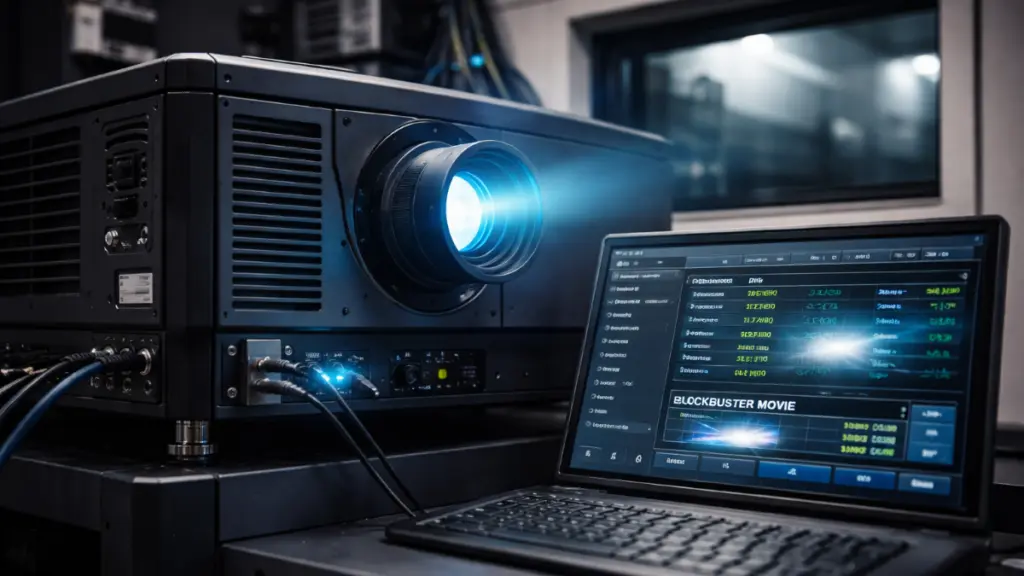
The shift from 35‑mm film to digital projection in the 2000s radically changed how movies are delivered. Digital Cinema Packages (DCPs), bundles of encrypted image, sound and metadata files are now the industry standard. Instead of mailing heavy film prints, studios distribute encrypted files over specialized networks. The Digital Cinema Distribution Coalition (DCDC), a consortium formed by major studios and exhibitors, “built the world’s largest cinema delivery network” and moved the industry standard away from physical hard drives to encrypted digital delivery via satellite and terrestrial connections. DCDC has delivered millions of feature films and events to theaters across North America.
Each cinema receives DCPs through a high‑bandwidth connection or via download to a local Library Management Server (LMS). The LMS stores terabytes of data and connects to each auditorium’s Integrated Media Block (IMB) or digital cinema server. These servers decode the JPEG 2000–compressed image and uncompressed audio in real time. Because DCP files are encrypted, playback requires Key Delivery Messages (KDMs). A KDM securely delivers symmetric encryption keys to a specific device and allows playback only during the authorized window. Each KDM targets one media block, includes the composition identifier, validity period and recipient identifier, and contains encrypted keys.
Theatre Management Systems: The Local Orchestrator
Running multiple screens requires more than file storage. A Theatre Management System (TMS) acts as the local brain, orchestrating playlist creation, schedule integration and device automation. GDC Technology’s TMS‑2000WEB is an example of a modern TMS. According to GDC, the TMS‑2000WEB provides centralized control of multiplex digital cinema operations via a web‑based GUI. It integrates with point‑of‑sale (POS) systems to import show schedules, automatically associates CPLs with titles, generates Show Playlists (SPLs) and schedules them to the correct screens. It also features automatic content management, scanning FTP or removable drives for new DCPs and KDMs and ingesting them automatically. For cinema chains with multiple sites, the TMS can integrate with a Central Management System (CMS) to allow headquarters to control content transfers, advertisements and schedules across all locations. That CMS communicates with trusted device lists, enhancing key delivery security and supporting third‑party advertising integrations.
The TMS functions as a mini‑orchestrator at the edge. It ensures that each screen has the right playlist, that pre‑show ads and trailers run in the correct order, and that projectors and sound processors are powered on at the right time. Many TMS platforms are now cloud‑enabled. Arts Alliance Media’s Producer platform is a cloud‑hosted enterprise theatre management system that eliminates heavy hardware investments because it’s delivered as software as a service (SaaS), customers need no on‑site servers. The system bridges local Screenwriter TMS installations with the cloud and relies on POS data and a stable internet connection.
Network Operations Centers: Remote Monitoring and Support
The next layer in cinema’s edge architecture is the Network Operations Center (NOC). GDC’s NOC‑3000 illustrates how centralized monitoring works. The NOC‑3000 is built on a browser/server architecture that allows cinema headquarters or third‑party providers to monitor screening status, transmit content and manage playlists. Its dashboard provides real‑time monitoring of network connections and device statuses across multiple complexes, enabling staff to quickly see whether equipment is online or experiencing issues. If a problem arises, the system generates fault tickets and alerts, allowing remote support staff to respond before a show is affected. The design allows access from computers or mobile devices, and uses RSA asymmetric encryption for secure data transmission.
NOC staff function like remote system administrators. They can push firmware updates, diagnose projector faults, or resend content keys when there is a mismatch. Combined with TMS automation, the NOC reduces the need for dedicated projectionists while improving reliability through proactive monitoring.
Edge Data Centers: Definition and Benefits
At this point, it’s clear that cinema infrastructure mirrors the broader concept of edge data centers. According to Equinix, an edge data center is a smaller, decentralized facility located closer to the end users and devices it serves. Unlike centralized data centers, these edge nodes bring processing power to the network’s edge, eliminating the need to send data back to a distant core for processing. The proximity yields several benefits:
- Reduced latency: processing and caching near users cuts the travel time of data and enables real‑time interactions.
- Improved data transfer efficiency: local processing optimizes bandwidth usage for streaming and IoT applications.
- Scalability: edge facilities can be deployed incrementally, scaling infrastructure based on demand.
- Enhanced reliability: localized facilities provide redundancy and backup for critical services.
- Cost efficiency: by reducing network hops and central infrastructure needs, edge deployments can lower overall costs. In a Forrester study commissioned by Equinix, a composite organization achieved a 60 % reduction in holistic infrastructure costs through digital services.
A multiplex theatre replicates these characteristics. Each venue houses servers and storage to process and deliver content locally (reduced latency), uses high‑bandwidth links to ingest content from the cloud (transfer efficiency), and can scale by adding more auditoriums or servers as needed. Local operations ensure that shows continue even if the connection to the central site is temporarily lost (enhanced reliability). Meanwhile, centralized services, like SaaS TMS and remote NOC support, allow theaters to reduce onsite staff and shift capital expense to operating expense (cost efficiency).
Security and Compliance in Digital Cinema
Understanding KDMs and Trusted Device Lists
KDMs are essential to digital cinema security. Each KDM contains the symmetric keys required to decrypt a particular CPL and a validity window specifying when playback is allowed. KDMs target specific devices, usually the media block’s certificate, and can’t be shared between auditoriums. Centralized distribution systems maintain a Trusted Device List (TDL) of authorized devices. When GDC’s CMS delivers KDMs, it communicates with Deluxe’s Global Trusted Device List to ensure keys are sent only to valid hardware. Managing the TDL centrally reduces the risk of sending keys to compromised or retired equipment.
Secure Communications and Data Transmission
Edge theaters communicate with remote systems over the internet. To protect sensitive metadata and keys, they employ asymmetric encryption. GDC’s NOC‑3000 uses RSA asymmetric secret key encryption for data transmission between cinemas and headquarters. This ensures confidentiality and integrity, preventing interception or tampering. Web interfaces typically use TLS, and many exhibitors deploy VPNs or private networks for content delivery.
Regulatory Compliance and Standards
Digital cinema adheres to standards created by the Digital Cinema Initiatives (DCI) consortium and Society of Motion Picture and Television Engineers (SMPTE). DCI specifications define picture and sound quality, encryption, device authentication and security logging. SMPTE standards such as ST 430‑2 describe certificate validation rules. Exhibitors must maintain logs for each playback event and share them with studios for auditing. Non‑compliance can result in revocation of distribution rights.
Privacy Considerations and Data Analytics
Cinemas increasingly collect data from online ticket sales to mobile app check‑ins and concession purchases. Cloud‑based analytics can optimize scheduling and marketing campaigns. Regulations like the General Data Protection Regulation (GDPR) and California Consumer Privacy Act (CCPA) impose obligations for data security, transparency and user consent. Exhibitors must adopt zero‑trust architecture principles, ensuring that only authorized processes can access customer data.
Lessons Learned and Best Practices
Certificate Lifecycle Management and Monitoring
The December 2023 outage demonstrated that a single expired certificate can bring down an entire chain of theaters. Best practices include:
- Inventory of certificates: Maintain an up‑to‑date inventory of all certificates used in mastering, sign‑off and device authentication.
- Proactive renewal and roll‑out: Renew certificates well before expiration, distribute new chains to all mastering facilities, and test sample content on every server model.
- Firmware updates: Apply vendor firmware updates that clarify certificate validation rules (e.g., DCI update clarifying that certificates should be validated against the IssueDate instead of the current time).
- Real‑time monitoring: Use the NOC and TMS logs to monitor playback failures and certificate validation errors. Generate alerts when a certificate is nearing expiration.
- Fallback content: Keep unencrypted or IOP versions of critical titles on hand as an emergency fallback.
Redundancy and Disaster Recovery
- Hardware redundancy: Deploy redundant LMS and IMB units. Use RAID storage and dual power supplies.
- Network redundancy: Maintain multiple network connections (e.g., fiber and 5G). Configure dual network paths on servers.
- Content caching: Cache high‑priority titles on each IMB or maintain a local copy on a backup server.
- Disaster recovery plan: Document procedures for manual playback using Blu‑ray or file‑based backup systems. Train staff to switch to backup within minutes.
- Regular drills: Perform periodic failover drills to ensure staff know how to handle outages.
Security Hygiene
- Key management: Store private keys in Hardware Security Modules (HSM) within IMBs. Rotate keys according to industry standards.
- Access control: Restrict access to TMS, NOC and CMS systems using multi‑factor authentication and role‑based permissions.
- Patch management: Keep firmware and software up to date. Pay close attention to security advisories from server vendors and OS providers.
- Log auditing: Regularly review logs for anomalies. Use centralized logging to detect patterns across multiple theaters.
- Compliance audits: Conduct periodic security and compliance audits to ensure adherence to DCI, SMPTE and privacy regulations.
Operational Efficiency and Cost Management
- Cloud adoption: Evaluate SaaS solutions like AAM’s Producer to reduce on‑site hardware and operational overhead.
- Centralized CMS: Use central management to automate KDM delivery, playlist creation and advertising across all sites.
- Energy efficiency: Implement energy‑efficient projection systems and use remote management to turn off equipment when not in use.
- Analytics: Leverage cloud analytics to optimize scheduling, pricing and promotions based on attendance and demographics.
- Sustainability: Digital delivery networks reduce the carbon footprint by eliminating the transport of heavy film prints. Adopt renewable energy and efficient HVAC systems to further reduce emissions.
Training and Staff Preparedness
Even with automation, human expertise remains essential. Train staff to recognize and respond to common errors (missing KDMs, network failures, certificate errors), use TMS and NOC dashboards, maintain relationships with vendor support teams, and communicate effectively with patrons during outages.
Emerging Trends: The Future of Cinema as an Edge Platform
Hybrid Multi‑Use Venues
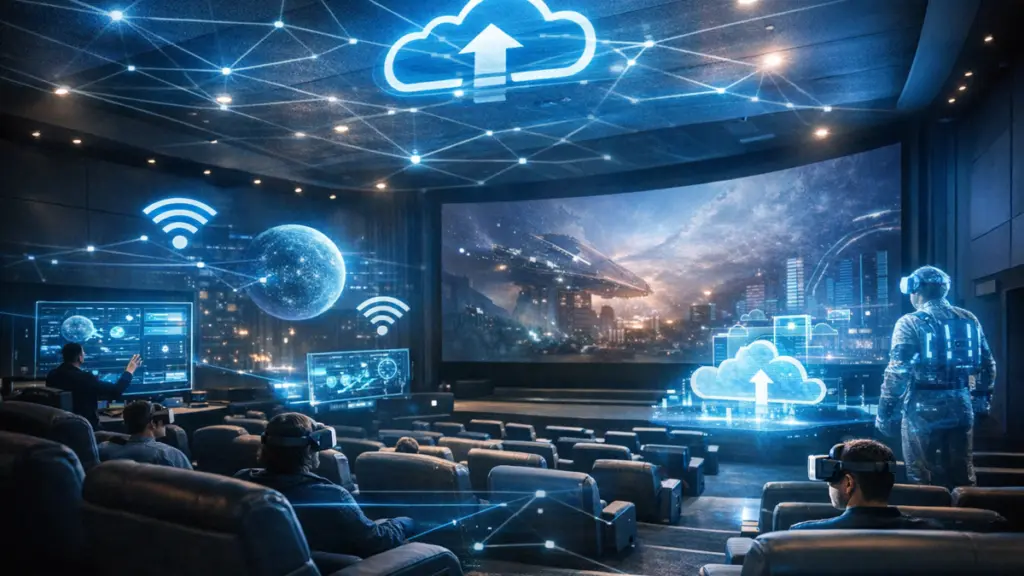
As movie theaters evolve beyond film exhibition, the infrastructure they’ve built as edge data centers can serve new functions. Live events and eSports are increasingly broadcast to cinemas. The same hardware can host virtual reality (VR) and augmented reality (AR) experiences. Future venues may integrate LED volumes and immersive audio to host interactive experiences and game tournaments.
5G and Satellite Integration
Emerging networks such as 5G and next‑generation satellite services promise higher bandwidth and lower latency for content distribution. Cinemas could receive real‑time streaming of new releases or dynamic ad insertion from the cloud, eliminating the need to download entire DCPs ahead of time. 5G redundancy could also provide instant failover for primary connections.
Edge Compute Beyond Movies
During off‑hours, the compute resources in a cinema could be repurposed for other edge workloads. With proper segmentation, servers could process data analytics for local businesses, render cloud gaming sessions or provide compute for federated learning models. This would optimize infrastructure usage and create new revenue streams. Isolation between workloads would be critical to maintain compliance.
AI‑Driven Scheduling and Personalization
Machine learning models analyzing attendance patterns might recommend show times, dynamic pricing or targeted promotions. Real‑time analytics, combined with loyalty-program data, could personalize pre‑show advertisements. Integrating these systems will require careful data governance and respect for privacy regulations.
Sustainability and Net‑Zero Goals
With film prints eliminated and digital delivery networks widely adopted, the next frontier is reducing energy consumption in theaters. Laser projection, LED cinema screens and efficient HVAC controls can reduce power usage. Some venues install on‑site solar arrays or purchase renewable energy credits. As edge data centers, theaters must adopt green data center practices to balance performance with environmental responsibility.
Conclusion: Cinema as a Critical Edge Data Center
The New Year’s Eve outage revealed how deeply digital infrastructure is woven into the moviegoing experience. When a certificate expired, servers at the edge refused to play content, illustrating that a single vulnerability can cascade across an entire industry. Today’s multiplexes are no longer just dark rooms with projectors; they are edge data centers that manage terabytes of encrypted content, communicate with global networks, and deliver immersive experiences with near‑zero latency. They rely on cloud‑based systems for scheduling, monitoring and analytics, and must adhere to strict security standards to protect intellectual property and customer data.
For exhibitors, embracing this reality offers opportunities. By adopting centralized management, cloud services, and robust redundancy, theatres can improve reliability, reduce costs and unlock new revenue streams. Maintaining strong security hygiene and certificate management prevents outages and preserves trust. Exploring emerging trends such as live events, 5G streaming and sustainable operations will keep cinemas relevant in an era where content is ubiquitous. Ultimately, treating the multiplex as an edge data center isn’t just a metaphor, it’s a necessary mindset for any organisation committed to delivering seamless, secure and future‑ready entertainment.



Reader perspectives, questions, and reactions.
No comments yet. Start the conversation.
Comments are closed for this article.