

A Storm Seen Before It Forms
On a bitter February morning in 2026, meteorologists across the U.S. Northeast watched computer screens flicker with shades of blue and crimson. Days before the public heard the first whispers of a major nor’easter, artificial intelligence (AI) forecast models were already flagging the potential for a “bomb” winter storm. The AI version of the Global Forecast System, or AI‑GFS, showed a sprawling snow‑laden low‑pressure system curling up the coast and hinted at rapid intensification. Later, its sibling AI model of the European ensemble also locked onto the same pattern. In that moment, one could feel the conversation shifting: were machines now better than humans at seeing a blizzard coming?
The question is not just rhetorical. Bomb cyclones, storms whose central pressure drops by at least 24 millibars in 24 hours, can cripple transportation, knock out power and isolate communities. Accurate, timely forecasts save lives and money. As AI supercharges weather prediction with unprecedented speed and scale, we need to ask: what happens when black‑box algorithms become our early warning system? This review looks at the science behind AI weather models, their remarkable successes, their blind spots and the ethical landscape they create.
Table of Contents
What Makes a Blizzard? Bomb Cyclone Basics
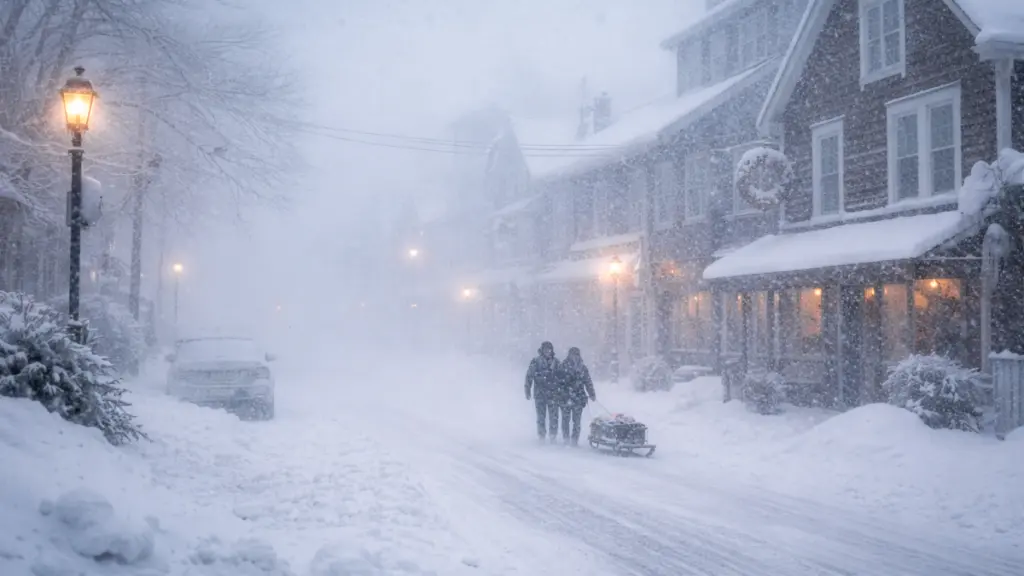
Before assessing whether AI can outwit human meteorologists, it helps to understand the challenge. Blizzards are not simply “big snowstorms”; they are defined by sustained winds of at least 35 mph and reduced visibility for three hours or more. On the U.S. East Coast, many blizzards form as nor’easters, low‑pressure systems that track up the Atlantic coastline and pull moisture off the warm Gulf Stream. When these storms intensify dramatically, meteorologists call them bomb cyclones. In bombogenesis, the central pressure of a storm drops at least 24 millibars in 24 hours (17.8 mb at 40° N latitude), creating powerful winds and heavy precipitation. This process often occurs when cold continental air collides with warm ocean waters; the resulting pressure gradient fuels explosive growth.
These ingredients make forecasting blizzards notoriously tricky. Small shifts in ocean temperatures or jet stream position can change snow bands, rain/snow lines and wind fields. Traditional numerical weather prediction models solve physical equations on grids, but the fine‑scale processes that produce thundersnow or localized power‑line icing often happen below those grid scales. It is here that the promise of AI becomes tantalizing, can neural networks learn the patterns of explosive growth from decades of storms and deliver more accurate warnings?
The Rise of AI in Weather Forecasting
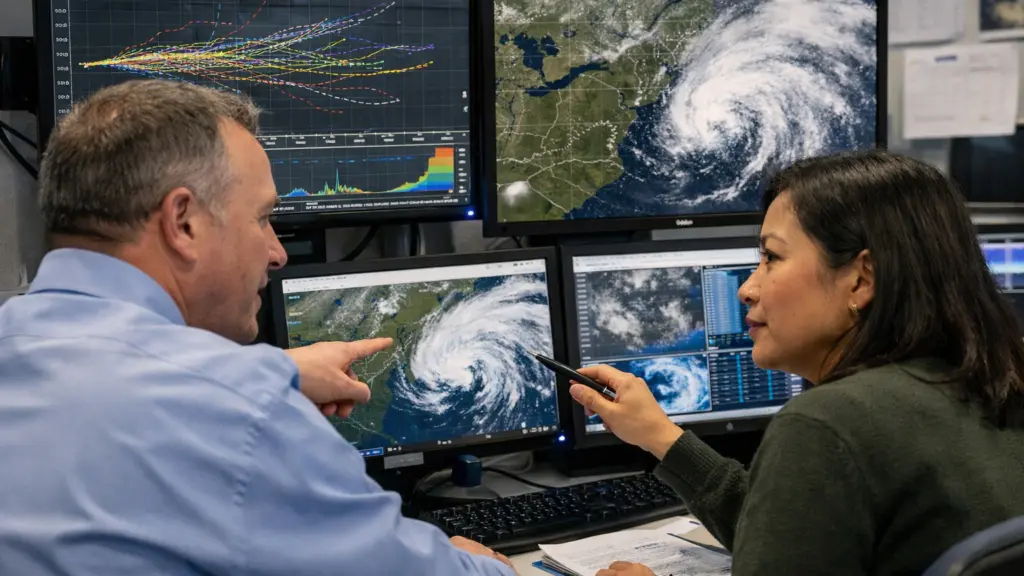
For decades, weather forecasting has relied on solving the equations of fluid dynamics on supercomputers. A traditional Global Forecast System (GFS) run can require tens of thousands of processors and more than two hours to produce a single forecast, making it costly to run large ensembles and slowing down the delivery of new guidance. The emergence of AI offers a fundamentally different approach: instead of numerically integrating the equations of motion, neural networks learn relationships between atmospheric variables from historical data. Once trained, they can generate full‑globe predictions in seconds.
NOAA’s AI Revolution
In December 2025, the U.S. National Oceanic and Atmospheric Administration (NOAA) launched three operational AI weather models: the Artificial Intelligence Global Forecast System (AIGFS), the Artificial Intelligence Global Ensemble Forecast System (AIGEFS) and the Hybrid‑GEFS (HGEFS). These models represent a watershed moment for public meteorology. The AIGFS delivers a 16‑day forecast using only 0.3 % of the computing resources of the traditional GFS and completes its run in approximately 40 minutes. Although initial versions show some weakness in predicting storm intensity, AIGFS’s track forecasts are as good as, and sometimes better than, the physical model.
The AIGEFS, a 31‑member ensemble analogous to the conventional GEFS, requires just 9 % of the computing resources of its physical counterpart and extends forecast skill by 18–24 hours. NOAA’s hybrid HGEFS goes one step further by combining 31 AI members with the 31 members of the physical GEFS, creating a 62‑member “grand ensemble” that consistently outperforms both the standalone AI and physics‑only systems.
GraphCast and the Global AI Arms Race
Many of NOAA’s gains came from building on GraphCast, an AI model developed by Google DeepMind. GraphCast uses graph neural networks to predict the state of the atmosphere ten days into the future, requiring only two snapshots of data six hours apart. It runs a global forecast in under a minute on a single TPU, yet outperforms Europe’s flagship High Resolution Forecast (HRES) on more than 90 % of the 1 380 test variables. In some cases, GraphCast provided earlier warnings for cyclones, atmospheric rivers and extreme temperatures, such as predicting Hurricane Lee’s landfall nine days in advance, whereas traditional models saw it only six days ahead.
Another AI system, WeatherNext, released by Google later in 2025, blends GraphCast’s principles with finer resolution. Meanwhile, the European Centre for Medium‑Range Weather Forecasts (ECMWF) developed AIFS, an AI version of its Integrated Forecasting System, which improved some performance metrics by 10–20 % while using 1/1000th of the computing power and producing forecasts within seconds.
Success Stories: When AI Shines
AI’s appeal rests not on hype but on a series of concrete victories. Consider these examples:
- Long‑range accuracy: GraphCast’s medium‑range forecasts delivered unprecedented lead times on Hurricane Lee and other storms, predicting landfall three days earlier than the best physics‑based systems. This additional warning window gave emergency managers more time to prepare.
- Rapid computation: AI models like AIGFS and AIFS complete forecasts in minutes rather than hours, enabling meteorologists to run larger ensembles and update guidance more frequently.
- Energy efficiency: Google’s AI system consumes up to 1 000 times less energy than conventional models and was trained on 40 years of weather data. Such efficiency could democratize forecasting for developing nations with limited compute infrastructure.
- Hurricane Erin (2025): In experimental tests, AI models produced warnings 1.5 days earlier than the U.S. National Hurricane Center for Hurricane Erin. Cambridge University’s Aardvark Weather demonstrated that accurate global forecasts can be produced on a laptop, lowering barriers for local agencies.
- Hurricane Melissa (2025): A National Hurricane Center Q&A notes that AI models “honed in very early on the likely track and intensity” of Hurricane Melissa, providing valuable guidance that complemented traditional models.
These cases illustrate that AI is not simply a novelty; it can transform the operational timeline for emergency planning. When a storm is spinning up over the Atlantic, hours matter. AI’s ability to recognize subtle patterns in reanalysis datasets, assimilate data quickly and generate vast ensembles could mean the difference between under‑preparedness and resilience.
Limits of Machine Insight
Yet even as the accolades pile up, AI remains far from infallible. Neural networks learn by digesting past patterns, and their skill depends on the breadth and representativeness of that data. Several critical limitations deserve attention.
Rare or Unprecedented Events
AI models can underperform when confronted with situations absent or rare in the training set. A 2025 study highlighted that an AI hurricane model trained without examples of Category 5 hurricanes consistently underestimated storms that should have been Category 5, defaulting instead to a Category 2 intensity. Extreme blizzards or unique atmospheric setups may similarly trip up AI predictions, especially when climate change alters baseline conditions.
Resolution and Intensity
Most AI weather models operate at coarser spatial resolution than dedicated physics models. While GraphCast’s predictions captured storm tracks well, its low resolution limited its ability to forecast storm and rainfall intensity. Scientists have noted that AI forecasts may miss mesoscale banding, the narrow, intense snow bands that distinguish a “typical” nor’easter from a crippling blizzard, because those features occur below the model’s grid scale. NOAA’s AIGFS developers acknowledge that while the AI system excels at track forecasts, its intensity forecasts still need improvement.
Physics and Interpretability
One of AI’s greatest strengths, dispensing with explicit physics, is also a weakness. Without the constraints of physical equations, neural networks can occasionally produce unrealistic solutions or “ghost storms.” The Conversation’s risk managers caution that AI models not bound by conservation laws can drift into physically impossible states. The black‑box nature of deep networks also makes it hard for forecasters to understand why a particular prediction was made. The National Hurricane Center notes that active research is underway to help forecasters interpret AI outputs and that understanding why a model produced a given forecast remains a major challenge.
Data Gaps and Equity
AI is only as good as the data it ingests. Regions with sparse observational networks, such as parts of the Southern Hemisphere, the Arctic or low‑income countries, are underrepresented in the reanalysis datasets used for training. This uneven data coverage may perpetuate geographical biases in forecasts, potentially widening the global weather prediction gap. As AI becomes integral to public warning systems, ensuring that communities in data‑sparse regions are not left behind is both a technical and ethical imperative.
Generative AI Is Not a Forecaster
Finally, it is important to distinguish AI forecast models from chatbots. Some users have mistakenly consulted generative AI assistants for real‑time blizzard warnings. Such systems cannot access up‑to‑the‑minute meteorological data and operate under knowledge cutoffs, making them incapable of issuing live warnings. Official alerts should always come from national meteorological services, whose forecasters integrate AI guidance with real‑time data and local expertise.
Human Forecasters: The Essential Partner
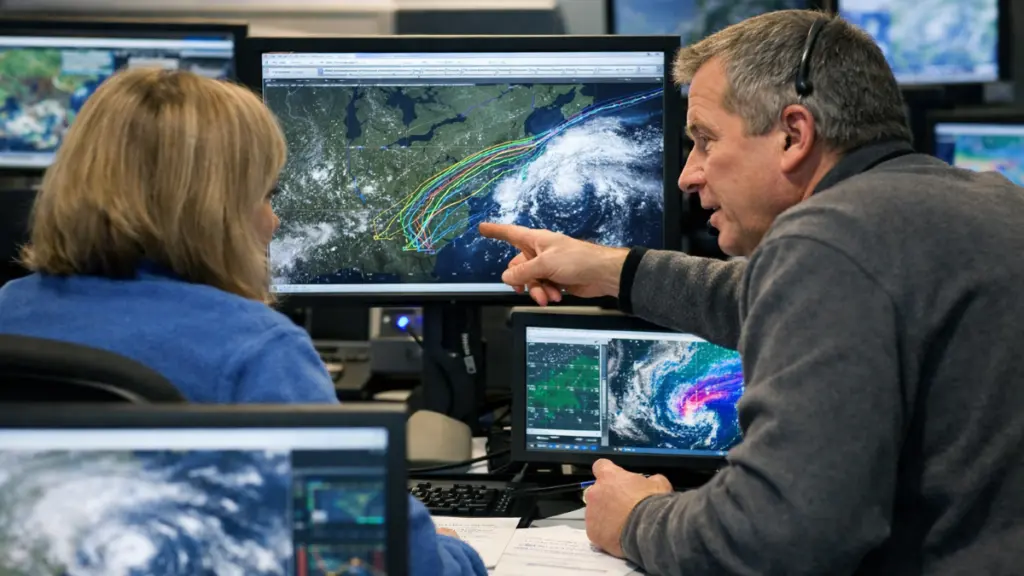
If AI models are so powerful, do we still need human meteorologists? The answer is unequivocally yes. In an interview published by the National Hurricane Center, Science Operations Officer Wallace Hogsett states that while AI systems provide new guidance, human experts remain indispensable for synthesizing information, understanding strengths and weaknesses of models, and communicating risk. He notes that NHC forecasters have decades of experience integrating new tools into their workflow and that AI is “a resounding ‘no’” when asked if it will replace human forecasters.
Local Knowledge and Context
AI models typically provide global or continental‑scale output. Local forecasters know the idiosyncrasies of their region, the sea‑breeze interactions that create “snow shadowing” along Connecticut’s Connecticut River valley, for example, or the way Appalachian topography shifts rain/snow lines. In NOAA’s AI rollout, developers observed that AI ensembles were coarse in resolution, and forecasters needed to “fill in the gaps” using local knowledge and real‑time observations. When power grids, school closures and emergency services hinge on whether the rain/snow line stalls 10 miles north, such expertise is irreplaceable.
Ensemble Interpretation and Risk Communication
The promise of AI ensembles, thousands of possible storm tracks and intensities generated in minutes, means that forecasters will need to become statistical storytellers, translating probability distributions into actionable guidance. Hogsett stresses that communicating the full range of possibilities is central to hurricane and storm forecasting. AI models add new dimensions to this task, but only humans can contextualize them within societal values.
Moreover, even the best AI models sometimes disagree with each other or with physical models. A deep knowledge of model biases, physics and current observations allows forecasters to decide which guidance to lean on. As Hogsett puts it, “None of the models are perfect, and they never will be”.
Ethics and Equity in AI Weather Forecasting
As AI prediction becomes embedded in emergency management, it raises profound ethical questions. Weather forecasts are public goods; they influence evacuation orders, school closures and resource allocation. Biases in AI models could disproportionately affect vulnerable communities if the training data underrepresents them. A tropical cyclone predicted as weaker than reality could lead to under‑preparedness, while a blizzard predicted as stronger might lead to costly over‑precaution.
Transparency and Accountability
Black‑box forecasts challenge accountability. If an AI model mispredicts a storm’s track, who is responsible? The developers? The agency that adopted it? Ethicists argue for model interpretability and clear lines of responsibility. NOAA acknowledges this challenge, noting that active research is needed to help forecasters understand not only the answer but why the model produced it. Building transparency into AI systems is crucial for maintaining public trust.
Equity and Access
Climate change is intensifying extreme weather; at the same time, AI models require enormous historical datasets that many regions cannot supply. Wealthy countries may have the compute and data to refine AI forecasts, but developing nations could be left behind. For AI to fulfill its promise ethically, stakeholders must invest in observational networks, share data freely and develop models accessible to low‑resource agencies. The energy efficiency of AI models, consuming fractions of the power of traditional forecasts, hints at the potential for more inclusive forecasting.
The Human–Machine Contract
AI also forces us to interrogate the nature of human agency in hazard communication. The National Hurricane Center emphasises that no model, AI or otherwise, can “decide” on evacuations or hazard warnings; those are policy choices grounded in human judgement. Ethically deploying AI means using it to augment human capacity, freeing experts to focus on messaging and decision support, rather than surrendering decisions to opaque algorithms. Responsible AI design should embed fairness, accountability and user feedback into the development process.
Looking Ahead: Toward a Hybrid Forecasting Future
Where does this leave us as we move deeper into the twenty‑first century? The next generation of AI weather models will likely blend machine learning with physical principles, achieving higher resolution and better intensity forecasts. NOAA’s Hybrid‑GEFS is a harbinger of this future, combining AI and physical model ensembles into a larger, more robust system that consistently outperforms both separately. Because AI models run so quickly, forecasters envision running thousands of ensemble members, allowing a finer mapping of uncertainty and helping decision‑makers see not just one forecast but a distribution of outcomes.
Research directions include coupling AI models with high‑resolution satellite data, radar and ground observations; training models on rare extreme events using simulation or synthetic data; and developing physics‑informed neural networks that honour conservation laws while retaining AI’s speed. Google’s MetNet‑3, for instance, provides minute‑by‑minute precipitation forecasts at 1‑km resolution up to 24 hours ahead, outperforming physics models at short lead times. These advances hint at a future where AI provides high‑resolution blizzard guidance with intensity details, helping municipalities plan plow routes and power grid pre‑staging.
Climate change adds urgency. Warmer oceans and shifting jet streams could alter the frequency and intensity of bomb cyclones, making the historical record less predictive. AI systems must adapt to a non‑stationary climate. Hybrid approaches that continually retrain on new data while retaining physical constraints could provide resilience in a warming world.
Conclusion: Beyond the Hype
Returning to our opening scene, the AI forecast that hinted at a 2026 nor’easter did not stand alone; seasoned meteorologists dissected the output, considered other models and used their judgement to issue warnings. So can AI predict a blizzard better than humans? The answer is both yes and no. AI can spot patterns earlier, run thousands of scenarios quickly and extend lead times for action. In some cases, it has indeed outperformed human‑guided models, giving emergency managers precious days. But AI also falters on extremes, lacks interpretability and depends on humans to integrate local nuance and convey risk ethically.
From the perspective of an AI ethicist and former machine-learning researcher, weather forecasting represents a powerful example of productive tension between human judgment and algorithmic precision.We must embrace AI’s ability to democratize and accelerate prediction while resisting the temptation to cede judgement to a neural network. The future of blizzard prediction lies not in choosing between human and machine but in weaving them together, developing transparent, equitable systems that serve diverse communities, investing in the expertise of forecasters and ensuring that those living in the path of the storm have a say in how technology protects them. Only then can we answer confidently not just whether AI can predict a blizzard, but whether it should.




Reader perspectives, questions, and reactions.
No comments yet. Start the conversation.
Comments are closed for this article.