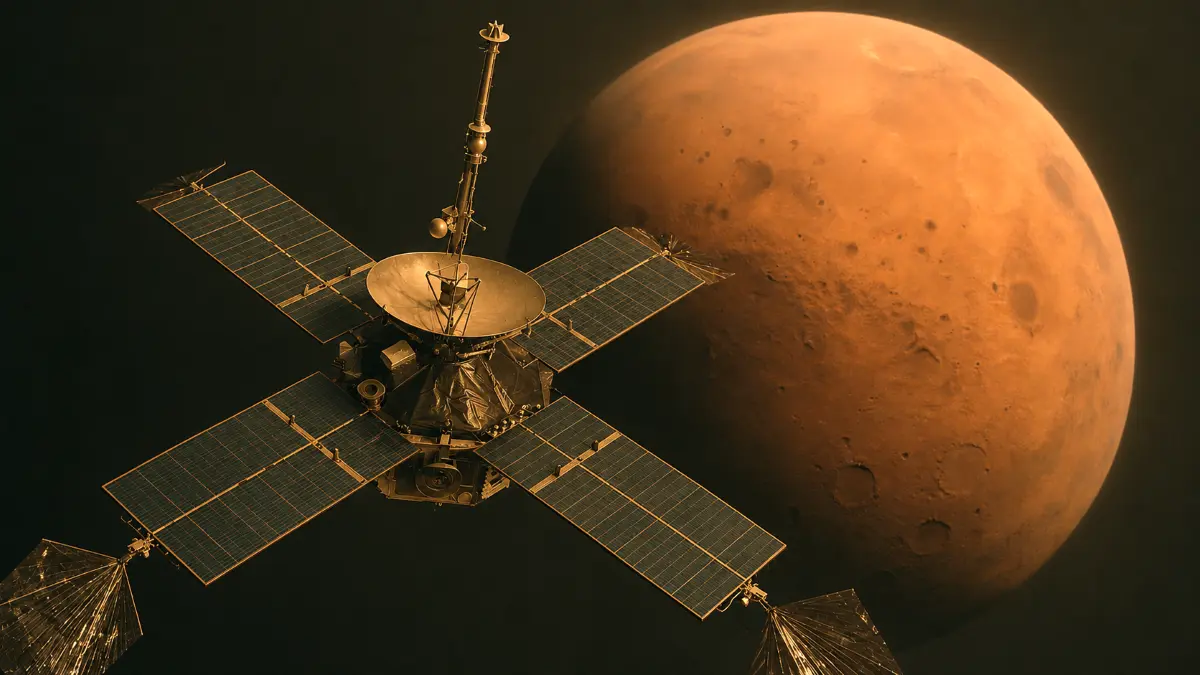

The allure of Mars has captivated humanity for centuries, but it wasn’t until July 14, 1965, that we finally got our first real glimpse beyond Earth’s atmosphere. On this day, NASA’s Mariner 4 became the first spacecraft to perform a successful fly-by of Mars and the first to send back photographs of another planet from deep space. These images revealed a cratered, barren landscape, challenging previous assumptions and redefining what we knew about our planetary neighbor.
The Mariner 4 Mars fly-by was a technical milestone. Before this mission, Mars was largely a mystery, with telescopic observations offering only blurry hints of its surface. The spacecraft’s camera system transmitted 21 images, each pixel painstakingly sent across millions of miles of space. This was not just a feat of engineering but a triumph of communication technology, as the data had to be encoded, transmitted, and decoded with unprecedented precision.
At the time, the photographs shattered optimistic ideas about Mars. The surface was not smooth or Earth-like but scarred with extensive cratering, resembling our Moon more than a potentially habitable world. This forced scientists to reconsider Mars’ geological history and atmospheric conditions. The mission also demonstrated the viability of deep-space communication and navigation, setting the stage for more complex interplanetary missions.
What changed because of Mariner 4 was profound. It marked the beginning of a new era in planetary exploration where robotic spacecraft could travel to other worlds, gather data, and send it back to Earth. The mission proved that remote sensing from space was not only possible but essential for understanding planetary environments. This laid the groundwork for decades of Mars exploration, from orbiters to rovers, each building on the foundation Mariner 4 established.
Today, the legacy of Mariner 4 still matters. Its images were the first data points in a long-term scientific inquiry into Mars’ climate, geology, and potential for life. The mission’s success validated the approach of using unmanned probes to explore distant planets, a principle that underpins current and future missions to the Moon, Mars, and beyond. The technology and methodologies pioneered then have evolved but remain fundamentally connected to that first fly-by.
Reflecting on the event, Mariner 4’s journey reminds us that exploration is as much about overcoming technical challenges as it is about discovery. It was a bold step into the unknown, driven by curiosity and ingenuity, that continues to inspire the quest to understand our place in the cosmos.