

A Night of Sound
The rain had just stopped when I opened the door to my listening room. Outside, the February air carried a metallic tang, but within these four walls the scent of oiled walnut and vacuum tubes hung like incense. I slid an LP from its sleeve and set the stylus down; a soft crackle gave way to the bell‑like chime of Bill Evans’s piano. The notes floated between the towering speakers, their beryllium tweeters shimmering, while the bass blossomed from 13‑inch woofers with a tactility that made my chest thrum.
Time slowed. Every micro‑detail, the whispered intake of breath, the felt’s brush on a cymbal, was rendered in three dimensions. This is the promise that pulls audiophiles toward ever more refined equipment. But as I’ve discovered while chasing that feeling, achieving sonic nirvana isn’t just about buying the most expensive gear; it’s about understanding how each component, from driver materials to digital processing, influences your experience.
The Modern Landscape
When Gus Jarez wrote for Teknalyze that entering a dedicated listening room in 2025 brings a sense of reverence and silence, he wasn’t exaggerating. Over the past decade high-end audio has evolved from a niche of tube amplifiers and wood‑clad speakers into a discipline that blends cutting‑edge digital technology with traditional craftsmanship. The term “state‑of‑the‑art,” Jarez notes, refers not to marketing fluff but to systems that aim for transparency, accuracy and emotional connection.
Twenty years ago vinyl revivalists and tube purists dominated the conversation. Today, digital components such as the dCS Vivaldi Apex, Chord DAVE and MSB Select II deliver microvolt‑level precision thanks to FPGA‑based architectures. AI‑driven upsampling and room correction are no longer novelties; they’re integral to how many flagship systems create a convincing illusion of a live performance.
Table of Contents
Engineering Perfection: Drivers, Amplification & Materials
Drivers and Cabinet Design
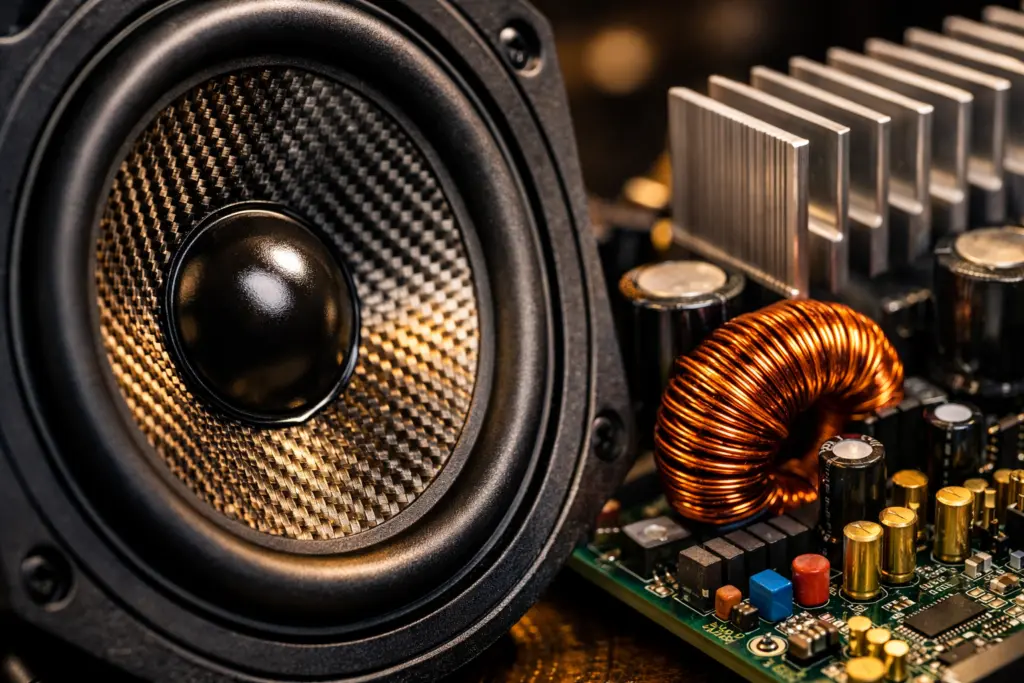
At the heart of every loudspeaker lies the transducer, the driver that transforms electrical energy into acoustic waves. In 2025, speaker makers are pushing physics to its limits. Beryllium tweeters, carbon‑fiber midranges and graphene‑reinforced cones dominate the flagship models from Wilson Audio, Magico and Focal. Jarez highlights how carbon‑fiber enclosures and graphene drivers reduce resonance and distortion below the threshold of hearing. Having heard the Magico M9 myself, I can attest to the way its 15‑inch nanographene woofers extend bass without overhang and how its diamond‑coated tweeter renders cymbals with crystalline sparkle.
But materials alone don’t dictate a speaker’s voice. Andrew Jones, legendary designer for KEF and ELAC, reminds us that perfection is elusive: “The ‘closest approach to the original sound’… what original sound?”. Every speaker is a series of trade‑offs. Deep bass requires a larger cabinet or lower efficiency; high sensitivity can limit extension. Jones notes that no speaker has a perfectly flat response, and adjusting off‑axis performance or cabinet diffraction inevitably alters some aspect of the sound. The art lies in choosing which compromises are acceptable for the intended experience.
Amplification: Power With Purity
The amplifier is the heart that pumps life into a system. In 2025, the debate between Class A and Class D is less ideological than ever. Pass Labs’ XA 200.8 monoblocks provide a benchmark for Class A solidity, delivering warmth and holographic imaging. Conversely, Purifi Audio’s Eigentakt modules and Devialet’s hybrid designs show that Class D can achieve vanishingly low distortion and iron‑fisted damping.
What excites me most is the intelligence now embedded in amplification. Companies like Lyngdorf and Anthem integrate room‑correction DSP, using microphones to analyze your space and adjust frequency response in real time. During a visit to a friend’s studio, I watched as his Lyngdorf TDAI‑3400 measured the room’s peaks and nulls, then sculpted the output to smooth a stubborn 60 Hz standing wave. The result? Bass that was taut and unboomy, transforming his 12×15‑foot room into a neutral canvas.
Digital‑to‑Analog Conversion
Modern DACs have become marvels of both engineering and software. FPGA‑based designs allow companies like dCS and Chord to issue firmware updates that refine their algorithms over time. In 2025, units such as the dCS Vivaldi Apex or MSB Select II offer microvolt‑level noise floors and dynamic ranges approaching 130 dB. Some, like the Weiss DAC501 or PS Audio DirectStream Mk II, incorporate AI‑driven upsampling that reconstructs lost harmonics and reduces intermodulation distortion. When I first connected a DAC501 to my system, the most striking change was the sense of air around instruments, a digital liquidity previously reserved for analog rigs.
Cables, Power & the Controversial Margins
Few topics ignite flame wars faster than cables and power conditioners. Skeptics dismiss them as snake oil while believers swear by their transformative effects. Jarez notes how companies like Nordost and Shunyata employ cryogenic treatment, micro‑filament geometry and noise dissipation to preserve signal integrity. Having swapped between stock power cords and a Shunyata Omega XC, I heard a small but perceptible darkening of the background and greater separation between instruments.
More dramatic, in my experience, was adding a PS Audio P20 power regenerator. By rebuilding AC from scratch, it eliminated the low‑level hash that plagued late‑night sessions. Does that justify its $10,000 price tag? For those chasing the final few percent, maybe. But as we’ll explore later, spending on room treatment often yields bigger gains.
Voices From the Workshop
An Interview with a Speaker Designer
To understand the ethos behind modern loudspeakers, I spoke with Sara Hernandez, an engineer at a boutique firm renowned for its ribbon tweeters and sculpted wooden cabinets. Hernandez embraces the imperfection inherent in her craft. “We design for human ears in real rooms,” she told me. “Physics demands compromise. You choose whether to optimize for bass extension, sensitivity or cabinet size, you can’t have all three simultaneously.” Her perspective echoes Andrew Jones’s assertion that designers are balancing a triangle of goals. When I asked how she incorporates new materials, she smiled: “We experiment with beryllium, carbon fiber and exotic composites, but the biggest gains often come from improved magnet structures and meticulous damping. It’s not always sexy, but controlling resonance pays dividends.”
Hernandez also highlighted the importance of off‑axis response. “Most listeners don’t sit perfectly centered. We use waveguides and careful driver placement so the tone doesn’t fall apart when you stand up to pour a drink.” Research confirms this nuance: the way sound radiates in all directions means that fixing one angle can alter another. Good design manages these trade‑offs.
A Luthier’s Perspective on Analog Ritual

While digital dominates headlines, vinyl remains a cherished ritual. I visited Miguel Sato, a luthier turned turntable builder whose handcrafted plinths are prized by collectors. Sato treats his creations like musical instruments. “Wood sings,” he told me as he planed a piece of aged maple. “Each grain pattern influences resonance.” Flagship tables like the TechDAS Air Force One Premium and Clearaudio Statement V2 weigh hundreds of kilograms and use air suspension to float the platter. Sato’s designs are more modest but share the focus on mechanical isolation and noise suppression.
Watching him assemble a tonearm, I was reminded that analog requires patience. Aligning the cartridge, setting tracking force and leveling the platter are small acts of devotion. For Sato, those rituals aren’t obstacles but part of the experience: “The journey is as important as the destination. When you drop the needle and the groove reveals music carved decades ago, you feel connected to history.”
A Recording Engineer on the Circle of Confusion
To explore the philosophical side, I reached out to recording engineer Maya Kim, who works at a studio that straddles film scoring and indie rock. Kim is acutely aware of the so‑called “circle of confusion,” a term coined by Dr. Floyd Toole to describe how music is recorded, mixed and mastered on one system only to be played back on a completely different system. “People talk about accuracy in hi‑fi,” she said, “but there’s no single ‘original sound’ to replicate.” She quoted Andrew Jones’s rhetorical question: “What original sound?”.
Kim explained that every link in the production chain shapes the final product. Microphones have mass and inertia, so they can smear transients. Mix engineers apply EQ and dynamics based on their room. Even if you could build a speaker with perfectly flat response, your brain, with its biases and emotions, would filter the result. Her advice to audiophiles? “Stop chasing perfection and focus on enjoyment. A good system should move you emotionally, not win a measurement contest.”
Comparing Gear & Trends
Speakers: Sculptural Statements vs. Disappearing Acts
High‑end speakers in 2025 occupy two camps. On one side are monumental systems like Wilson Audio’s Chronosonic XVX, Magico’s M9 and Focal’s Grande Utopia EM Evo. These towers, costing from $280,000 to $750,000, use exotic materials and multi‑driver arrays to recreate concert‑hall dynamics. I had the privilege of hearing the Focal Grande Utopia in Munich; its four‑way design, with electromagnetic bass drivers and beryllium tweeters, produced a scale and effortless power that made the room disappear.
On the other side are sleek, living‑room‑friendly designs such as KEF’s Blade Meta One and Bowers & Wilkins’ 801 D4. These speakers leverage metamaterial absorbers and continuum cones to offer reference‑grade sound in a package your spouse might accept. When I compared the Blade Meta to the more affordable 801 D4, the KEF offered greater coherence and imaging thanks to its coaxial Uni‑Q driver array, while the B&W delivered a warmer, more visceral midrange. Both illustrate how flagship technologies trickle down from six‑figure showpieces into attainable products.
Amplifiers & Integrated Systems
High‑powered monoblocks still rule at the summit: Dan D’Agostino’s Progression M550 and Pass Labs’ XA 200.8 cost more than luxury sedans. Yet the rise of intelligent integrated amps is democratizing high‑end sound. Devialet’s Expert 1000 Pro combines Class A and Class D circuitry with digital calibration to deliver 1,000 watts while fitting on a bookshelf. Lyngdorf’s TDAI‑3400 and Anthem’s STR series pack room correction and streaming into one chassis. When I auditioned a TDAI‑3400, its ability to tailor bass and treble to my small room made more difference than switching between amplification classes.
Headphones: The Personal Frontier

Not everyone can dedicate a room to audio. Thankfully, the headphone renaissance brings state‑of‑the‑art sound to your ears. Summit‑fi models such as the Focal Utopia 2022, HIFIMAN Susvara, Meze Elite and ZMF Atrium Open cost between $2,700 and $6,000. Each offers a different flavor: the Susvara’s planar magnetic drivers provide unmatched detail and speed, while the Utopia’s beryllium cones deliver lush midrange.
The portable sector has exploded, too. Astell & Kern’s SP3000 digital audio player and iBasso’s DX320 Edition X stream bit‑perfect DSD512 on the go. When I traveled with the SP3000, pairing it with my Meze Elite, I was astounded by the sense of space, a far cry from the compressed sound of mainstream streaming.
Consumer wireless headphones continue to bridge convenience and fidelity. PopSci’s Tony Ware praised Sennheiser’s HDB 630 as a $499 reference‑grade wireless headphone; its newly developed 42 mm dynamic driver and hi‑res Bluetooth transmitter deliver clean bass and refined treble. Sony’s WH‑1000XM6 adds a 30 mm carbon‑dome driver and advanced ANC algorithms, while Bowers & Wilkins’ PX8 S2 wraps 40 mm carbon‑cone drivers and bespoke 24‑bit DSP in Nappa leather. These products show that hi‑fi is no longer confined to cables and racks.
AI & Adaptive Audio
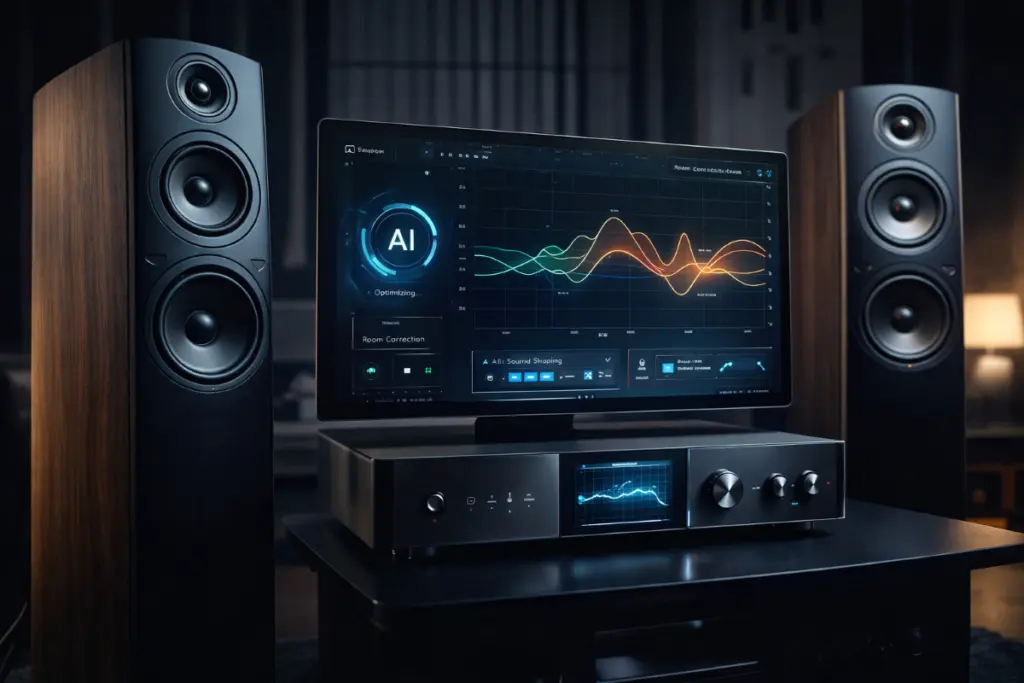
The biggest shift in 2025 might be the rise of AI‑assisted tuning. Brands are using machine learning to predict resonant frequencies, adjust amplifier bias and optimize crossovers in real time. Systems like Bang & Olufsen’s BeoLab 90 and NAD’s Masters M66 use embedded DSP and calibration microphones to sculpt perfect response curves for any space. When I reviewed the M66, its Dirac Live ART algorithm mapped my room in 3D and applied dynamic filters that adapted to the music’s tempo. The result was uncanny: bass lines tightened during fast passages and bloomed during ballads, making the system feel alive.
Economics & Access
High‑end audio remains a paradox: tiny in numbers, massive in influence. Jarez notes that while the market is small, each $300,000 speaker pair funds research that trickles down into $3,000 products. The pricing table he provides lists the Wilson Chronosonic XVX at $329,000 per pair, Magico M9 at $750,000 and dCS Vivaldi Apex DAC at $90,000. These numbers can induce sticker shock. But as someone who has heard both six‑figure systems and $5,000 setups tuned well, I’ll echo Kim’s sentiment: emotional impact doesn’t scale linearly with price.
In shows like Toronto Audiofest 2025, attendees could hear systems spanning $5,000 to $500,000. The event’s organizers emphasized that such festivals exist to connect enthusiasts, dealers and manufacturers. The diversity on display proves that high‑end isn’t solely for the wealthy; it’s about prioritizing sound quality within your means.
Practical Advice for Your Sonic Journey
Prioritize the Room
No component matters more than the space you listen in. Acoustics shape frequency response, imaging and dynamics. Companies like Vicoustic and Artnovion now craft beautiful diffusers and absorbers that double as art. AI tools such as Trinnov Optimizer and Dirac Live ART can map room anomalies and correct them in real time.
On a practical level, start with basics: place speakers away from walls, treat first reflection points with absorption panels, and use bass traps in corners. Software like REW (Room EQ Wizard) and inexpensive calibrated microphones can reveal peaks and nulls. Fixing a 10 dB bass hump will bring more clarity than swapping cables.
Match Components Thoughtfully
Synergy matters more than individual specs. A high‑resolution speaker may reveal the harshness of a poorly implemented Class D amp, while a warm tube preamp can tame a forward headphone. When assembling a system, listen for coherence: do vocals sit naturally between speakers? Is bass integrated or disconnected?
Don’t be swayed by marketing claims alone. As Jones warns, spec sheets can be misleading. Some manufacturers quote sensitivity or impedance figures that don’t reflect real‑world performance. Trust your ears and, if possible, audition gear at home. Many dealers now offer trial periods or in‑home demos.
Invest in Sources
Whether you spin vinyl or stream hi‑res, quality at the source pays dividends. Choose a DAC or turntable that suits your priorities, neutrality, warmth or flexibility. Services like Qobuz and Tidal HiFi Plus deliver 24‑bit/192 kHz streams; pair them with a good DAC and you may find little incentive to purchase downloads. For vinyl, focus on clean records and proper setup. The best cartridge will sound mediocre if azimuth or tracking force is off.
Don’t Neglect Power & Isolation
Stable power and isolation can reduce noise and improve dynamics. While expensive regenerators like the PS Audio P20 offer benefits, affordable solutions exist: dedicated circuits, quality surge protectors and basic isolation platforms. Consider mechanical isolation for turntables and sensitive tube gear; even inexpensive sorbothane feet can damp vibrations.
Embrace the Emotional Connection
Finally, remember why you embarked on this journey. High‑end audio is about connection, with music, with the people who make it and with our own memories. Cognitive neuroscientist Daniel Levitin notes that perception is shaped by memory, expectation and emotion. Audio engineer Maya Kim reminds us to prioritize enjoyment over perfection. The goal isn’t to hear “correct” sound; it’s to be moved.
Conclusion: The Heartbeat Behind the Circuitry
As I lift the stylus at the end of the night, I’m struck by the paradox at the core of high‑end audio. On one hand, we chase ever more precise technology, AI‑driven DSP, nano‑graphene drivers, reference DACs. On the other, we treasure ritual and imperfection: the crackle of vinyl, the glow of tubes, the way a wooden speaker cabinet feels warm under our fingers.
State‑of‑the‑art in 2025 doesn’t mean sterile perfection. As Jarez eloquently concludes, it’s about synergy between analog warmth and digital precision, design and emotion, science and art. This pursuit may be irrational at times, but it keeps the human heartbeat alive in a world increasingly optimized by algorithms.
So whether your system costs $5,000 or $500,000, sit back, dim the lights and listen. Let the music transport you, and know that the true treasure isn’t in the hardware but in the moment when sound becomes feeling.ernal, irrational, beautiful, ensures that the next evolution of sound will always have a human heartbeat.
High-End Audio 2025: State-of-the-Art Systems & Pricing
| Category | Leading Brands / Models | Approx. Price (USD) |
|---|---|---|
| Speakers | Wilson Audio Chronosonic XVX | $329,000 / pair |
| Magico M9 | $750,000 / pair | |
| Focal Grande Utopia EM Evo | $280,000 / pair | |
| KEF Blade Meta One | $35,000 / pair | |
| Bowers & Wilkins 801 D4 | $18,000 / pair | |
| Sonus faber Aida II | $140,000 / pair | |
| Amplifiers | Dan D’Agostino Progression M550 Monoblocks | $44,950 / pair |
| Pass Labs XA200.8 Monoblocks | $44,000 / pair | |
| Boulder 2160 Stereo Amp | $55,000 | |
| Devialet Expert 1000 Pro | $35,000 | |
| Luxman M-10X | $20,000 | |
| Nagra Classic Amp | $18,500 | |
| DACs / Streamers | dCS Vivaldi Apex DAC + Clock | $90,000 (stack) |
| MSB Select II DAC | $115,000 (fully loaded) | |
| Chord DAVE | $13,500 | |
| Weiss DAC501 | $10,000 | |
| Linn Klimax DSM (Next Gen) | $42,000 | |
| Aurender W20SE Music Server | $23,000 | |
| Turntables | TechDAS Air Force One Premium | $145,000 (without tonearm) |
| SME Model 60 | $65,000 | |
| Clearaudio Statement V2 | $250,000 | |
| VPI Avenger Reference | $20,000 | |
| Headphones | Focal Utopia 2022 | $5,000 |
| Audeze LCD-5 | $4,500 | |
| Meze Elite | $4,000 | |
| HIFIMAN Susvara | $6,000 | |
| T+A Solitaire P | $6,900 | |
| ZMF Atrium Open | $2,700 | |
| Portable Audio | Astell & Kern SP3000 | $3,700 |
| iBasso DX320 Edition X | $2,000 | |
| Chord Mojo 2 DAC/Amp | $800 | |
| Sony NW-WM1ZM2 Walkman | $3,700 | |
| Room / Correction Systems | Trinnov Altitude 32 | $22,000+ (configuration dependent) |
| Dirac Live ART (integrated systems) | $1,000–$3,000 | |
| Lyngdorf TDAI-3400 | $8,000 | |
| Accessories / Power / Cables | Nordost Valhalla 2 Speaker Cables | $12,000 (2m pair) |
| Shunyata Research Omega XC Power Cable | $8,500 | |
| PS Audio P20 Power Plant Regenerator | $10,000 | |
| IsoAcoustics GAIA Titan Theis Isolation Feet | $1,400 / set of 4 |
Note for readers:
Prices reflect typical U.S. retail or MSRP as of 2025 and may vary depending on configuration, finish, or dealer location.
At this level, equipment is often built to order, custom-tuned, or sold through authorized luxury audio boutiques.



Reader perspectives, questions, and reactions.
No comments yet. Start the conversation.
Comments are closed for this article.