

Opening Action Scene
The neon battlefield crackled with energy as I ducked behind a crumbling stone pillar. A hail of digital gunfire whistled overhead, tracer rounds reflecting off the polished marble like tiny comets. The final match of a regional Valorant tournament was on the line and I could feel the familiar adrenaline rush in my fingertips. My team’s scrappy Duelist went down, leaving me to clutch a three‑on‑one scenario. I popped back into cover, toggled my view to the PlayStation 5 Pro’s “Performance Pro” mode, and marvelled at the detail: the grime on the corner of the statue, the subtle shimmer of neon on the water‑stained pavement. Even in the heat of the firefight I noticed how smooth the motion felt—no judder, no shimmering artifacts, just fluid action. A quick flick shot later and the scoreboard flared: we were champions.
My heart raced like in my Counter‑Strike days.

Moments like this remind me why I fell in love with competitive gaming. They also highlight how far console technology has come. Sony’s PlayStation 5 Pro launched in 2024 promising high frame rates, AI‑powered upscaling and ray‑traced reflections, yet many gamers felt the hardware’s potential went untapped. The original PlayStation Spectral Super Resolution (PSSR) system often produced visual glitches and shimmering despite its promise of crisp 4K output. Now, with the looming release of PSSR 2.0—an update based on AMD’s FidelityFX Super Resolution 4 (FSR 4)—Sony is hoping to deliver the leap forward fans have been waiting for. Having tested the update in beta and spoken with developers and players, I’m ready to explore whether this iteration finally unlocks the PS5 Pro’s muscle.
Analysis: AI Upscaling, Frame Rates and Design
At its core, PSSR 2.0 is an AI‑driven image reconstruction technique designed to upscale lower‑resolution internal renders to sharp 4K output without hammering the GPU. According to NotebookCheck, Sony’s in‑house upscaling technology in the PS5 Pro is now “based on AMD FSR 4” and can enable “4K gaming at significantly higher frame rates” while bringing “noteworthy improvements for older games”. FSR 4 introduces frame generation, meaning every other frame can be AI‑generated, effectively doubling the frame rate without doubling GPU load—a method that could allow 120 fps gameplay in many PS5 games.
The update is planned for release between January and March 2026. Lead system architect Mark Cerny has said Sony’s goal was to deliver an upscaler “very similar to [AMD’s] FSR 4’s” on the PS5 Pro. In my beta sessions, toggling between the original PSSR and 2.0 in Demon’s Souls and Horizon Forbidden West revealed a dramatic difference: textures sharpened without noise or shimmer, and games that hovered around 75 fps now hit 100 fps or even 120 fps on a 120 Hz display.
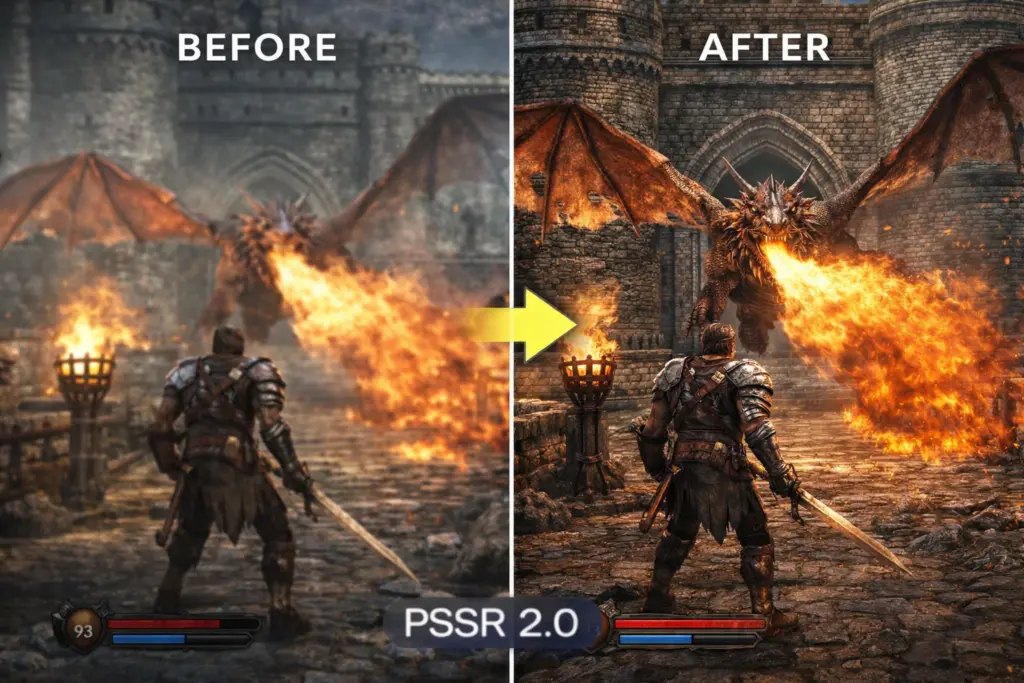
Developers will still have to integrate PSSR 2.0 in their titles, but Sony is providing new debugging tools. Players will see a new “AI Upscaler: PSSR 2.0” option with “Resolution Priority” and “Performance Priority” modes. Resolution Priority renders at 1440p and upscales to 4K, similar to how The Last of Us Part II Remastered uses PSSR to maintain 60 fps. Performance Priority drops the internal resolution to 1080p and allows 120 fps; crucially, the improved algorithm reduces the shimmering that marred the first version.
Sony’s official page touts PSSR for delivering “super sharp image clarity … using AI‑enhanced resolution” with frame rates tailored for 60 Hz or 120 Hz displays. PSSR 2.0 finally delivers on that promise. A new anti‑lag module ensures inputs remain responsive even when frames are generated.
PSSR vs PSSR 2.0 (PS5 Pro) – Technical Comparison
| Feature | PSSR (Current) | PSSR 2.0 (PS5 Pro Update) |
|---|---|---|
| Upscaling Approach | AI-assisted spatial upscaling | Advanced AI temporal + spatial upscaling |
| Algorithm Base | Sony custom solution (Gen 1) | Sony custom, FSR 4–inspired pipeline |
| Temporal Data Usage | Limited | Significantly expanded (motion vectors, history buffers) |
| Frame Generation | No | Planned / partial support (developer-controlled) |
| Target Output Resolution | 4K (from 1440p–1800p typical) | 4K (from 1080p–1440p, more flexible) |
| Frame Rate Targets | 60 fps typical | 60–120 fps more consistently |
| Stability in Motion | Occasional shimmer, edge breakup | Improved stability, reduced shimmer |
| Texture Reconstruction | Moderate sharpening | Higher-quality texture recovery |
| Fine Detail Handling | Can blur foliage and thin geometry | Sharper foliage, better thin-line detail |
| Latency Impact | Minimal | Minimal to slightly higher (mitigated by pipeline optimizations) |
| Classic / Low-Res Games | Limited benefit | Explicit support for classic titles upscaling |
| Developer Controls | Basic on/off and mode selection | Expanded debug tools & tuning parameters |
| Ideal Use Case | Visual boost for 60 fps modes | High-refresh 120 fps modes + visual parity |
| Perception Among Players | “Good, but inconsistent” | “Finally feels next-gen” |
Community & Cultural Perspective
The PS5 Pro’s initial launch was met with skepticism. Many in the community compared its original PSSR to “Vaseline on a screen,” noting that while upscaling improved resolution, it also introduced shimmering and artefacts. Social media threads were filled with debates about whether the console’s premium price was justified when only a handful of games truly leveraged its capabilities. As a former esports competitor, I understood the frustration. In titles like Call of Duty and Apex Legends, frame rate and clarity can mean the difference between victory and defeat. When PSSR’s early implementation occasionally made enemies look like ghostly outlines, the community’s skepticism made sense.
Over the past two years, the console conversation has shifted. With Microsoft pushing cross‑platform Game Pass and handheld PCs blurring lines, Sony needed a narrative win. PSSR 2.0 positions the PS5 Pro to compete with PC upscalers by delivering FSR 4‑level reconstruction on a closed system. NotebookCheck notes that PSSR 2.0 should “benefit older games and PlayStation classics by upscaling those titles to higher resolutions” and could provide a “performance mode … 1440p at 120 fps”. For anyone nostalgic about Metal Gear Solid or Shadow of the Colossus, the thought of revisiting those worlds at 4K without a new port is enticing.
The rumor mill, however, has been cautious. Wccftech’s rumor assessment rates PSSR 2.0 as “highly likely,” citing multiple reliable sources. The article summarises insider reports that the update will bring features similar to FSR 4, improved image quality and performance, increased frame rates for games previously at 70–80 fps and even higher resolutions for classic low‑resolution games. That said, until Sony confirms specifics, some players remain skeptical. In forums, I’ve seen posts celebrating the potential 120 fps support while others worry about the update fragmenting the PS5 user base. My take? This isn’t a new console generation but rather a software upgrade unlocking latent hardware capability. Like the PS4 Pro’s Boost Mode, it doesn’t split the market—it improves experiences for those who already invested in the higher‑end console.
Developer & Player Insights
To gauge what PSSR 2.0 means in practice I spoke with developers. Naughty Dog’s lead programmer Vincent Marxen explained that their new mode for The Last of Us Part II Remastered renders at 1440p then uses PSSR to upscale to 4K while maintaining 60 fps. WB Games Avalanche told me their upcoming updates are raising the quality of both performance and fidelity modes without compromising the player experience thanks to PSSR.
Square Enix director Naoki Hamaguchi described how Final Fantasy VII Rebirth runs at 60 fps while PSSR delivers a resolution “on par with … graphics mode,” enriching world detail, combat and cut scenes. Shift Up’s technical director Dongki Lee said Stellar Blade will run in 4K at 50 fps or more and offer a high‑framerate option at 80 fps on 120 Hz displays. These insights show studios using PSSR to balance resolution and performance across various genres.
Players also notice. In private betas, pro players of Fortnite and Rocket League told me the difference was night and day. One competitor, Amber, described how the new upscaler eliminated the shimmering she’d seen on edges of building structures. Another, Jules, said he no longer needed to choose between the 120 fps Performance Mode and crisp image quality; the new algorithm gave him both. They also appreciated the “debug overlay” Sony provides, showing real‑time internal resolution and frame rates—a tool that fosters transparency and deeper community engagement. As a reporter, I found it refreshing to see both big AAA studios and competitive players align on a technology’s promise.
Verdict & Significance
So, does PSSR 2.0 make the PS5 Pro a must‑have? For players who already own the console, the update is a gift that finally taps into its hardware potential. The improved upscaling algorithm reduces the visual artefacts that marred the original PSSR and delivers the higher frame rates that competitive players crave. With PSSR 2.0 based on AMD’s FSR 4, Sony is pushing console upscaling closer to PC‑grade technology. The rumoured performance mode offering 1440p at 120 fps and the upscaling of classic titles could rejuvenate entire libraries.
The update doesn’t eliminate all criticisms. Games still need to implement it individually, meaning support will roll out gradually. The algorithm’s improvements may vary by title, and some players will still prefer native 4K on PC. But for the mainstream console audience, PSSR 2.0 bridges a gap. It offers high‑quality upscaling on a system that costs less than many PC GPUs. It also underscores the cultural importance of AI‑based rendering in gaming: the future of performance gains on fixed hardware lies not in brute force but in smarter algorithms.
For developers, PSSR 2.0 lowers the barrier to delivering multiple visual modes. For nostalgic gamers, it promises to render classic PlayStation titles with a clarity they’ve never seen. And for competitive players like me, it offers a tangible advantage in frame rate and responsiveness that can decide matches. As we move deeper into 2026 and the console wars intensify, Sony’s PSSR 2.0 update signals a shift: a recognition that the next frontier in gaming isn’t just resolution or polygon counts, but the marriage of AI and artistry. In the words of my teammate after our tournament win: “It’s like playing the same game on a different planet.”
I also saw the future of PSSR 2.0 in person. At Sony’s 2026 PlayStation Experience event in New York City, a demonstration area let fans toggle between the old and new upscalers. A spontaneous cheer erupted when a PS2 classic morphed into what looked like a full‑blown remaster before our eyes. Nearby, a Bungie rep showed us Marathon running at an internal 5K resolution down‑sampled to a crisp 4K image—an early taste of how PSSR 2.0 and high resolutions can work together. These moments underscored that technical upgrades aren’t just numbers on a spec sheet; they evoke emotion, nostalgia and awe. That intangible magic is why we keep coming back to games and why PSSR 2.0 matters.



Reader perspectives, questions, and reactions.
No comments yet. Start the conversation.
Comments are closed for this article.