

The Model That Built SaaS is Now Under Threat
Per‑seat pricing has been one of the most durable business models in enterprise software. The logic is simple: charge a set fee for every user who needs access, collect recurring revenue, and grow as your customers hire more people. This model helped turn horizontal platforms such as Salesforce and Microsoft 365 into annuity machines. According to a 2025 SaaStr analysis, average SaaS prices rose 8–12 % annually as vendors relied on seat‑based price hikes to maintain growth. Yet a structural change is underway. Autonomous AI agents now write emails, resolve tickets and analyze data. They reduce the number of people needed to perform a task, compressing the very “seat count” that pricing models depend on. As venture capitalists at Bessemer note, AI economics involve material unit costs per query and drastically different margins from traditional SaaS.
A flurry of reports from late 2025 and early 2026 warn that seat‑based pricing may be approaching its sell‑by date. Fast Company argues that AI performs tasks rather than simply supporting users and therefore breaks the assumption that value scales with human usage. The Technology & Services Industry Association (TSIA) describes how AI makes user‑based pricing economically unsustainable and forces companies to align prices to outcomes. A SaaStr breakdown of 2025 pricing trends notes that seat models are under pressure as AI agents replace human tasks. Meanwhile, a Pilot study finds that seat‑based pricing fell from 21 % to 15 % of companies in just 12 months, while hybrid models surged from 27 % to 41 %. These signals point to a future in which “per seat” is no longer the primary unit of account.
This article, written from the perspective of a software engineer and open‑source contributor, examines why AI is driving this shift. We unpack the technical, economic and community factors reshaping SaaS pricing and propose practical recommendations for founders and developers. Along the way, we use analogies, diagrams and code snippets to demystify complex concepts. Our goal is to provide a clear, evidence‑based view of what comes after the seat.
Table of Contents
The Origins and Logic of Per‑Seat Pricing
From perpetual licenses to seats
In the early days of enterprise software, vendors sold perpetual licenses. Customers paid a large upfront fee and optional maintenance. As software moved to the cloud, subscription licensing emerged. Per‑seat pricing became the default because it offered predictability for both parties: customers could budget per employee, and vendors could forecast recurring revenue. It also mapped neatly to value: if the software helped a salesperson close more deals, adding another salesperson increased the customer’s revenue and justified another seat. The TSIA reminds us that recurring models gave rise to entire functions such as customer success, retention metrics and annual recurring revenue.
This model persisted even as products added tiers. For example, Salesforce’s CRM top tiers reached US$500 per seat per month by 2025, double their price five years earlier. Vendors like HubSpot introduced new seat types: view‑only, core, or collaboration seats, and added surcharges for monthly billing. The “seat count” remained the primary lever for revenue expansion.
The analogies: seats and theaters
To visualize per‑seat pricing, imagine a theatre. Each ticket grants access to a seat; more attendees mean more tickets sold. The capacity of the venue (the software platform) constrains how many seats can be sold, and the price per seat reflects the value of the performance (features). This analogy works as long as the audience members are humans who watch the show. However, what happens when robots begin to occupy seats? They don’t watch the show in the same way, and they can run multiple shows simultaneously without fatigue. This is what AI agents do in software environments: they execute tasks autonomously, breaking the direct link between a seat and the work performed.
Technical underpinnings
Per-seat models align closely with the architecture of many traditional SaaS applications. Users authenticate through identity providers such as SSO or OAuth, and authorization rules grant access based on roles tied to licensed seats. Behind the scenes, licensing systems track how many active users a customer has purchased and prevent additional logins once the seat limit is reached.
This model is straightforward to implement, easy to audit, and predictable from a revenue perspective. It works well when software usage scales directly with employee headcount, since each additional user typically represents incremental value.
However, the model starts to fracture when usage becomes decoupled from humans. When AI agents execute workflows autonomously through APIs rather than user logins, the relationship between “seat” and “value delivered” weakens. In that environment, tracking active users no longer reflects the actual work performed by the system.
Why AI Breaks the Seat Count

AI performs work, not just assists
Modern AI systems go beyond suggestion. Large‑language‑model–based agents can compose emails, generate code, triage tickets and conduct research. Fast Company notes that seat‑based pricing assumes value scales with human usage, but AI performs tasks without direct user action. The result is a misalignment: customers pay for access while AI generates outcomes. A customer may buy 100 seats but have AI handle 80 % of the workload, making the per‑seat fee feel arbitrary.
Fudzilla describes the old model as “predictable” and “cosy” because budgets were tied to headcount. When AI agents handle tasks autonomously, the meter shifts to tasks completed, queries run and tokens burned. In other words, the unit of value becomes the work, not the worker. Forbes further argues that agentic AI systems evolve continuously and orchestrate existing systems, making seat‑based pricing disconnected from how value is created.
In practice, this shift surfaces quickly. SaaStr observed that seat models come under pressure as AI agents replace discrete human tasks; the publication notes that its own business has downgraded seat counts because it employs over a dozen AI agents in production. Similarly, Pilot reports that companies sticking with per‑seat AI pricing see 40 % lower gross margins and 2.3× higher churn than those adopting usage‑ or outcome‑based models. When AI reduces headcount, per‑seat fees penalize success, fewer humans using the software means less revenue for the vendor, even if the customer derives greater value.
AI has real and variable costs
Unlike traditional software, AI workloads involve non‑negligible cost of goods sold (COGS). Each model inference uses compute and sometimes third‑party data. Bessemer Venture Partners notes that AI companies see 50–60 % gross margins compared with 80–90 % for SaaS, and every query incurs real costs. That means vendors need pricing structures that scale with usage to maintain profitability. If a customer uses AI intensively, a flat per‑seat fee may not cover the vendor’s costs.
Because AI costs scale with tokens or compute, many vendors introduce usage‑based pricing (UBP) for AI features. Fast Company observes that UBP, long common in infrastructure services like AWS and Snowflake, is moving up the stack to application‑layer SaaS. Vendors meter requests, assign credits or tokens, and bill based on consumption. Yet pure UBP introduces unpredictability; a viral use case can spike costs for both the customer and the provider. The Pilot report warns that CFOs hate opacity; one viral use case can crater margins.
Hybrid and outcome models
To reconcile predictability with value alignment, many providers layer usage‑based components onto existing seat models. These hybrid models combine a base subscription (perhaps still per seat) with metered AI credits. Fast Company notes that hybrid models allow companies to introduce UBP for high‑impact features while preserving familiarity for core collaboration functionality. The Pilot study shows that hybrid pricing jumped from 27 % to 41 % of AI companies in a year. ServiceNow’s product chief Amit Zavery recently acknowledged that some customers aren’t ready for pure consumption models, so the company offers combined monthly fees and pay‑as‑you‑go extras.
Another emerging model is outcome‑based pricing, where customers pay per problem solved, tickets resolved, documents classified, leads generated. Intercom adopted a per‑resolution model for its Fin AI assistant and saw 40 % higher adoption with healthy margins. Outcome‑based pricing aligns vendor revenue with customer ROI but requires robust attribution to prove that the AI, rather than process changes, drove results. It also often demands continuous services, consulting, customization, monitoring, blurring the line between software and professional services, as Forbes notes.
Agents dilute the meaning of a seat
Agentic AI systems such as OpenAI’s Frontier or Anthropic’s Claude Cowork operate on behalf of humans. Fortune explains that investors worry these agents could reduce the number of seat licenses needed and thereby hurt SaaS vendors. The same article notes that incumbents like Salesforce are pivoting: they offer fixed‑price “Agentic Enterprise Licenses,” while ServiceNow and Microsoft introduce consumption‑based elements. Forbes echoes that in an agentic world, pricing based on the number of people logging in becomes arbitrary. When agents handle tasks, the “seat” is effectively the AI itself, and the metric of success is how many workflows it completes. A side-by-side table can help clarify this shift:
| Human-Driven SaaS | Agentic SaaS |
|---|---|
| Users log in via SSO | Agents authenticate via API |
| UI triggers workflows | Agents invoke APIs autonomously |
| Billing = seats × price | Billing = tasks × unit cost + service |
| Value scales with users | Value scales with outcomes |
In agentic SaaS, the licensing server checks API keys rather than user IDs. Usage metrics are tasks completed or data processed. This requires new architectures and metering systems.
Architectures, APIs and Developer Ergonomics
Metering and billing infrastructure
Moving from per‑seat to consumption or outcome models requires fine‑grained metering. Systems must capture events such as API calls, AI inference tokens or completed tasks. They then aggregate usage per customer and integrate with billing. Many vendors build a usage service that records events to a time‑series database and a billing service that applies pricing rules. Here is a simplified architecture:
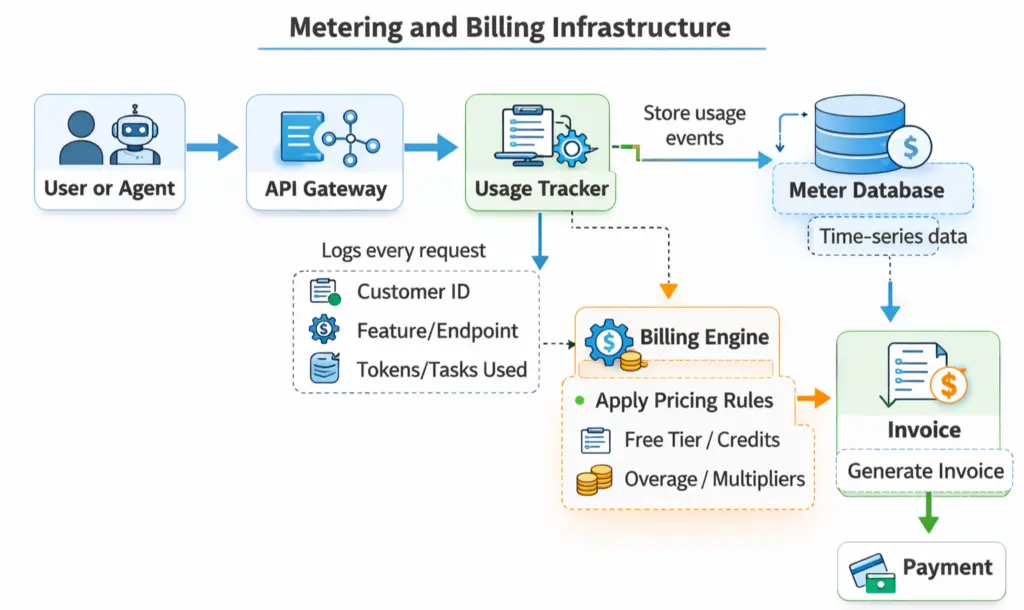
The Usage Tracker logs every request with metadata (customer ID, feature, tokens used). The Billing Engine applies pricing rules, free tiers, included credits, overage multipliers, and generates invoices. Developers may integrate open‑source billing libraries or use services like Stripe Billing or Metronome. Implementation details differ, but the core tasks include:
- Instrumenting APIs. Add middleware to capture metrics such as number of tokens or workflow completions.
- Defining a value metric. For an AI writing assistant, track emails generated; for a support agent, track resolved tickets. The Pilot report emphasizes choosing metrics tied to ROI and warns that if your product succeeds and customers need fewer of what you charge for, you should pick a different metric.
- Handling overages and credits. Provide bundles of tokens or tasks that users can purchase up front and burn down. As Metronome advocates, credits can bridge the gap between usage and perceived value by giving customers a translation layer.
- Forecasting costs. AI COGS must be tracked per customer to ensure the price covers compute, data and human verification costs. The Pilot report reveals that infrastructure costs are the #1 constraint for 67 % of AI startups and that only 23 % of enterprises can predict their AI spend month‑to‑month.
From a developer’s perspective, usage‑based billing adds engineering complexity. You must design event schemas, maintain low‑latency data pipelines and ensure privacy compliance. For open‑source projects, this can be a daunting lift. However, open‑source communities benefit from transparency: developers can audit metering code, contribute improvements and avoid vendor lock‑in. Proprietary platforms may offer convenience but often hide pricing logic behind opaque dashboards.
Programming languages and API design
APIs for AI-enabled SaaS must expose usage metrics in a developer-friendly and transparent way. Instead of simply returning a result, modern AI endpoints increasingly return structured metadata about consumption. For example, an AI translation service should not only deliver the translated text but also report how many input and output tokens were processed and the associated cost of the request.
By embedding usage and cost details directly in the API response, platforms enable developers to monitor spending in real time. Applications can log token consumption, aggregate usage across workflows, and trigger alerts when thresholds are reached. This approach turns billing visibility into a first-class feature rather than an afterthought.
Clear usage reporting improves developer ergonomics and reduces the risk of unexpected invoices. Many modern SDKs in languages such as Python, JavaScript, and Go include built-in helpers that automatically track cumulative usage across multiple API calls. When pricing is consumption-based, good API design is inseparable from financial transparency.
Open source versus proprietary models
The AI pricing debate also intersects with the open‑source versus proprietary conversation. Open‑source language models (e.g., Llama, Mistral) allow companies to self‑host and avoid per‑call fees. However, self‑hosting shifts costs to hardware, maintenance and fine‑tuning. Proprietary APIs (e.g., OpenAI, Anthropic) offer state‑of‑the‑art performance but charge per token and can change pricing unpredictably. The choice influences a company’s pricing model: an open‑source deployment may justify a seat‑based subscription because marginal costs are lower, whereas a proprietary model with high COGS necessitates usage‑based fees.
For developers, open source offers freedom to instrument custom metrics and integrate into existing billing systems. Proprietary services may provide built‑in metering but constrain customization. Ultimately, transparency and flexibility are essential; whichever model you choose, ensure that developers can track costs and align pricing to value.
Community Insights and Developer Perspectives

To understand how the shift away from per‑seat pricing is playing out in practice, let’s examine perspectives from developers, maintainers and users. The following quotes are drawn from blog posts, conference talks and interviews around the industry.
On misaligned incentives: “If our AI assistant works perfectly, we need fewer human reps. Why should we pay for seats when we’re paying to make those seats redundant?” – a customer quoted in Pilot’s AI pricing report.
On hybrid models: “Some customers aren’t ready for purely consumption‑based pricing.” ServiceNow’s product chief Amit Zavery told reporters in 2026. His team offers a combination of monthly fees and pay‑as‑you‑go extras.
On outcome pricing: “Intercom’s bet on outcome‑based pricing proved that aligning price with value beats protecting legacy revenue models every time.” Pilot’s case study of Intercom’s Fin illustrates how a $0.99 per AI‑resolved conversation drove 40 % higher adoption.
On agentic AI: “In that world, the idea of a ‘seat’ starts to lose meaning, because the agents are effectively the users.” Forbes’ analysis of agentic AI captures the existential challenge.
On developer friction: “Tokens work for technical buyers but confuse everyone else.” Bessemer’s AI pricing playbook warns founders to choose charge metrics carefully and notes that hybrid models win when you’re uncertain.
Collectively, these voices highlight a tension: customers want fairness and predictability; vendors need to cover costs and capture value; developers require transparency and flexibility. There is no one‑size‑fits‑all solution, but there are patterns.
Implications for SaaS Providers and Buyers
Pricing becomes a strategic driver
Historically, pricing was a downstream decision. Companies built products first and tweaked pricing later. The TSIA argues that in the AI era, pricing drives transformation. Moving away from seat‑based licenses triggers cascading changes: revenue recognition, compensation plans, forecasting models, customer success roles and services portfolios all evolve. Pricing is the first domino; once it falls, the entire organization must adapt.
Financial metrics and forecasting
Consumption and outcome models introduce revenue volatility. ARR must be augmented with metrics such as gross margin per usage tier, expansion versus contraction rates and customer lifetime value. Vendors must invest in data infrastructure to forecast usage accurately. Meanwhile, buyers must budget for variability. SaaStr recommends that operators audit their SaaS stack, start renewal conversations early and optimize seat usage. Procurement leaders should form buying groups, demand transparency and build alternate scenarios. In other words, both sides need to prepare for dynamic pricing.
Organizational changes
As pricing moves toward outcomes, services become strategic. TSIA notes that modern pricing models require continuous services such as managed services, advisory, optimization and value realization. Roles like adoption specialists and value engineers emerge. This blurs the line between software and consulting; vendors may need to internalize capabilities akin to systems integrators. Buyers should evaluate vendors not only on product features but also on their ability to deliver ongoing value.
Regulatory and ethical considerations
As AI systems make decisions and influence business processes, pricing models intersect with compliance and fairness. For instance, billing per action might incentivize overuse of AI even when human oversight is needed. Outcome pricing may raise concerns about accuracy and attribution. Vendors must ensure transparency and allow customers to audit usage and costs. Open‑source metering components and clear API reporting can mitigate these risks. Regulators may also scrutinize opaque pricing practices, especially where AI influences sensitive domains.
Practical Recommendations
For founders, product managers and developers navigating the shift away from per‑seat pricing, the following actionable recommendations can help.
1. Define a clear value metric
Identify what outcome your AI product drives, tickets resolved, emails generated, revenue influenced, and align pricing accordingly. Avoid metrics that shrink as customers succeed; if your product reduces headcount, per‑seat pricing is self‑defeating. Consider hybrid metrics (base + usage) to provide predictability while capturing upside.
2. Invest in usage instrumentation
Build or adopt metering infrastructure early. Capture detailed usage events, store them in a scalable database and expose them via APIs. Provide customers with dashboards, alerts and programmatic access to usage and cost information. Transparent metering builds trust and facilitates outcome discussions.
3. Model COGS and margin scenarios
Track the cost of compute, third‑party data and human verification per unit of work. Use scenario modeling to understand how margins behave under different usage patterns and pricing schemes. This informs credit bundles, overage rates and thresholds where outcome pricing becomes profitable.
4. Test and iterate pricing
Follow Bessemer’s advice: treat your charge metric as a strategic statement. Start with a price point, then raise it until customers hesitate, and refine it based on real usage data. Pilot different models, usage‑based, hybrid, outcome, and monitor adoption, churn and support burden. Be prepared to pivot; Pilot reports that AI companies test an average of 3.2 pricing approaches in their first 18 months.
5. Offer flexibility and education
Recognize that not all customers are ready to abandon seats. Provide options: seat‑based tiers for those who value simplicity, usage‑based or credit‑based add‑ons for AI features, and outcome‑based contracts for high‑ROI scenarios. Educate customers about how your pricing maps to costs and value. Usage unpredictability can be mitigated through caps, alerts and contract clauses.
6. Embrace open standards and community feedback
Participate in open‑source efforts around usage metering and billing. Contribute documentation and SDKs that make it easy for developers to integrate your APIs and understand costs. Listen to feedback from users and maintainers; as the community insights above show, transparency fosters trust and drives adoption.
Looking Ahead: The Future of Pricing in an Agentic World

The transition away from per‑seat pricing is not a binary switch. Seat models will persist in some contexts, especially where human collaboration remains the primary value driver. Fortune argues that enterprise customers are unlikely to build custom CRM or HR software from scratch, meaning demand for core SaaS platforms will remain. However, AI will steadily compress seat counts and drive usage toward automated workflows. SaaStr predicts that AI may disrupt pricing models entirely in three to five years but notes that vendors are already feeling pressure. Meanwhile, Fudzilla contends that agents could make software spend even higher by unlocking new productivity, with Goldman Sachs predicting a near‑tripling of U.S. software spend by 2037.
In the near term, expect hybrid pricing to dominate. Seat‑based subscriptions provide a revenue floor and familiarity, while usage‑based AI meters capture additional value. Credits and token bundles will serve as translation layers between consumption and value, easing procurement and budgeting. Outcome‑based deals will grow in niches where ROI is easily measurable, such as customer support and lead generation. Vendors will increasingly treat billing UX as product UX, offering real‑time dashboards, spend controls and cost simulators.
Long term, agentic platforms could blur the line between software and services. Pricing will likely combine IP licensing for core models with ongoing customization and integration fees. As for the unit of value, tasks solved and outcomes achieved will matter more than people logged in. That will require new financial metrics, organizational structures and regulatory frameworks. Developers and open‑source communities can play a critical role in making these systems transparent and fair.
Conclusion
Per‑seat pricing has served the software industry well for decades. It offered simplicity, predictability and alignment with headcount‑driven value. But AI is rewriting the rules. Agents that write code, answer emails and resolve support tickets decouple usage from human seats. Seat‑based models now penalize success, compress margins and misalign incentives. Industry voices, from Fast Company to TSIA, SaaStr, Forbes and Pilot, agree that the shift toward usage, hybrid and outcome‑based pricing is both inevitable and already underway. The data shows seat‑based pricing declining and hybrid models rising.
For builders, this is a moment of opportunity. By defining clear value metrics, instrumenting usage, modeling costs and iterating pricing, you can capture the value your AI delivers while giving customers predictability and fairness. For buyers, understanding how vendors meter and charge for AI will be critical to budgeting and negotiating. For the industry, the end of per‑seat pricing is less a death than an evolution. Seats won’t vanish tomorrow, but they will be joined. and in many cases supplanted, by models that reflect the true unit of value in an AI‑driven world: the work done.




Reader perspectives, questions, and reactions.
No comments yet. Start the conversation.
Comments are closed for this article.