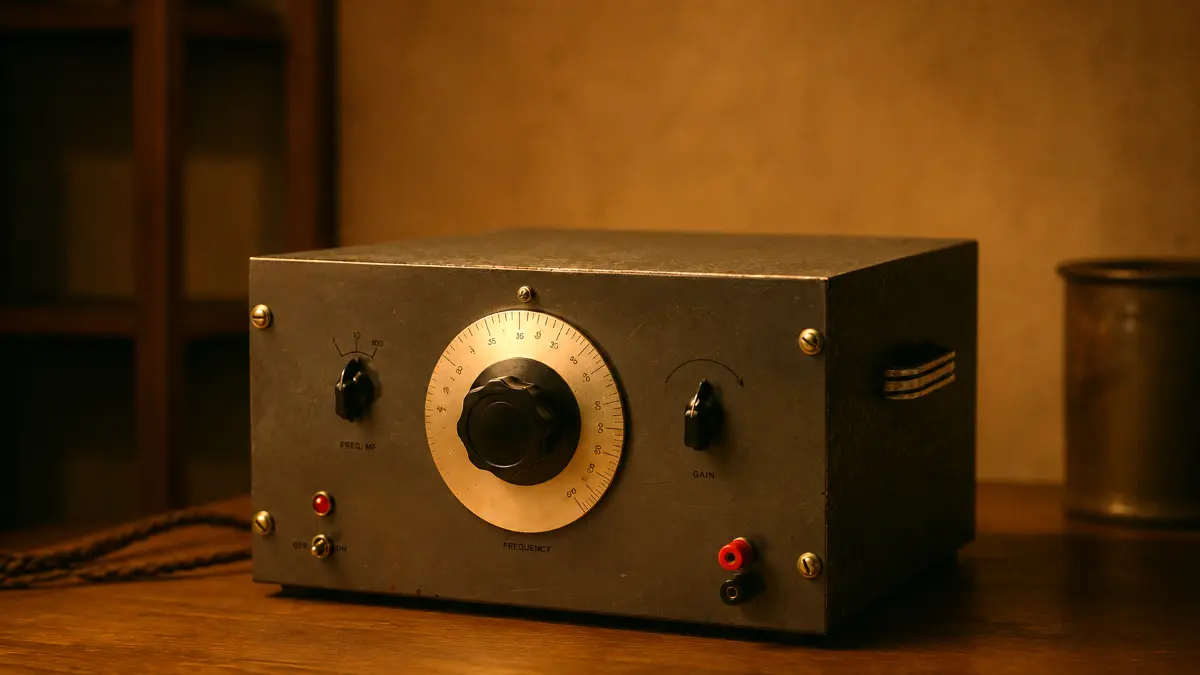

The hum of innovation often starts quietly, tucked away in garages and small workshops. On July 11, 1939, Bill Hewlett filed a patent application for what would become Hewlett-Packard’s first product: the 200A oscillator. This wasn’t just another piece of test equipment. It was a design that would define a new standard in precision electronics and set the tone for decades of technological advancement.
The Hewlett-Packard 200A oscillator was a compact, reliable audio oscillator designed for testing sound equipment. Unlike its predecessors, which were often bulky, unstable, and expensive, the 200A introduced a fresh approach to oscillator design. Bill Hewlett’s patent application marked the beginning of a product that combined innovation with practical engineering, delivering a device that was both affordable and highly accurate.
At the time, electronic testing equipment was a niche but critical market. Engineers and technicians needed tools that could deliver consistent signals for calibrating radios, amplifiers, and other audio devices. The 200A oscillator solved a clear problem: it provided a stable, low-distortion sine wave output at a fraction of the cost and size of existing models. This made it accessible to a broader range of users, from professional labs to hobbyists.
The impact was immediate. The success of the 200A oscillator gave Hewlett and Packard the financial and reputational boost to move out of their garage on Addison Avenue and into a rented commercial space by 1940. This transition marked the birth of Hewlett-Packard as a serious player in the electronics industry. The oscillator’s design principles, precision, reliability, and cost-effectiveness, became the foundation of HP’s product philosophy.
What changed because of this? The 200A oscillator set a new benchmark for test equipment, influencing not only HP’s future products but also the broader electronics industry. It demonstrated that high-quality electronic instruments could be produced efficiently and sold at prices that expanded the market. This shift helped accelerate the growth of consumer and professional electronics by making reliable testing tools more widely available.
Moreover, the oscillator’s design innovations contributed to the evolution of signal generation technology. The 200A used a unique approach to stabilize frequency and reduce distortion, techniques that would be refined and adapted in later generations of oscillators and signal generators. The ripple effect of this innovation can be traced through decades of electronic development, from radio broadcasting to modern audio engineering.
Today, the Hewlett-Packard 200A oscillator remains a symbol of smart engineering solving real-world problems. It’s a reminder that breakthrough technology often comes from rethinking existing tools and making them better, smaller, and more accessible. HP’s early success with the 200A also highlights the importance of user-focused design in technology development, a principle that continues to drive innovation across industries.
Reflecting on this event, it’s clear that the 200A oscillator was more than just a product. It was a catalyst that helped transform a garage startup into a global technology leader. It showed how a single, well-designed device could open doors to new markets and new possibilities. That spirit of innovation and practical problem-solving is still very much alive in today’s tech landscape.