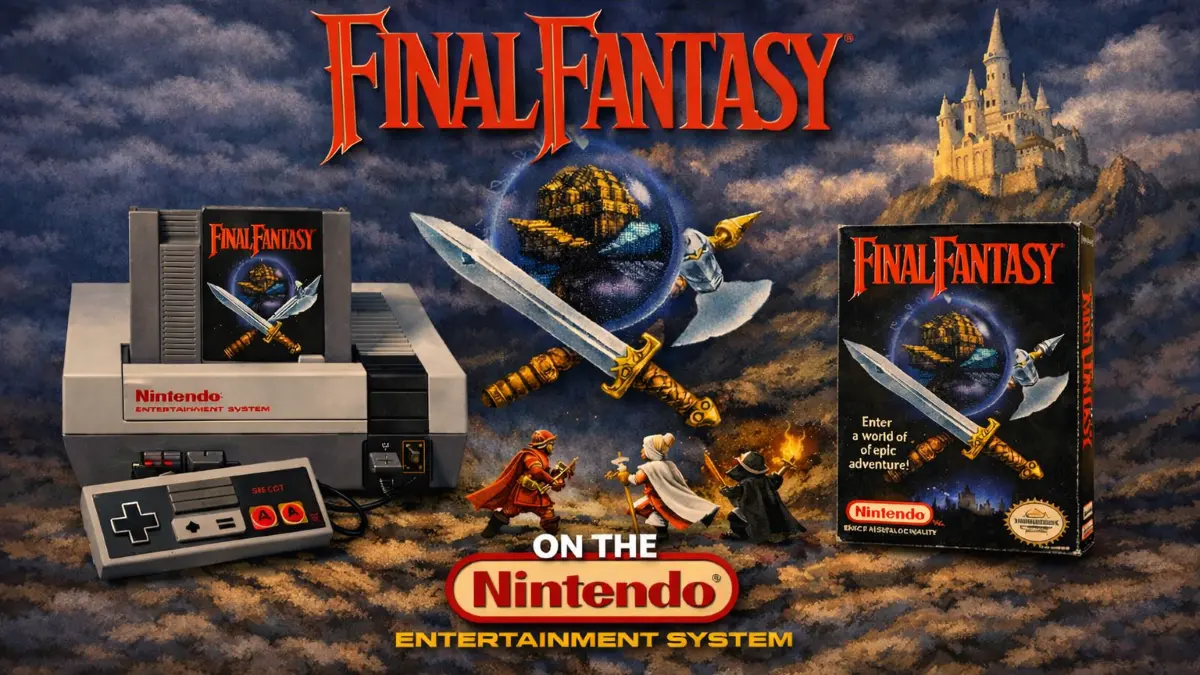

The world of gaming often hinges on moments that seem small at first but ripple out to shape entire genres. On July 12, 1990, Nintendo released the original Final Fantasy video game for its Nintendo Entertainment System in North America. This wasn’t just another cartridge hitting store shelves; it was a decisive moment that helped crystallize the role-playing game (RPG) genre for a broader audience.
Final Fantasy’s NES release came at a time when RPGs were still niche, often confined to Japanese markets or PC players. What set this game apart was its ambitious blend of storytelling, character development, and tactical combat, all packaged within the limited hardware of the NES. The game’s creator, Hironobu Sakaguchi, ironically named it “Final Fantasy” because he believed it might be his last project. If the game failed, he planned to quit game development altogether. Instead, the title’s success not only saved his career but also laid the groundwork for one of the most enduring franchises in gaming history.
At the time, Final Fantasy solved a critical problem: how to make deep, narrative-driven RPGs accessible to a wider console audience. Prior to this, RPGs were often complex, text-heavy, and intimidating for casual players. Final Fantasy struck a balance by streamlining gameplay mechanics without sacrificing depth. It introduced players to a compelling world where choices mattered, characters grew, and stories unfolded over hours of engagement. This approach made RPGs more inviting and commercially viable on home consoles.
The release also changed the landscape of game design. It demonstrated that consoles could handle intricate RPG mechanics and storytelling, encouraging other developers to explore the genre. Final Fantasy’s success pushed the envelope for what was possible on 8-bit hardware, inspiring innovations in graphics, music, and gameplay complexity that would become staples in later RPGs. The game’s influence is evident in how it shaped player expectations for character progression, party management, and epic quests.
Why does this matter today? The original Final Fantasy’s legacy is not just nostalgia. The franchise it launched remains a benchmark for RPG quality and innovation. Modern RPGs still draw from the design principles that Final Fantasy popularized: immersive worlds, strategic combat, and rich narratives. The game’s success proved that deep, story-driven experiences could thrive on consoles, paving the way for the genre’s explosion across platforms and generations.
Moreover, the story behind the game’s creation adds a layer of human drama to its technological significance. Sakaguchi’s gamble on this “final” project underscores how innovation often comes from risk-taking and uncertainty. The title’s survival and growth into a multi-billion-dollar franchise show how a single release can redefine an industry’s trajectory.
Looking back, the Final Fantasy NES release is a reminder that technology and creativity often collide in unexpected ways. It wasn’t just about pushing hardware limits; it was about crafting an experience that resonated with players and expanded what games could be. That blend of technical ingenuity and storytelling ambition continues to influence game development and player expectations nearly four decades later.
Final Fantasy’s debut on the NES is more than a historical footnote. It’s a case study in how a well-crafted game can open new avenues for an entire genre, making complex gameplay accessible and appealing. It’s a testament to the power of innovation under pressure and the enduring impact of thoughtful design.