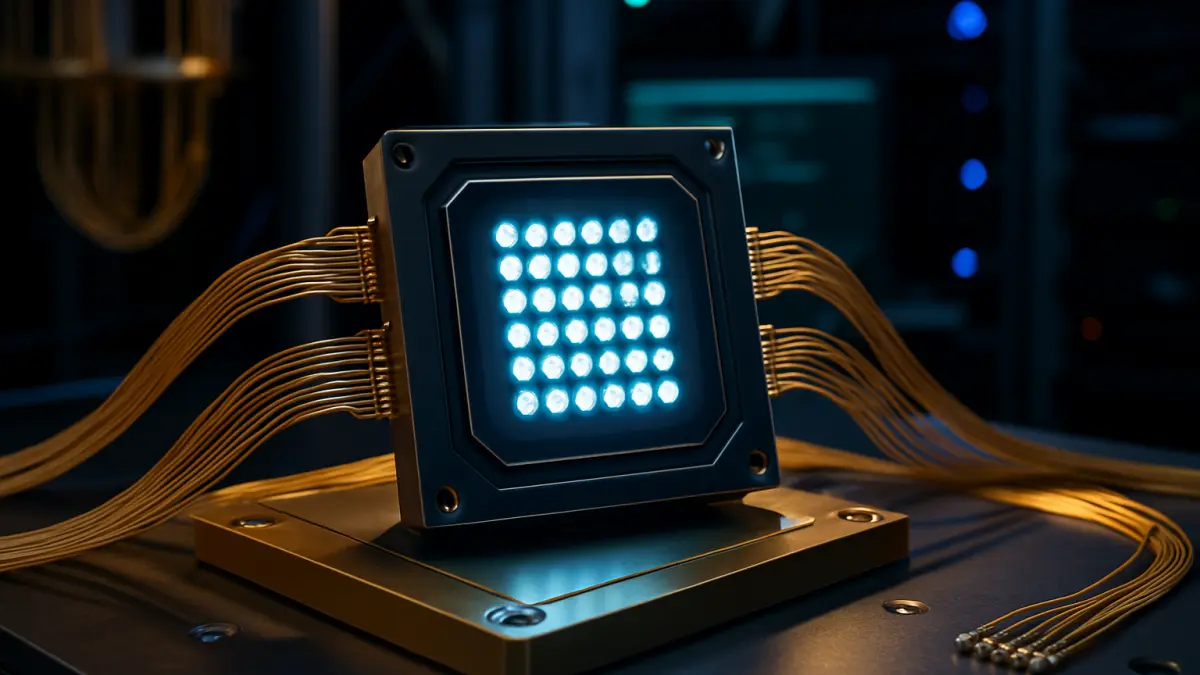

Oratomic has raised $300 million in a funding round led by ARCH Venture Partners, Spark Capital, and Khosla Ventures to develop a quantum computer that operates with just 20,000 qubits. This ambitious effort targets a more resource-efficient path to practical quantum computing, which traditionally demands millions of qubits to achieve error correction and scalability.
The significance of Oratomic’s approach lies in its potential to drastically reduce the quantum hardware complexity that has long hindered the technology’s commercial viability. By focusing on a quantum computer that needs only 20,000 qubits, Oratomic aims to accelerate the timeline for real-world quantum applications, from cryptography to complex simulations. This could mark a shift in how the industry approaches quantum hardware design, prioritizing qubit quality and architecture over sheer quantity.
In the broader quantum computing landscape, companies have been locked in a race to scale qubit counts, often at the cost of increased error rates and operational overhead. Oratomic’s strategy challenges this norm by suggesting that fewer, more reliable qubits could unlock practical quantum advantage sooner. The involvement of heavyweight venture capital firms underscores growing investor confidence in alternative quantum architectures that promise faster commercialization.
Strategically, this funding round positions Oratomic as a key player in the next wave of quantum innovation. If successful, their technology could reshape enterprise and government quantum initiatives by lowering entry barriers and infrastructure costs. It also raises questions about how competitors will respond, whether by doubling down on qubit scaling or pivoting to more efficient designs.
Looking ahead, the industry will be watching Oratomic’s technical progress and validation milestones closely. Demonstrating a working quantum system with 20,000 qubits that outperforms classical computers would be a critical proof point. Meanwhile, the broader quantum ecosystem must grapple with balancing qubit count, error correction, and system complexity to unlock the technology’s full potential.