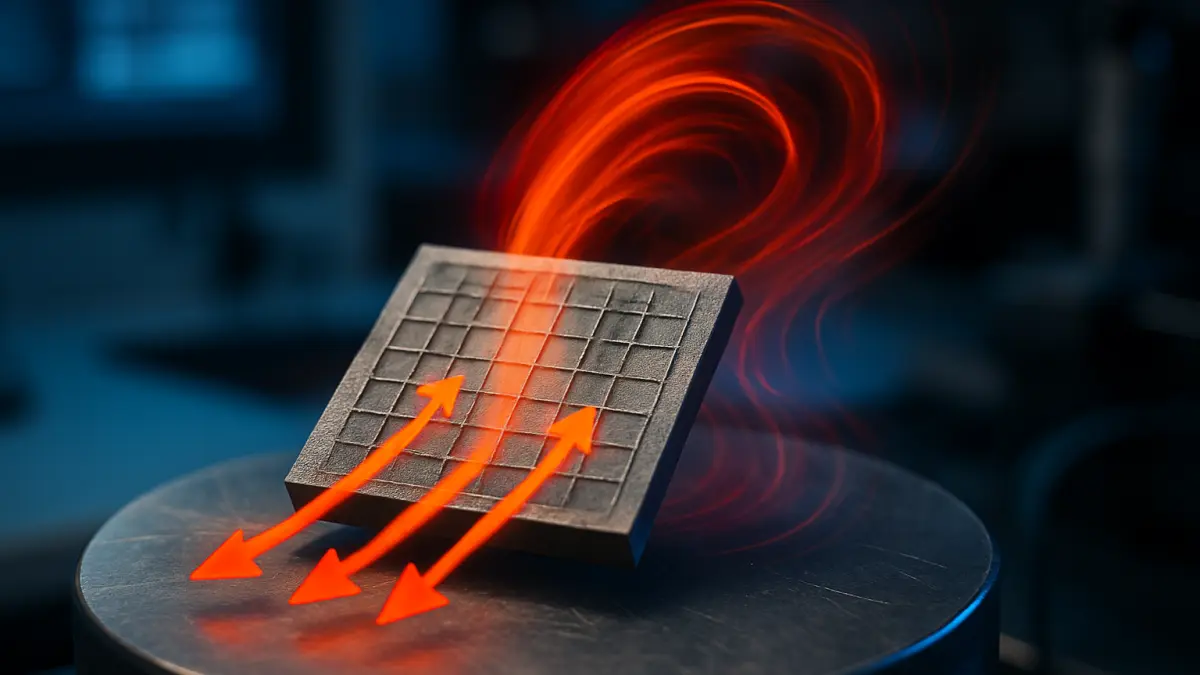

Researchers have unveiled a programmable thermal material capable of steering heat flow and retaining its configuration without any power input. This innovation marks a significant step forward in thermal management technology, particularly for applications in AI chip cooling and silicon photonics, where precise heat control is critical.
The programmable thermal material can be configured to direct heat in specific pathways and maintain that state indefinitely without requiring continuous energy. This capability could dramatically improve energy efficiency in cooling systems, which is a growing concern as AI processors and photonic devices generate increasing amounts of heat. Efficient thermal management is essential to maintain performance and reliability in these high-demand environments.
This development arrives amid broader industry efforts to tackle the thermal challenges posed by next-generation computing hardware. Traditional cooling solutions often rely on active components and continuous power, which add complexity and energy consumption. A material that can passively manage heat flow and “remember” its thermal state could reduce system overhead and enable more compact, energy-efficient designs.
Strategically, this breakthrough may influence how chipmakers and photonics developers approach thermal design. Integrating programmable thermal materials could lead to smarter, adaptive cooling solutions that respond dynamically to workload changes without additional power draw. While the technology is still in early stages, its potential to reshape thermal management aligns with the increasing demand for sustainable and high-performance computing infrastructure.
Looking ahead, the key question is how quickly this material can be scaled and integrated into commercial AI chips and photonic devices. Further research will need to address durability, manufacturing processes, and compatibility with existing semiconductor technologies. Still, this programmable thermal material offers a promising glimpse into the future of passive, intelligent heat control.