

When the PlayStation 5 launched in 2020, it was billed as the start of a new era for console gaming: lightning-fast load times, cinematic 4 K worlds, and 3D audio that pulled you straight into the action.
Five years later, that single machine has evolved into an entire ecosystem of hardware that spans price points, lifestyles, and expectations.
The PS5 Standard and Digital Edition laid the groundwork. The PS5 Slim refined it for living-room elegance. And the PS5 Pro? It’s the enthusiast’s dream — a mid-generation leap that blends raw horsepower with AI-driven wizardry.
This guide dives into what makes each model distinct — not just on paper, but in real use. Because whether you’re upgrading, buying your first PS5, or deciding between disc and digital, the differences now matter more than ever.
Standard & Digital PS5 (Launch model)
The Foundation: PS5 Standard & Digital (Launch Models)
When Sony unveiled the original PS5 in November 2020, it shipped in two flavors:
- PS5 Standard Edition — with an Ultra HD Blu-ray drive
- PS5 Digital Edition — identical hardware, minus the drive
Aside from that optical slot, they’re twins under the shell.
Under the Hood
Both versions run on an 8-core AMD Zen 2 CPU paired with an RDNA 2 GPU capable of 10.3 teraflops — roughly twice the output of the PS4 Pro. With 16 GB GDDR6 memory pushing 448 GB/s bandwidth and a custom 825 GB SSD that moves data at 5.5 GB/s raw, these consoles redefined what “no loading screen” meant.
Games like Ratchet & Clank: Rift Apart proved the point — teleporting between worlds instantly wasn’t marketing fluff; it was architecture in action.
Audio and Visuals
Both support 4 K up to 120 Hz, HDR, 8 K output, and variable refresh rate (VRR) via HDMI 2.1. Sony’s Tempest 3D AudioTech rounds out the sensory upgrade, letting compatible headsets render positional sound that feels almost spatially tangible.
Launch Pricing (2020)
- PS5 Digital Edition — $399.99 USD
- PS5 Standard Edition — $499.99 USD
For nearly five years, those base prices defined “next-gen value.” Even through shortages and regional price shifts, the core experience stayed identical — the same frames, fidelity, and features.
Verdict
The launch PS5 remains a performance benchmark. Its only real drawback today is storage. With game file sizes ballooning, the 825 GB SSD (about 667 GB usable) fills up quickly. Still, for players who want pure PS5 power without extras, the base models continue to deliver.
PS5 Slim (2023 refresh)

Three years after launch, Sony unveiled a sleeker revision: the PlayStation 5 Slim.
This wasn’t a performance upgrade — it was a lifestyle one.
Design Evolution
The Slim trims roughly 30 % of volume and up to 24 % of weight, replacing the two large side panels with a new four-panel modular design. The look is cleaner, easier to service, and notably friendlier for entertainment centers.
Perhaps the smartest change: a detachable disc drive. The Slim Digital Edition can add the drive later — meaning you can start digital and go physical later without rebuying the console.
Specs and Improvements
Internally, the Slim keeps the same CPU, GPU, and memory architecture, but expands storage to a 1 TB SSD (vs 825 GB).
That alone makes daily use more comfortable, giving space for several big titles plus system updates.
Pricing and Accessories
- PS5 Slim Disc Edition — $499.99 USD
- PS5 Slim Digital Edition — $449.99 USD
- Detachable Blu-ray Drive — $79.99
- Vertical Stand — $29.99 (optional)
Functionally, there’s zero difference between the Slim Disc and Slim Digital beyond the drive itself. Performance, frame rates, and thermals are identical.
Who It’s For
The Slim targets first-time buyers in 2025 — those who want PS5 performance in a cleaner, smaller body.
It’s also perfect for digital-only players who might eventually want physical discs or 4 K movies.
PS5 Pro (2024 mid‑generation upgrade)
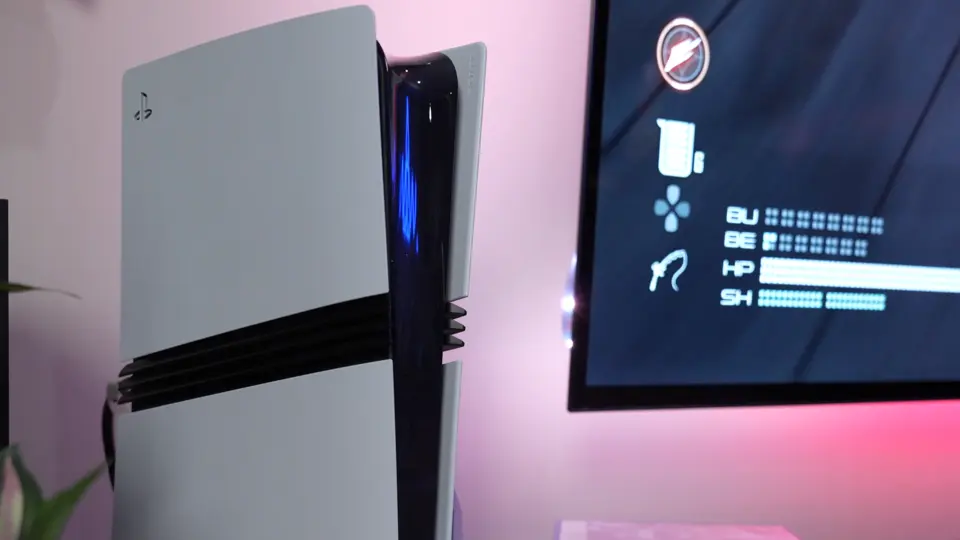
November 7, 2024 marked Sony’s boldest hardware step since the PS5’s debut: the PlayStation 5 Pro.
Think of it not as a replacement but as an evolutionary leap for those who crave the highest fidelity and smoothest gameplay possible.
Hardware Breakdown
At its core sits the same Zen 2 CPU family, but with clock-tuning and efficiency gains. The real transformation is on the graphics side:
- Upgraded RDNA 3-based GPU (16.7 TFLOPs)
- 67 % more compute units
- 28 % faster memory bandwidth
In plain terms: about 45 % more raw rendering power than the base PS5.
Storage doubles to a 2 TB NVMe SSD, and connectivity jumps ahead with Wi-Fi 7, 8 K output support, and advanced ray tracing cores.
Then there’s the new ace up Sony’s sleeve — PSSR (PlayStation Spectral Super Resolution), an AI-driven upscaling system. Similar in philosophy to NVIDIA DLSS or AMD FSR, PSSR boosts image clarity and frame rates without demanding full native rendering.
Design and Build
Visually, the Pro resembles the Slim chassis but adds subtle vents and a darker finish. Like the Slim Digital, it ships without a disc drive; you can add the same bolt-on Blu-ray accessory if you need one.
Price and Market Position
- PS5 Pro — $699 USD (or local equivalents)
It’s the most expensive PlayStation console yet, sitting squarely in enthusiast territory — but for players running 120 Hz 4 K or 8 K TVs, the performance jump justifies it.
Benchmarks and Real-World Gains
Independent testing shows:
- 45–60 % higher frame rates in ray-traced scenes
- Steadier 4 K 60 fps in demanding titles like Cyberpunk 2077 Ultimate Edition
- Reduced pop-in and improved texture streaming
- Faster loading even against the already-fast SSD in base models
For developers, Sony’s unified SDK means games scale dynamically, offering “Performance” and “Fidelity” modes that finally hit consistent targets on high-end displays.
Who It’s For
The PS5 Pro caters to serious players — streamers, tech enthusiasts, and anyone eyeing the bleeding edge.
If you own a 120 Hz monitor or 8 K TV, it unleashes that potential. But for most casual gamers with standard 4 K screens, the leap, while visible, isn’t essential.
Model Comparison (At a Glance)
| Model | Processor & GPU | Memory | Internal storage | Optical drive | Key features | Launch price (USD) |
|---|---|---|---|---|---|---|
| PS5 (Standard) | 8‑core Zen 2 CPU & RDNA 2 GPU (10.3 TFLOPs) | 16 GB GDDR6 | 825 GB custom SSD | Ultra HD Blu‑ray disc | 4K/120 Hz output, HDMI 2.1, Tempest 3D audio | $499.99 |
| PS5 Digital Edition | Same CPU & GPU as standard model | 16 GB GDDR6 | 825 GB SSD | None (digital only) | Identical performance to standard model | $399.99 |
| PS5 Slim | Same CPU & GPU as launch model | 16 GB GDDR6 | 1 TB SSD | Detachable Ultra HD Blu‑ray (optional) | 30 % smaller chassis, 18 %–24 % lighter | $499.99 (disc) / $449.99 (digital) |
| PS5 Pro | 8‑core Zen 2 CPU & upgraded RDNA 3‑based GPU (16.7 TFLOPs) | 28 % faster memory | 2 TB NVMe SSD | Detachable Blu‑ray (optional) | AI upscaling (PSSR), advanced ray tracing, Wi‑Fi 7, 8K output | $699 |
Performance in Practice
Graphics and Frame Rates
- Standard / Digital / Slim: Capable of true 4 K 60 fps in most titles; 120 fps modes in select games.
- Pro: Adds headroom for 4 K 120 fps and enhanced ray tracing; supports AI-upscaled 8 K.
Storage and Load Times
Even the slowest PS5 obliterates mechanical drives. Expect 10-15 second load times for most AAA titles.
The Pro’s larger 2 TB SSD simply means more library, less juggling.
Thermals and Noise
The Slim introduced quieter fans and a refined cooling chamber; the Pro keeps those optimizations despite its stronger GPU. Both run cooler and quieter than early 2020 launch units.
Backward Compatibility
All PS5 models play nearly the entire PS4 library — a huge plus for newcomers upgrading from older consoles. Performance mode automatically improves many PS4 titles with faster load times and higher frame rates.
Choosing Your PlayStation 5 in 2025
So which PS5 should you buy? That depends less on teraflops and more on context.
If You’re New to PS5
Go with the PS5 Slim Digital Edition.
It’s sleek, quiet, and gives you 1 TB of fast storage — plenty to start a digital library. Add the disc drive later if your habits change.
If You Prefer Physical Media or 4 K Blu-rays
Pick the PS5 Slim Disc Edition.
Same specs, plus disc flexibility for used games or film collections.
If You Already Own a Launch PS5
Upgrade only if you need the storage bump or crave smaller design. The Slim isn’t faster, just leaner.
If You Chase Cutting-Edge Performance
The PS5 Pro is your arena.
Pair it with an HDMI 2.1 display, and you’ll see tangible gains — sharper textures, steadier frame rates, and improved lighting.
If You’re on a Budget
The original PS5 Digital Edition (still widely available refurbished) remains a powerhouse at $399.99. You’ll miss physical discs, but not performance.
How Sony’s Hardware Strategy Evolved
Sony’s mid-generation updates aren’t new — the PS4 Slim and PS4 Pro followed the same pattern — but this generation feels more deliberate.
- The Slim keeps costs stable while simplifying manufacturing.
- The Pro future-proofs the lineup for 8 K displays and AI-based rendering.
- The Detachable Drive unifies the ecosystem — one chassis, modular features.
It’s a subtle but significant shift toward flexible design. Rather than fragmenting the market, Sony built an upgrade path that keeps accessories and game compatibility universal.
Looking Ahead
The PS5 Pro’s arrival also signals where gaming is heading:
AI rendering, hybrid cloud computing, and adaptive hardware.
Expect future updates to push more AI-driven visual enhancements and system-level tools — like automatic highlight capture, smarter upscaling, and integrated voice assistance through PlayStation Link headsets.
If the PS4 era was about higher resolution, the PS5 era is about intelligence.
The system learns, optimizes, and evolves — a console designed not just to play games, but to grow with them.
Final Verdict: The Best PS5 for You
| User Type | Best Fit | Why It Works |
|---|---|---|
| New Gamers / First Buyers | PS5 Slim Digital | Smaller design, 1 TB storage, future drive option |
| Collectors / Disc Users | PS5 Slim Disc | Physical media support + same performance |
| Hardcore Gamers / Streamers | PS5 Pro | AI-upscaling, 2 TB SSD, best visuals |
| Budget Seekers | PS5 Digital (2020) | Lowest price with full next-gen power |
In 2025, every PS5 — from the $399 Digital to the $699 Pro — delivers true next-generation gaming. The difference isn’t about can it run the game but how beautifully and how conveniently it fits your life.
Sony has refined the formula, not rewritten it: smaller, smarter, faster — and still unmistakably PlayStation.
Whichever version you choose, you’re stepping into the same world-class ecosystem that’s defined console gaming for half a decade — just with the design and power level that fits you.



Reader perspectives, questions, and reactions.
No comments yet. Start the conversation.
Comments are closed for this article.