
The New Shape of Intelligence
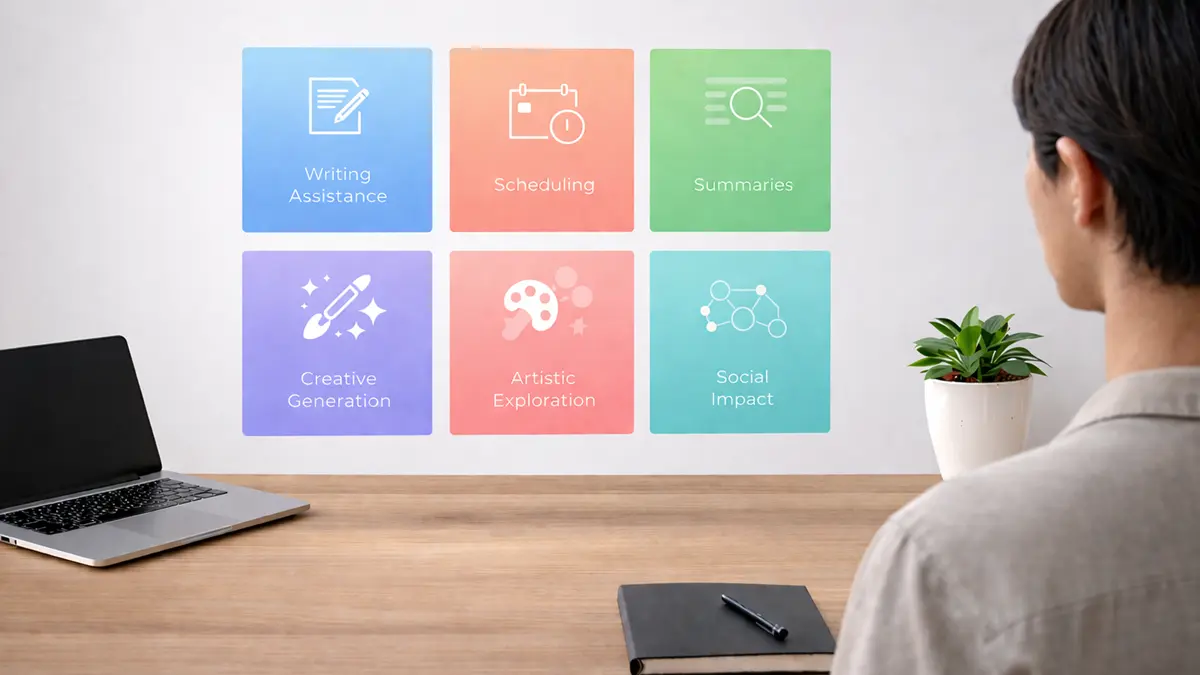
Artificial intelligence (AI) has travelled a long road from academic curiosity to integral partner. In 2026 AI systems are writing code, designing marketing campaigns, drafting legal briefs and even co‑creating music. The promise of these technologies has been matched by debate over how they affect our jobs, our creative expression and our social fabric. As someone who spent a decade building language models and now studies their ethical impact, I want to ground this exploration in both technical clarity and social context. We will look at how AI works, demystify machine‑learning basics, examine the rise of generative models, explore adoption in the workplace, reflect on the artistic and legal battles in the creative industries, consider social risks such as algorithmic bias and regulatory responses and finally look ahead to where AI may take us next. Throughout, I will emphasise nuance over hype and the human agency that remains central to technological progress.
Table of Contents
What Is Artificial Intelligence and How Does It Work?
The term artificial intelligence encompasses a range of techniques that allow machines to perform tasks that once required human intellect. Modern AI systems largely derive their abilities from machine learning, a field that enables computers to learn from examples rather than follow explicitly coded instructions. Unlike traditional programming, where humans write step‑by‑step rules, machine learning algorithms discover patterns in data and use those patterns to make predictions or generate content. MIT researchers note that machine learning “enables computers to learn without explicitly being programmed”, using data that can include numbers, text, images or audio. The more data a model sees, the better it becomes at spotting underlying structures.
Supervised, Unsupervised and Reinforcement Learning
Machine learning comes in several flavours. Supervised learning trains models on labelled data. Each example in the training set includes an input and the desired output, allowing the algorithm to compare its predictions to the correct answer and iteratively reduce its error. This approach is ideal when we know what we want to predict, such as whether an email is spam, forecasting product demand or detecting fraudulent transactions. Unsupervised learning, by contrast, works on raw, unlabelled data to uncover hidden structures or patterns. It can be used for tasks like clustering similar customers, anomaly detection or identifying relationships between products. Between the two are semi‑supervised and self‑supervised methods that leverage both labelled and unlabelled data. Reinforcement learning adds another dimension: algorithms learn through trial and error, receiving rewards or penalties for actions taken. In autonomous racing, systems like AWS DeepRacer use reinforcement learning to optimise navigation decisions, while in finance similar techniques help algorithms make intelligent trades.
Generative AI vs Traditional Machine Learning
Not all AI models are designed merely to predict. Generative AI uses machine learning to create new content, text, images, music or code, rather than just classifying existing data. MIT experts explain that Generative AI is a type of machine learning that can produce new content based on large datasets. Transformer‑based large language models like ChatGPT and Claude have been trained on billions of sentences, allowing them to respond to prompts with coherent prose or even write computer programs. Generative models go further than predictive machine learning: instead of mapping inputs to known outputs, they identify relationships and structures in their training data and then synthesise novel outputs. Because generative AI models are pretrained on massive datasets, they can sometimes be more accurate and easier to deploy than bespoke machine‑learning systems. However, there remain cases where traditional machine learning is preferable, for example, when handling sensitive or highly specialised data or when privacy concerns preclude sharing information with third‑party models.
Machine‑Learning Fundamentals: A Quick Reference Table
Below is a high‑level comparison of three core machine‑learning paradigms. Use it as a reference while reading the sections that follow.
| Paradigm | Key idea | Example applications |
|---|---|---|
| Supervised learning | Models learn from labelled examples, mapping inputs to known outputs. | Spam detection, demand forecasting, medical image classification |
| Unsupervised learning | Algorithms discover patterns in unlabelled data, grouping, compressing or associating data based on similarity. | Customer segmentation, anomaly detection, recommendation systems |
| Reinforcement learning | Agents learn through trial and error, receiving feedback signals (rewards or penalties). | Autonomous driving, algorithmic trading, robotics |
Generative AI in Action
Text Generation and Large Language Models
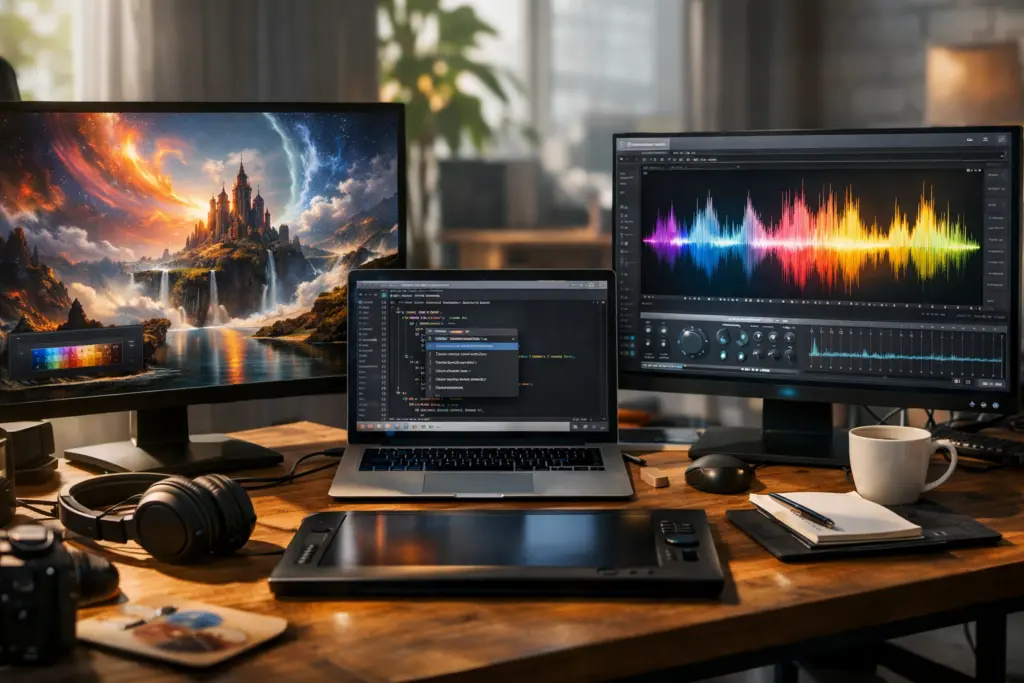
One of the most striking demonstrations of deep learning’s power is natural‑language text generation. Models like ChatGPT, Anthropic’s Claude, Google’s Gemini and Meta’s Llama can interpret plain‑language prompts and produce essays, dialogue or code. OpenAI’s GPT‑4 improved upon its predecessor by achieving higher scores on academic and professional exams, even outperforming 90 % of lawyers on the bar exam. This leap underscores the rapid pace of progress: language models are not only refining grammar and coherence but also extending their abilities to multimodal inputs such as images. The result is a tool that makes information search conversational and intuitive, changing how we interact with computers.
Large language models also underpin generative coding assistants. GitHub Copilot integrates with popular code editors to suggest snippets and functions based on surrounding context. In a study of more than 2,000 developers, 60–75 % of users reported feeling more fulfilled and less frustrated when using Copilot. These tools do not replace programmers but act as pair programmers, increasing velocity and reducing mundane tasks.
Music and Speech Generation
Generative AI is extending its reach into the sonic arts. Models such as Google’s MusicLM can generate unique melodies and harmonies from textual descriptions. In 2024 a song titled Heart on My Sleeve appeared on TikTok with vocals made to sound like Canadian musicians Drake and The Weeknd; the track went viral. Universal Music Group quickly requested its removal from platforms, highlighting unresolved questions about artistic consent and rights. Such controversies illustrate that AI can inspire creativity but also raise legal and ethical issues.
Image Generation and Visual Creativity
Text‑to‑image tools like Midjourney, DALL·E and Stable Diffusion have exploded in popularity. They translate written prompts into photorealistic or stylised images, enabling designers and illustrators to iterate concepts in minutes. The scale of adoption is astonishing: researchers estimate that more than 15 billion images were created using text‑to‑image algorithms in 2025, a number that historically took photographers 150 years to reach. These models are also being used for personalised marketing, icon design and data visualisation. Tools like Adobe Firefly and Figma’s Magician generate icons and textures from textual descriptions, while AI‑powered analytics platforms turn unstructured feedback into actionable insights.
Generative AI in Code and Product Design
Beyond language and images, generative models are shaping how we build software and products. GitHub Copilot, mentioned above, accelerates coding by suggesting functions and patterns. In interface design, AI companions such as Genius for Figma understand design context and propose components that match a team’s style. These tools free up human designers to focus on strategy and aesthetics rather than repetitive layout work.
Table: Representative Generative AI Examples
| Domain | Model/tool | Notable features and issues |
|---|---|---|
| Language | ChatGPT, Gemini, Claude, Llama | Conversational interface; multimodal input; improved exam performance. Raises concerns about hallucinations and bias. |
| Code | GitHub Copilot | Provides context‑aware code suggestions; surveys show 60–75 % of developers feel more fulfilled and less frustrated. Requires careful review of generated code for correctness and security. |
| Music | MusicLM; AI‑generated songs like Heart on My Sleeve | Generates melodies and instrumentals from prompts. Sparks legal debates when voices mimic famous artists. |
| Images | Midjourney, DALL·E, Stable Diffusion | Create photorealistic or stylised images; over 15 billion images created via text‑to‑image algorithms in 2025. Raises concerns about copyright and authenticity. |
| Interface design | Figma’s Magician, Adobe Firefly | Generates icons and UI elements from text. Enhances productivity but may limit originality if over‑used. |
AI in the Workplace
Adoption and Trends
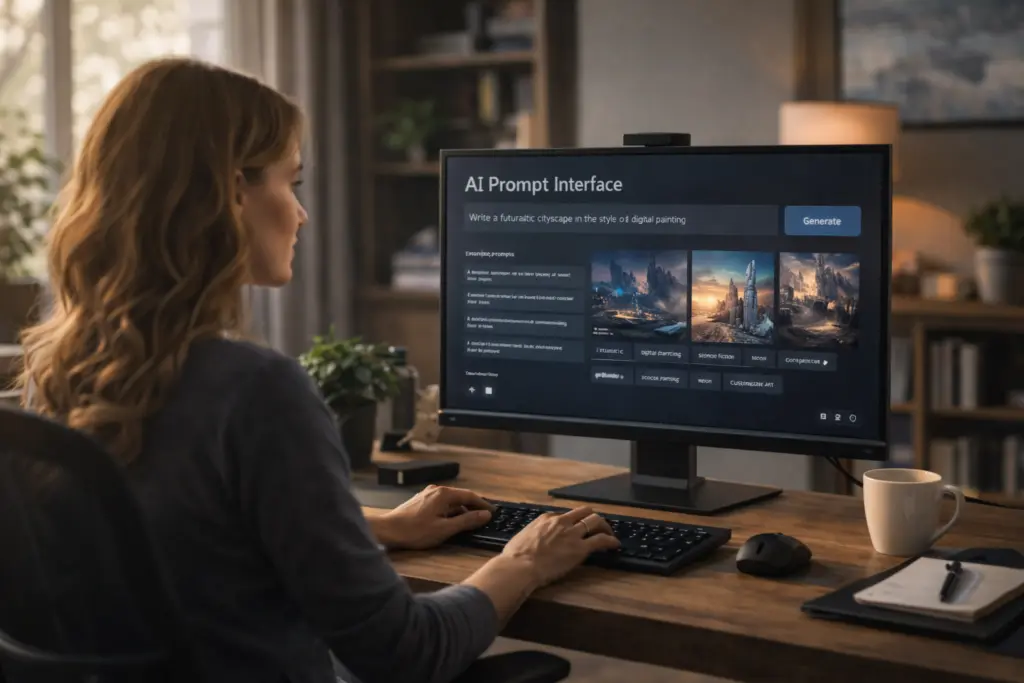
AI is no longer confined to research labs or large tech companies; it is becoming a ubiquitous workplace tool. Gallup’s 2025 survey of U.S. workers found that employees already using AI at work used it slightly more often in the fourth quarter of 2025 than in the prior quarter. Daily use rose from 10 % to 12 %, and frequent use (at least a few times a week) increased to 26 %. Despite this growth, nearly half of workers (49 %) reported they never use AI on the job. Only 38 % said their organisation had integrated AI to improve productivity, while 41 % said it had not adopted AI at all, highlighting the growing need for practical resources like top 5 free AI tools you should be using in 2025.
These aggregate figures hide substantial variation by industry and role. AI use is most prevalent in knowledge‑based sectors such as technology, finance and higher education; in the technology sector total AI use reached 77 %, with 57 % of employees using AI frequently and 31 % using it daily. In contrast, retail reported the lowest adoption at 33 % total use, including 19 % frequent users and 10 % daily users. Adoption also differs by job type: employees in remote‑capable roles saw total AI use climb from 28 % in 2023 to 66 % by 2025, with frequent use rising from 13 % to 40 %. For workers in non‑remote roles, AI use increased from 15 % to 32 %, and frequent use rose from 8 % to 17 %. Leaders are more likely than managers or individual contributors to embrace AI, with 69 % of leaders using AI at least a few times a year compared with 55 % of managers and 40 % of individual contributors.
Impact on Work and Productivity
The promise of AI in the workplace lies in augmenting human capabilities. Microsoft’s chief product officer for AI experiences argues that 2026 marks a shift from AI as an instrument to AI as a partner, a transition Aparna Chennapragada describes in Microsoft’s What’s Next in AI: 7 Trends to Watch in 2026. She envisions small teams launching global campaigns with AI handling data crunching and content generation while humans focus on strategy and creativity. This collaborative model is already visible in software development: GitHub Copilot improves developer productivity and satisfaction, and pair programming with AI is becoming the norm.
However, adoption remains uneven. Many workers lack clear use cases, which Gallup notes is the most common barrier to individual AI use. Leaders therefore need to ground AI adoption in actual problems rather than novelty. It is also essential to consider the new skills required: prompt engineering, critical evaluation of AI outputs and domain expertise to interpret recommendations. Importantly, AI is not replacing humans; Microsoft emphasises that the future belongs to those who learn to collaborate with AI rather than compete with it.
Remote Work and AI Agents
Remote work has accelerated AI use because digital collaboration generates data that can feed AI systems. In remote‑capable roles, total AI use has more than doubled since 2023. At the same time, AI agents are becoming digital co‑workers. Microsoft executives predict that AI agents will proliferate in 2026 and act more like teammates than tools, performing tasks under human direction. To build trust, these agents will require safeguards akin to those given to human employees, such as identity management, access control and robust security. Organisations that design for human‑AI collaboration and invest in security can harness AI’s benefits without sacrificing safety.
AI and Creativity

New Tools, New Art Forms
Generative AI is reshaping artistic processes, a shift explored in how generative AI is transforming creative work in art, music and design. Tools like DALL·E, Midjourney and Stable Diffusion enable anyone to create complex visuals from a sentence. The global generative AI art market is projected to grow by 42 % through 2029, reaching over $2.5 billion. These tools democratise creation and allow small teams or individuals to compete with large studios. Musicians are using models like MusicLM to brainstorm melodies, while designers can auto‑generate logos and icons. Even mainstream platforms have embraced AI: a recent ChatGPT feature allowed users to transform their photos into the style of Studio Ghibli films, resulting in over 15 million average weekly active users.
Copyright, Consent and Artistic Integrity
While generative AI opens new creative possibilities, it raises thorny questions about ownership and fairness. The Brookings Institution notes that as AI‑generated art becomes commonplace, debates continue over the legality of training on artists’ works and enabling users to replicate established styles. The U.S. Copyright Office has reaffirmed its longstanding human authorship requirement, stating that outputs generated solely by AI do not qualify for copyright protection. Safeguards are needed to prevent devaluation of human originality.
Recent controversies illustrate the tension. When TikTok user ghostwriter977 released Heart on My Sleeve, a song that convincingly mimicked Drake and The Weeknd, Universal Music Group demanded its removal. Similarly, Christie’s first AI‑dedicated art sale faced a public letter signed by thousands of artists and Hollywood insiders urging cancellation. These disputes underscore the need for clearer rules around consent, compensation and transparency. Without such frameworks, generative tools risk exploiting artists’ labour and undermining trust.
Preserving Human Creativity
Many critics worry that AI will supplant human creativity, but the evidence suggests a more nuanced picture. Generative models often require human prompting and curation, and they excel at remixing existing patterns rather than originating entirely new ideas. Moreover, the most compelling AI‑enhanced works often emerge from collaboration between artists and algorithms. The future of art likely lies in hybrid practices where humans use AI to explore ideas quickly and then refine and contextualise the outputs.
Societal Impact: Bias, Fairness and Regulation

Algorithmic Bias and Discrimination
AI systems are not inherently objective. The Leadership Conference on Civil and Human Rights warns that AI can perpetuate and amplify discrimination when trained on biased data or built with flawed designs. They note that AI may help reduce human bias by focusing on objective factors, for example, an underwriting algorithm using cash‑flow data can expand access to credit. Yet these benefits are not automatic. Representation bias in training data can lead to systems that misidentify darker‑skinned women, while labeling bias occurs when human annotators systematically misclassify data, leading AI to propagate stereotypes. Word‑embedding bias embeds societal stereotypes into language models; researchers have found that words like “computer programmer” and “champion” are mapped closer to male than female terms, while “homemaker” and “maid” are closer to female terms. Historical bias in training data can cause models to replicate past discrimination: Amazon’s hiring algorithm learned to penalise women’s résumés because it was trained on a decade of predominantly male hiring data, and a healthcare algorithm under‑estimated Black patients’ needs because it used healthcare spending as a proxy.
Bias also arises from algorithmic design choices. If a lending model weights ZIP codes heavily, it may effectively discriminate on the basis of race or ethnicity. Deployment bias occurs when an AI system is used outside the context for which it was trained, and feedback loops can create self‑fulfilling prophecies; predictive policing algorithms send more officers to certain neighbourhoods, leading to more arrests and reinforcing the model’s belief that those areas have higher crime. Transparency is limited because many deep‑learning models are black boxes, and automation bias can lead people to over‑trust algorithmic outputs.
Regulatory Responses
Governments around the world are grappling with how to mitigate AI’s risks while promoting innovation. The EU AI Act framework officially became law on 1 August 2024, with implementation staggered over several years. Bans on “unacceptable‑risk” systems and AI literacy requirements began on 2 February 2025, general‑purpose AI rules applied from 2 August 2025, and obligations for high‑risk systems will apply from 2 August 2026. Companies that fail to comply face fines of up to €35 million or 7 % of global turnover. Despite uncertainty about how the Act’s categories will be enforced, the EU has issued a General‑Purpose AI Code of Practice to clarify expectations.
In the United States, federal AI policy has shifted toward deregulation. In October 2023 President Biden signed Executive Order 14110 to promote safe and trustworthy AI, but President Trump revoked that order in January 2025 and replaced it with a directive emphasising deregulation and private investment. This reversal signals a preference for industry‑led innovation and has left the U.S. regulatory landscape fragmented. Many states are filling the void: Colorado passed the first comprehensive state AI law in May 2024 requiring developers of high‑risk AI systems to exercise reasonable care to prevent algorithmic discrimination and to disclose when consumers are interacting with AI. This law may serve as a model for other states as concerns about bias and transparency grow.
Globally, more than 72 countries have proposed over 1,000 AI‑related policy initiatives and legal frameworks as of early 2026. The regulatory landscape remains nascent and uneven, but the direction of travel is toward greater accountability and transparency. Organisations deploying AI should watch these developments closely and incorporate ethical considerations into product design.
The Future: Where AI Is Heading
AI as Partner and Co‑worker
Looking ahead, AI is set to deepen its role as a collaborator rather than a replacement. Microsoft predicts that AI agents will amplify what people can achieve together. Small teams may be able to run global campaigns with AI handling data‑heavy tasks, enabling humans to focus on strategy and empathy. This vision extends to research: AI will no longer just summarise papers or suggest hypotheses; it will actively participate in experiments. Scientists could have AI lab assistants that plan experiments, control equipment and collaborate with human colleagues. Such integration blurs the line between tool and partner.
AI Safeguards and Infrastructure
As AI becomes embedded in day‑to‑day work, security and trust will become paramount. Microsoft security leaders emphasise that each AI agent should have its own identity and limited access to systems and data. AI infrastructure will also evolve: instead of building ever larger data centres, organisations will focus on efficiency, packing computing power more densely across distributed networks. Flexible global “super‑factories” of compute will route workloads dynamically so that no resources sit idle. This shift will make AI more sustainable and accessible.
Healthcare and Scientific Discovery
In healthcare, AI is poised to close gaps in access. Microsoft’s Diagnostic Orchestrator solved complex medical cases with 85.5 % accuracy, far exceeding human clinicians. The World Health Organization projects a shortage of 11 million healthcare workers by 2030; AI can help bridge that gap by triaging patients, suggesting treatments and empowering people to manage their own health. More broadly, AI will accelerate scientific discovery by generating hypotheses, controlling experiments and analysing data. In fields from climate modelling to materials science, AI’s ability to explore vast parameter spaces will lead to breakthroughs that were once thought impossible.
Ethical and Societal Questions Remain
Despite the promise of AI, we must reckon with unresolved issues: Who owns AI‑generated content? How can we ensure fair access to benefits? What happens when personal data is used without consent? The debate over AI‑generated music and art illustrates that creative and legal frameworks have not caught up with technological capability. Algorithmic biases show that without deliberate design choices and oversight, AI can reproduce historical discrimination. Regulatory responses are still emerging, and there is no global consensus on how to balance innovation and protection. As AI becomes more powerful, these questions will only intensify.
Frequently Asked Questions
What is the difference between AI and machine learning? AI is a broad field encompassing any technique that allows computers to perform tasks that require intelligence, such as reasoning, perception or learning. Machine learning is a subset of AI that uses data to train models to perform specific tasks without being explicitly programmed.
How does generative AI differ from other machine‑learning approaches? Generative AI creates new content, text, images, audio or code, based on patterns learned from training data. Traditional machine‑learning models typically make predictions or classifications but do not synthesise novel outputs.
Is AI replacing human jobs? While AI automates certain tasks, current evidence suggests it augments rather than replaces most jobs. AI helps teams process data, generate content and automate repetitive tasks, freeing people to focus on strategy and creativity. Adoption remains uneven, and many workers still do not use AI.
What are the main ethical concerns with AI? Key issues include algorithmic bias, discrimination, lack of transparency, misuse of personal data and the impact on creative and labour markets. Bias can result from skewed training data, design decisions or deployment contexts. In the creative realm, AI’s ability to mimic artists raises questions about consent and copyright.
How is AI being regulated? Regulation varies by region. The EU AI Act introduces risk‑based categories and imposes fines for non‑compliance. The United States has shifted toward deregulation at the federal level but some states, like Colorado, have passed laws requiring developers to prevent algorithmic discrimination. More than 72 countries have proposed AI‑related policies.
Conclusion and Call to Action
AI systems are weaving themselves into the fabric of work, creativity and society. Their potential is vast: they can draft code, design campaigns, diagnose diseases and help scientists discover new materials. Yet these abilities come with trade‑offs. The same models that democratise creativity can undermine artists’ rights; the algorithms that expand access to credit can reproduce historical discrimination. Regulation is beginning to take shape, but it is uneven and contested. As AI becomes our partner, not just a tool, we must engage critically with how it is built and deployed. The future of AI is not predetermined; it will be shaped by the choices we make today.
If you’re curious about AI’s many facets, from the ethics of training data to the mechanics of deep learning and the latest generative tools, explore our Artificial Intelligence category. We offer deep dives, interviews with experts, tutorials for beginners and thoughtful commentary on the latest developments. Whether you’re a technologist, artist, policy maker or simply curious, there is more to discover. Join the conversation and help chart a human‑centred path for artificial intelligence.



Reader perspectives, questions, and reactions.
No comments yet. Start the conversation.
Comments are closed for this article.