

The Shift from Tool to Co-Creator
In late 2022, concert‑goers in a London chamber hall witnessed something unprecedented. Pianist David Dolan improvised melodies that were instantly echoed and elaborated by a semi‑autonomous AI companion. The performance blended human expressiveness with machine‑generated suggestions, offering an early glimpse of how generative AI can inhabit creative spaces. Within just a few years, AI models have moved from academic experiments to active collaborators in studios, design houses and music venues. This article unpacks the practical impact of generative AI on artistic disciplines and why a balanced view, one that embraces innovation yet interrogates its consequences, is essential, especially within the broader shift in how artificial intelligence is changing work, creativity and society.
Table of Contents
AI and the Visual Arts: Collaboration, Competition and Copyright
A surge of AI‑generated art
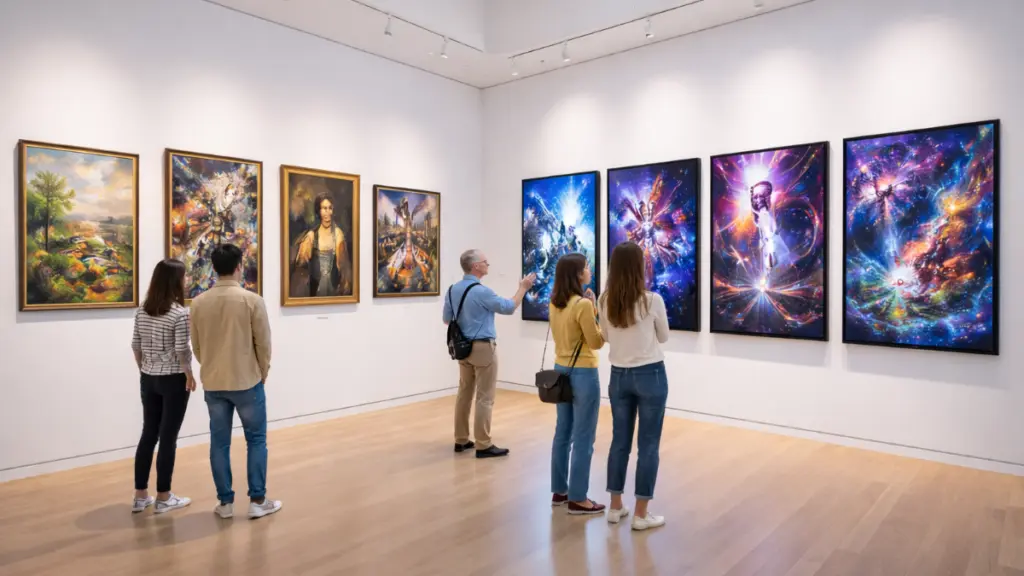
Visual art was among the first creative fields to be swept up by generative models, a subset of artificial intelligence systems capable of learning patterns from large datasets. When open source image generators appeared, marketplaces quickly became saturated with AI pieces. A Stanford Graduate School of Business study analysing an online marketplace found that after AI images were allowed, the total number of artworks skyrocketed while human‑created images declined. Consumers began favouring AI images for their novelty, and the influx of content crowded out non‑AI artists, who saw their sales drop. The research raises serious questions: will AI democratise art by enabling more creators, or will it funnel revenue toward those who operate AI systems? The data suggests that while the number of producers grows, the distribution of earnings skews heavily toward AI creators.
Creativity versus imitation
AI art engines leverage enormous datasets of images scraped from the internet. They learn statistical patterns and produce outputs that mimic distinctive styles. While this can yield stunning results, it also triggers concerns about derivative works and the undermining of original voices. Many artists argue that AI makes it easy to replicate their signature aesthetics without consent. Others see potential: AI can rapidly generate mood boards and concept drafts, freeing time for deeper craftsmanship. It’s crucial to remember that generative models cannot truly experience or interpret; they blend existing material. For those exploring AI tools, treat them as collaborative assistants, not substitutes for personal expression.
Legal landscape and copyright challenges
The legality of training AI on copyrighted works is unresolved. In 2025, U.S. courts issued some of the first substantive decisions. Cases such as Bartz v. Anthropic and Kadrey v. Meta held that using lawfully acquired data to train models may constitute fair use, but emphasised that market harm remains a key concern. The rulings didn’t settle whether AI outputs can infringe specific works; the judges acknowledged that training on pirated data is problematic and that the effect on human creators matters. As litigation continues, artists should stay informed about licensing options and consider watermarking or selective sharing to manage risks.
Music and Audio: Co‑creation and Controversy
Models composing melodies
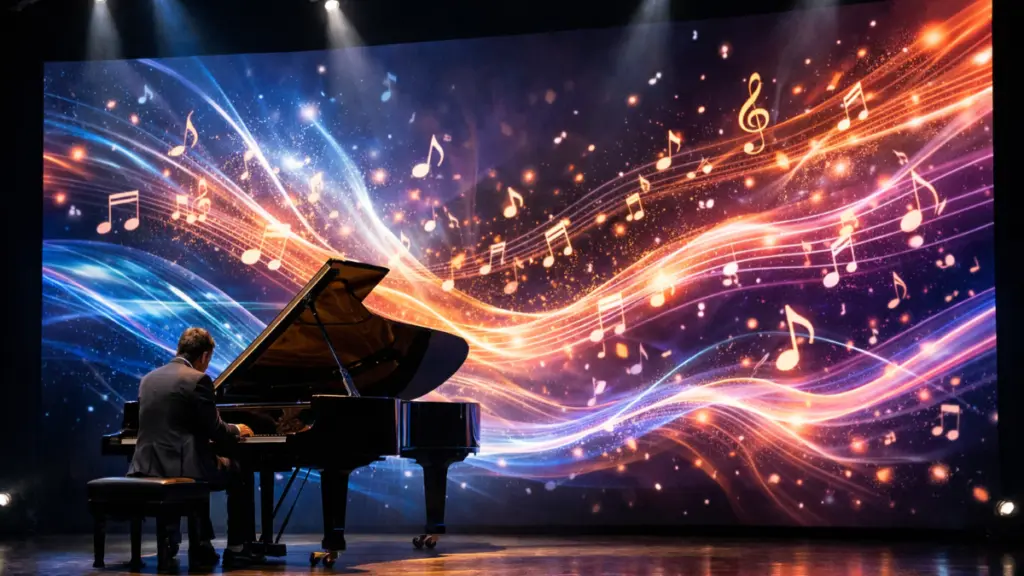
In music, generative AI has gone from academic project to mainstream tool. Music Transformer, MusicLM and other models can generate melodies and entire songs from short prompts. Producers now use AI to draft chord progressions, suggest instrumentation or match a particular genre. Streaming platforms personalise playlists using AI that analyses listening habits. The first recorded AI‑human performance showed that machines can respond to human improvisation in real time. For independent musicians, AI tools reduce barriers to entry; one person can compose, arrange and master a track with minimal equipment.
Excitement meets anxiety
Even as AI sparks creative possibilities, many musicians feel uneasy. They worry about job security and losing control over their sound. Some fear that AI‑generated music could saturate platforms, making it harder for human artists to be discovered. Others raise deeper concerns about authenticity. Is a song that emerges from statistical patterns capable of conveying human emotion? Legal debates mirror those in visual art. Many copyright laws still assume human authorship, leaving questions around the ownership of AI‑assisted compositions. However, early court decisions indicate that using lawfully obtained works for training may be permissible if the output doesn’t supplant the original’s market, an issue closely tied to evolving AI governance and standards.
Bridging art and algorithm
For musicians, the most productive path forward may be hybrid. Use AI as a sketching partner to explore harmonic variations, then apply your ear and intuition to refine the result. Designers of AI music tools emphasise that human feedback is essential; models benefit from guidance on what sounds authentic. Live performances incorporating generative algorithms, such as the Dolan concert, demonstrate that audiences can appreciate the interplay when it’s transparent and intentional. Ultimately, music’s power lies in its ability to connect emotionally; AI can enhance but not replace that human resonance.
Design and Product Development: Accelerating Creativity without Removing Designers
Rapid ideation and feedback loops
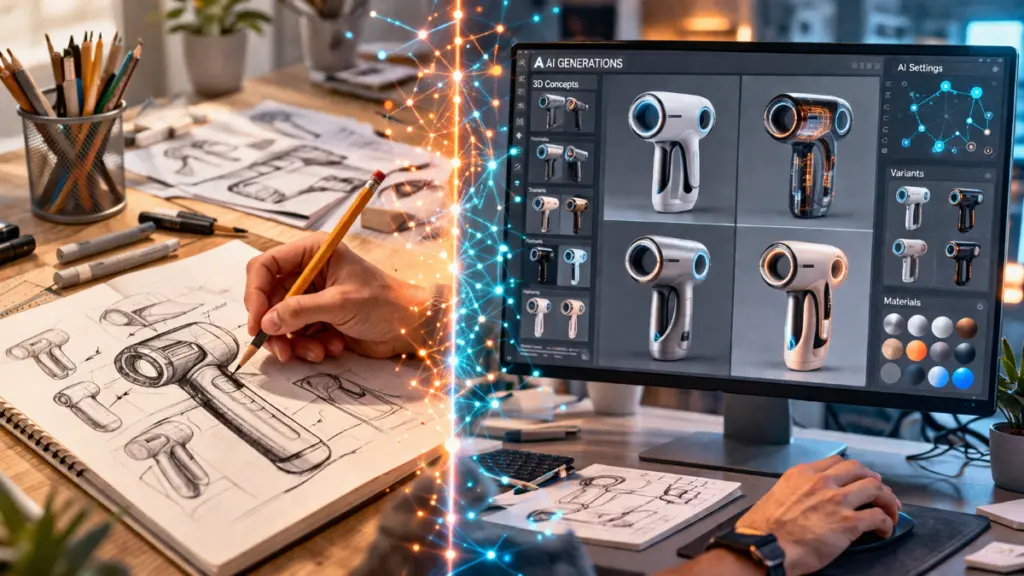
Generative AI is also reshaping industrial design and product development. By learning from vast image datasets and parametric models, AI can propose hundreds of design concepts in minutes. Designers can ask for “a shoe inspired by 1920s art deco” or “a minimalist electric kettle” and instantly see multiple high‑fidelity renderings. According to McKinsey’s analysis of generative AI in design, these tools can reduce product-design life cycle by up to 70 percent, enabling teams to quickly visualise, iterate and gather customer feedback. Early experiments suggest the technology could unlock $60 billion in productivity by streamlining design workflows.
Human judgment remains indispensable
Despite efficiency gains, AI cannot evaluate the subtleties that make products successful: how a chair feels, the cultural associations of a colour palette or the manufacturing constraints of a material. McKinsey cautions that human experts must assess manufacturability and aesthetics to avoid impractical or unattractive outcomes. Designers should think of generative systems as co‑pilots, tools for rapid ideation, rather than final decision‑makers. The most effective workflows embed AI within collaborative teams where designers guide the system, choose among outputs and ensure alignment with brand identity and user needs.
Ethical and Cultural Considerations
Bias and homogenisation
Generative models mirror the data they are trained on. If training sets over‑represent Western aesthetics, AI art and music can perpetuate cultural homogenisation, marginalising non‑dominant styles. UNESCO’s work on artificial intelligence warns that generative AI can deepen inequalities and undermine diverse cultural expressions. Without careful curation, models may replicate discriminatory stereotypes or exclude entire traditions. Creatives and platform owners need to champion inclusivity by sourcing diverse training data and challenging algorithmic bias, issues that reflect a broader transformation explored in a broader explanation of how AI systems work and their real-world impact.
Rights and agency
AI’s ability to recombine existing works raises questions about cultural and moral rights. UNESCO calls for governance frameworks that protect artists’ agency and ensure that AI expands rather than restricts cultural rights. Policy makers should involve artists, ethicists and marginalised communities when shaping regulations. For individual creators, transparency is key: disclose when AI is used, respect consent when training on others’ works and advocate for fair compensation structures.
Opportunities, Trade‑offs and Upskilling
Co‑pilot, not replacement
Industry advisors emphasise that generative AI should augment, not supplant, human creativity. The GSD Council frames generative tools as co‑pilots that handle repetitive tasks and spark ideas, allowing artists to focus on storytelling and conceptual development. The narrative of machines replacing artists oversimplifies reality. Rather than viewing AI as a threat, creatives can harness it to expand their toolkit, provided they maintain agency over the final output.
Upskilling strategies for creative professionals
Adapting to AI‑enhanced workflows requires new competencies. The GSD Council recommends several strategies:
| Skill | Why it matters | Tips for development |
|---|---|---|
| AI awareness | Understand the capabilities and limitations of generative models to use them responsibly. | Follow industry news, experiment with different tools and join online forums discussing creative AI. |
| Experimentation with tools | Hands‑on practice helps demystify AI and reveals how it can fit into your workflow. | Try free or low‑cost generative art and music programs; set small projects to test features. |
| Hybrid skills | Combining AI literacy with domain expertise enhances your value. | Learn basic prompt engineering, coding or data curation alongside your craft. |
| Creativity and critical thinking | Human ingenuity remains irreplaceable. AI can propose options, but vision and narrative come from you. | Dedicate time to exploring artistic influences, brainstorming and improvisation. |
| Ethical sensibility | Responsible use of AI protects cultural rights and fosters trust. | Reflect on potential biases and cultural impacts; engage with ethics discussions. |
| Community engagement | Collaboration and dialogue help shape norms around AI use. | Join creative AI meetups, share experiences and advocate for fair policies. |
These skills help artists not only survive but thrive in an AI‑assisted landscape. They encourage a mindset that is curious yet critical, experimental yet grounded in human values.
The economic balance
The integration of AI into creative industries will redistribute labour and revenue. On the one hand, generative tools lower barriers to entry and expand the pool of creators. On the other, they can devalue certain skills and concentrate income among those who control data and models. Policymakers and industry leaders should strive for fair remuneration, including licensing schemes that compensate training data providers and clear guidelines for AI‑assisted works. Creatives can advocate for collective bargaining and transparency from platforms using their work to train models.
Practical Guidelines for Creatives
- Choose the right tools: Evaluate generative software based on ease of use, cost, licensing and the diversity of training data. Tools built on ethically sourced datasets reduce legal risk.
- Keep original skills sharp: Continue practicing traditional drawing, composition and design techniques. AI is most effective when it complements, not replaces, human craft.
- Maintain an ethical workflow: Seek consent before training models on others’ works, and credit any AI assistance when appropriate. Transparently marking AI contributions helps audiences contextualise the work.
- Monitor market dynamics: Be aware of how AI shapes demand and pricing in your field. Adapt your business model, through niche specialisation, collaborations or community support, to sustain income amid changing supply.
- Advocate for rights: Participate in industry organisations and policy discussions. Collective voices can influence regulations and ensure AI benefits are shared broadly.
Looking Ahead: Regulating and Shaping a Collaborative Future
The rapid adoption of generative AI presents both promise and peril. While AI can democratise access to creativity and accelerate innovation, it also risks homogenising culture, undermining labour and amplifying bias. Solutions require a multi‑stakeholder approach: artists, technologists, researchers, policy makers and audiences all have roles to play. Legal frameworks must balance innovation with protection of rights; educational institutions should incorporate AI ethics into arts curricula; platforms ought to provide transparent licensing and opt‑out mechanisms. By approaching AI as a collaborative co‑pilot rather than an omnipotent creator, we can preserve the diversity and depth of human expression while leveraging the unique strengths of machines.
FAQ
Q1: What is generative AI in creative work?
Generative AI refers to algorithms, often based on deep learning, that can produce content such as images, music or design concepts. These models learn from existing datasets and generate new outputs by recombining patterns. They are used as tools for brainstorming, drafting and exploring possibilities rather than as full replacements for human creativity.
Q2: How does AI art impact human artists?
Studies show that allowing AI art on marketplaces increases the total number of works but can crowd out human artists and reduce their sales. However, AI tools also enable new creators and offer established artists a way to experiment with styles. The economic impact depends on how platforms set rules, how consumers value human originality and how artists adapt their business models.
Q3: Are AI‑generated works protected by copyright?
Copyright law is evolving. Early U.S. court decisions suggest that training on lawfully obtained data may be considered fair use. Yet the ownership of AI‑generated output and potential infringement remain contentious. Many jurisdictions require human authorship for copyright to apply, so purely autonomous AI works may not be protected. Artists should consult legal experts and follow emerging cases.
Q4: What ethical concerns should creatives consider when using AI?
Key concerns include bias in training data leading to cultural homogenisation, consent and compensation for artists whose works are used to train models, and transparency in disclosing AI contributions. Creatives should prioritise inclusive datasets, respect cultural rights and engage in conversations about fair use and ownership.
Q5: How can artists and designers upskill to stay competitive?
Develop AI literacy, experiment with different generative tools and cultivate hybrid skills that blend technical understanding with domain expertise. Equally important are creative thinking and ethical awareness. Engage with communities of practice to exchange experiences and advocate for equitable policies.



Reader perspectives, questions, and reactions.
No comments yet. Start the conversation.
Comments are closed for this article.