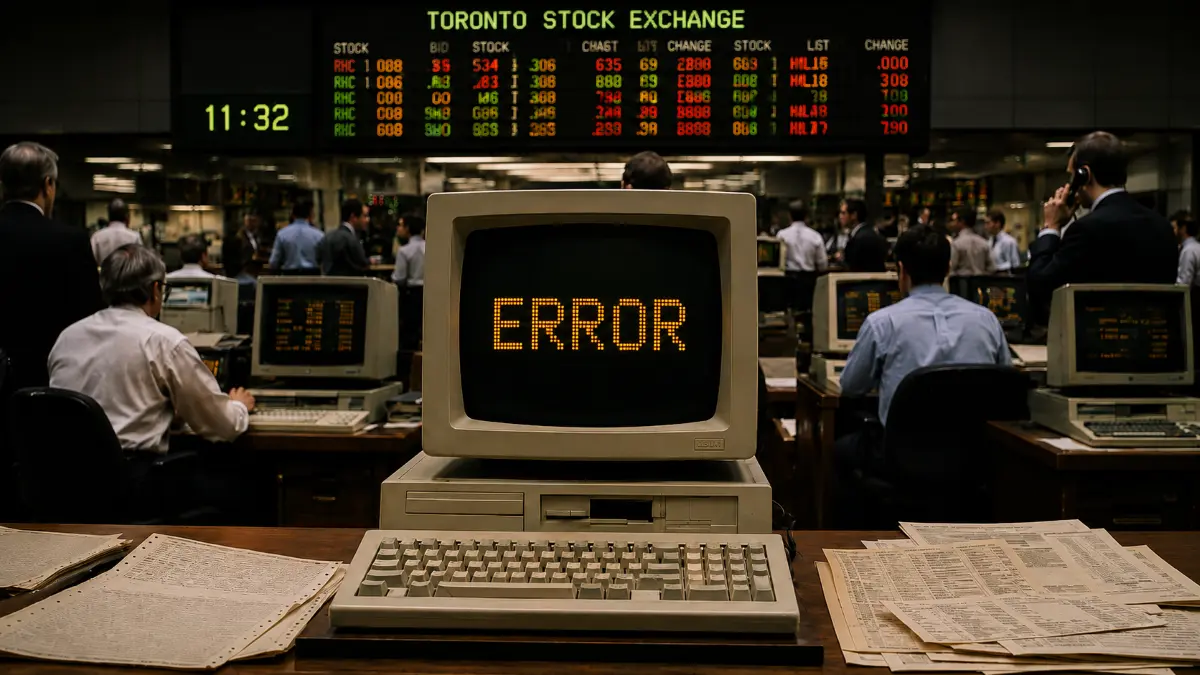

August 16, 1989, saw an unexpected disruption that exposed the fragility of digital infrastructure in the financial sector. A solar particle event affected computers at the Toronto Stock Exchange, forcing a halt to trading. This incident wasn’t just a hiccup in market operations; it was a stark reminder of how external cosmic phenomena could interfere with critical technology systems.
Solar particle events occur when the Sun emits bursts of charged particles, which can interact with Earth’s magnetic field and atmosphere. In 1989, the surge of energetic particles was intense enough to interfere with the electronics controlling the stock exchange’s computers. The result was a forced pause in trading, a scenario few had anticipated in an era increasingly reliant on digital systems.
At the time, the Toronto Stock Exchange was among the most technologically advanced financial hubs. However, this event revealed a blind spot: the vulnerability of sensitive electronics to space weather. The computers, designed for speed and precision, were not shielded against the electromagnetic disturbances caused by solar activity. This disruption highlighted a critical intersection between space science and technology infrastructure, an area that had been largely overlooked by financial institutions.
The immediate consequence was operational downtime and financial uncertainty. But beyond that, the event sparked a broader awareness within the tech and finance communities. It underscored the necessity for robust mitigation strategies against space weather effects. This included hardening electronic systems, developing backup protocols, and integrating space weather forecasts into operational planning.
The ripple effects of this 1989 incident extended far beyond the Toronto Stock Exchange. It prompted a re-evaluation of how sensitive digital systems, especially those integral to national economies, could be compromised by natural phenomena outside human control. The event pushed forward research into geomagnetic storms and their impact on technology, leading to improved forecasting models and protective measures.
Today, the legacy of that solar particle event remains relevant. As our reliance on digital infrastructure deepens, from stock exchanges to power grids and communication networks, understanding and mitigating space weather risks is more critical than ever. The 1989 disruption serves as a case study in resilience, reminding us that the environment beyond Earth can have tangible effects on terrestrial technology.
In an age where milliseconds can dictate market outcomes, the interplay between solar activity and electronics is a factor that cannot be ignored. The event on August 16, 1989, was not just a technical failure but a wake-up call. It pushed industries to think beyond traditional cybersecurity and hardware reliability, incorporating cosmic variables into their risk assessments.
Reflecting on this incident today, it’s clear that the boundaries of technology’s vulnerability extend beyond the physical and digital realms into the cosmic. The Toronto Stock Exchange’s forced halt in 1989 is a reminder that technology must be designed with a holistic understanding of its operating environment, including the unpredictable forces from space.