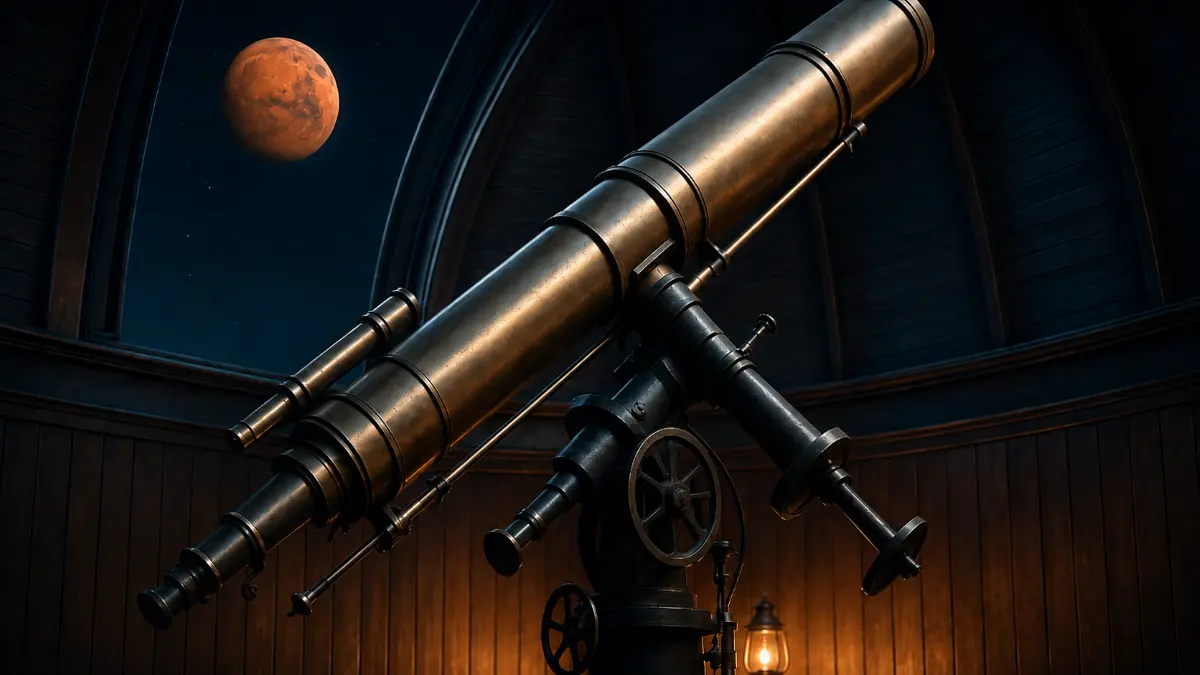

The night sky holds many secrets, but few discoveries have shaped planetary science like the discovery of Phobos. On August 18, 1877, American astronomer Asaph Hall discovered Phobos, one of Mars’s moons. This wasn’t just a new dot in the sky; it was a window into the complex gravitational dance around the Red Planet and a key to understanding Mars’s environment.
Before Hall’s discovery, Mars was known to have one moon, Deimos, but the presence of a second, much closer satellite was unexpected. Phobos orbits Mars at a mere 6,000 kilometers above the surface, closer than any other moon to its planet in the solar system. This proximity raised questions about tidal forces, orbital decay, and the moon’s origin. Hall’s observation solved the mystery of Mars’s moons and opened a new chapter in celestial mechanics.
At the time, the discovery of Phobos mattered because it challenged existing models of moon formation and planetary systems. Astronomers had to reconsider how moons could form and survive in such tight orbits. Phobos’s rapid orbit, completing a revolution around Mars in just 7.6 hours, also made it a natural laboratory for studying gravitational interactions. This was more than a curiosity; it was a problem-solving moment for astrophysics and planetary science.
The discovery changed the trajectory of Mars exploration. Phobos became a target for multiple missions, from flybys to landers, aiming to understand its composition and behavior. Its low gravity and close orbit suggested it might be a captured asteroid or debris from Mars itself. These hypotheses influenced mission designs and scientific priorities. Phobos’s study provided insights into Mars’s past, including the planet’s geological history and the dynamics of its atmosphere.
Today, Phobos remains a focal point for scientists and engineers. Its unique orbit and physical characteristics offer clues about the evolution of Mars and its environment. Future missions plan to use Phobos as a staging ground for Mars exploration, leveraging its low gravity for easier landings and launches. The moon’s potential as a resource base or scientific outpost is a direct legacy of Hall’s discovery. It’s a reminder that even small celestial bodies can have outsized importance in space exploration.
The discovery of Phobos on August 18, 1877, is more than a historical footnote. It represents a leap in our understanding of planetary satellites and the complex gravitational systems that govern them. As we push deeper into the solar system, the lessons from Phobos’s discovery continue to inform mission planning, scientific inquiry, and our broader quest to understand our planetary neighbors.
Reflecting on this event, it’s clear that the discovery of a tiny moon can ripple through time, influencing technology, science, and exploration strategies. Phobos is a testament to the enduring value of careful observation and the profound impact of seemingly small discoveries.