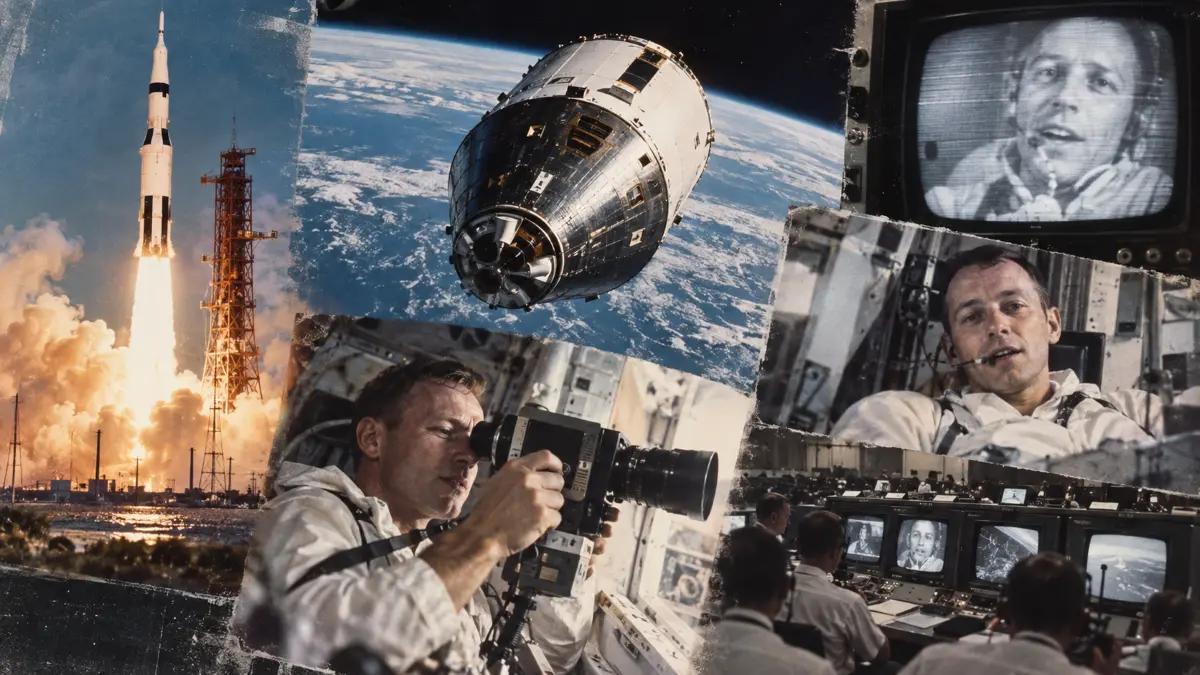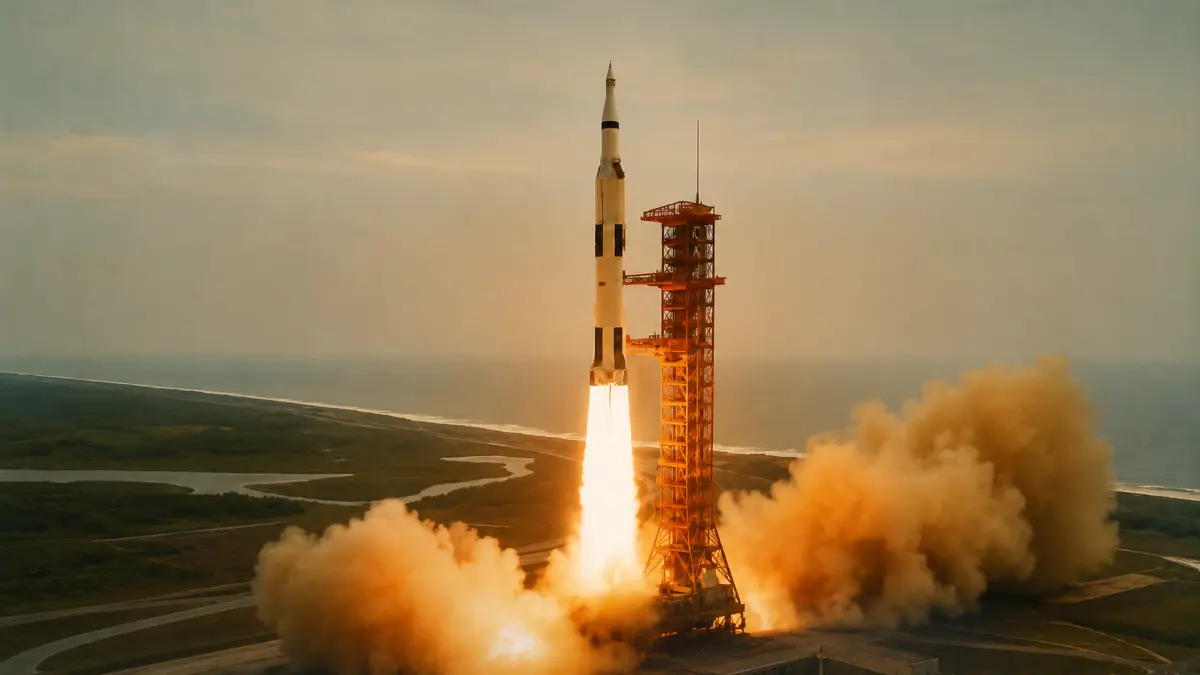

The countdown to one of humanity’s most daring technological feats began on July 16, 1969. The Apollo 11 lunar landing mission is launched from Cape Kennedy in Florida, USA. This was not just a rocket launch; it was the ignition of a complex engineering marvel that would push the boundaries of what machines and humans could achieve beyond Earth’s atmosphere.
At the time, the Apollo 11 mission represented the culmination of years of intense innovation in aerospace technology. The challenge was monumental: send humans to the Moon and bring them back safely. Achieving this required breakthroughs in propulsion, navigation, life support, and communication systems. The Saturn V rocket, the most powerful ever built, was the backbone of this effort, capable of delivering the necessary payload to escape Earth’s gravity. The onboard computers, though primitive by today’s standards, performed critical real-time calculations that guided the spacecraft through the void.
The launch itself was a flawless execution of this intricate technology. It set in motion a chain of events that would see Neil Armstrong and Buzz Aldrin become the first humans to walk on the lunar surface. But beyond the iconic moonwalk, the mission solved a series of complex problems: how to operate in a vacuum, how to manage limited resources, and how to communicate over vast distances with minimal delay. These solutions laid the groundwork for all subsequent space exploration.
What changed because of this mission was the demonstration that human spaceflight beyond low Earth orbit was feasible and controllable. It established a new standard for mission planning and execution, blending hardware and software with human skill. The technologies developed for Apollo 11 found applications beyond spaceflight, influencing fields like materials science, computing, and telecommunications. The mission also sparked a global interest in STEM fields, inspiring generations of engineers and scientists.
Today, the Apollo 11 lunar landing mission still matters because it serves as a benchmark for ambition in space technology. It reminds us that complex, high-risk projects can succeed with the right combination of innovation, precision, and teamwork. The mission’s legacy is evident in current lunar exploration plans and the renewed focus on establishing a sustainable human presence on the Moon and beyond. The systems thinking and problem-solving approaches pioneered during Apollo 11 continue to inform how we tackle the challenges of deep space missions.
Reflecting on this event, it’s clear that Apollo 11 was more than a historic moment; it was a masterclass in engineering under pressure. It taught us that pushing technological limits is not just about reaching new destinations but about expanding the realm of what is possible for humanity.