

A croissant and a vision
At the 2026 Consumer Electronics Show in Las Vegas, a crowd gathered as a wheeled humanoid rolled into a mock kitchen. Standing just under five feet tall, it extended one articulated arm to open a refrigerator and the other to retrieve milk. Minutes later, the robot slid a tray of croissants into a smart oven and began folding laundry on the counter. This demonstration, part of LG’s “Zero‑Labor Home” vision, showcased CLOiD, an AI‑powered home robot with seven‑degree‑of‑freedom arms and five‑fingered hands. The robot uses a vision‑language model to interpret scenes and translate instructions into physical actions, and it can interact through generative voice assistants and a connected app.
While LG has not announced production plans, the spectacle signaled a turning point: domestic robots are becoming more than novelty cleaners. Companies like Figure AI and 1X Technologies announced pre‑orders for their humanoids (Figure 03 and NEO) in 2025, with deliveries targeted for 2026. TIME magazine even named Figure 03—capable of folding clothes and loading a dishwasher with help—among the Best Inventions of 2025. Meanwhile, Intuition Robotics released ElliQ 3.0, a tabletop companion robot and caregiver platform that connects seniors with loved ones and monitors health remotely. Around the world, the idea of a robot living in your home is shifting from science fiction to consumer pitch.
Table of Contents
From automata to Alexa
Domestic robots have a long history. Ancient Greek automata and Victorian mechanical servants foreshadowed machines that could serve humans, but the first true robots appeared in 1960s factories, not kitchens. In the 1980s and 1990s, companies experimented with home robots—often expensive toys that mopped floors or served drinks—but limited sensors and high prices kept them from mainstream adoption. The real revolution came with cheap microprocessors, networked sensors and advances in artificial intelligence. By the 2010s, the humble Roomba vacuum and its cousins proved that autonomy could be both useful and affordable. Modern domestic robots now navigate using cameras, lidar and mapping algorithms; some integrate with smart home systems and Internet of Things devices.
Market research underscores this shift. The global household robots market was valued at US$ 14.54 billion in 2025 and is expected to surge to about US$ 71.26 billion by 2034, a compound annual growth rate of 19 percent. Domestic robots make up roughly 76 percent of this market, with vacuuming and mopping devices accounting for about 31 percent. Drivers include growing demand for smart home integration, more affordable sensors and an aging population; by 2030 more than 12 percent of Americans will be over 65, and the World Health Organization expects the global population aged 60+ to double to 2.1 billion by 2050. Companies are also experimenting with task‑specific robots—from security drones to lawn mowers and pool cleaners—while startups such as Preferred Robotics (Japan) and 1X Technologies (Norway) are developing mobile manipulators that fetch condiments or carry groceries.
Sustainability and energy realism
Behind the futuristic gloss lie practical concerns: energy, emissions and materials. Robot vacuum cleaners typically use 30–100 watts of power, compared with 600–1,500 watts for traditional vacuums. A model with a 50 Wh battery consumes roughly 18.25 kWh per year, about 15 kWh less energy than a manual vacuum. Likewise, robotic lawn mowers run on batteries and produce no direct emissions, unlike gas mowers whose exhaust rivals a car’s. Such robots can be scheduled during off‑peak hours and operate quietly, reducing noise pollution and greenhouse gases.
Yet the environmental ledger isn’t all positive. Training the machine‑learning models that power vision recognition, speech and planning demands enormous resources. MIT researchers note that training generative AI models like GPT‑4 can consume thousands of megawatt‑hours and that inference—each time a model is used—requires energy continuously. Data centers powering AI are projected to consume up to 1,050 terawatt‑hours of electricity by 2026, comparable to the entire consumption of Japan. Cooling these servers also demands significant water, straining municipal supplies. As Elsa Olivetti of MIT observes, the impact isn’t limited to the plug: “There are much broader consequences that go out to a system level and persist based on actions that we take”. In other words, even if a robot vacuum saves energy in your living room, the cloud intelligence behind its navigation may carry a hidden carbon cost.
Robots as caregivers and companions
While many robots tackle chores, others aim to address loneliness and caregiving. Intuition Robotics’ ElliQ blends a small lamp‑like robot with a tablet, using generative AI to chat, suggest activities, check medication schedules and connect with caregivers via an app. In a WHYY profile, 86‑year‑old Anthony Niemiec describes how his ElliQ greets him each morning and joins him on virtual tours; he says she feels like a housemate. Researchers note that about one in four older adults report feeling socially isolated, and companion robots can provide conversation and reminders when family members aren’t present. However, privacy concerns remain: some critics worry about over‑reliance on machines or constant surveillance.
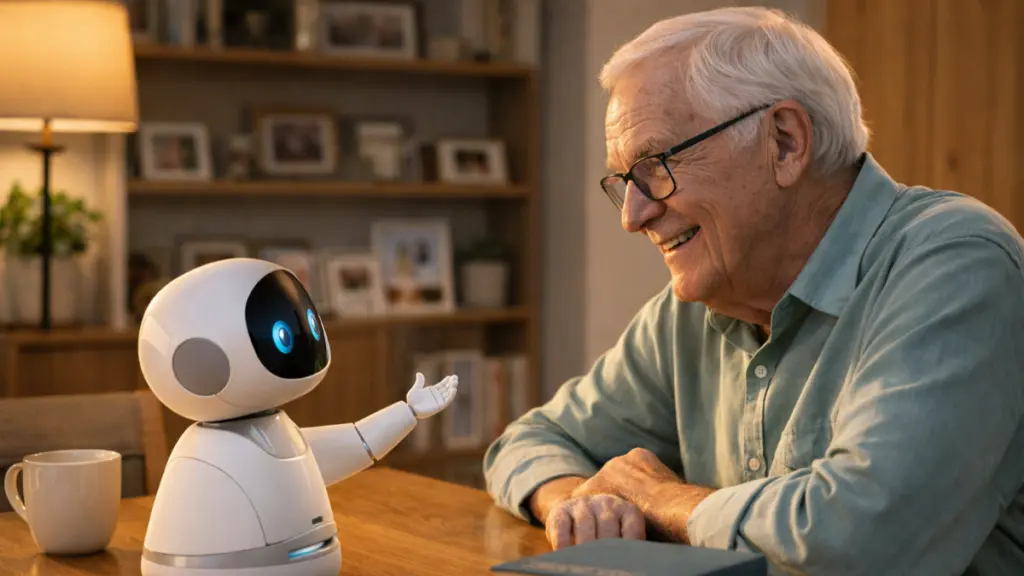
To support both seniors and their relatives, Intuition Robotics launched the ElliQ Caregiver Solution in 2025. The package pairs the companion robot with a caregiver app that tracks health indicators, delivers updates and enables remote goal‑setting. The company highlights that 48 million Americans provide unpaid care to adults, often spending 26 percent of their income on caregiving expenses. CEO Dor Skuler says the system aims to relieve burnout by automating routine monitoring so caregivers can focus on quality time.
Humanoids and a leap of faith
Humanoid robots like Figure 03, 1X NEO and LG CLOiD promise to replace multiple single‑purpose devices. NEO uses a tendon‑driven actuator system that yields high torque density, while its soft body is made from 3D‑printed lattice polymer; it can carry up to 24.9 kg and features Wi‑Fi, Bluetooth and 5G connectivity. Early access pricing—around US$20,000, or US$499 per month—suggests that these machines will enter affluent homes first. Figure 03 stands about 1.73 m tall, with a payload of 20 kg, and can run for five hours on a charge; at launch it could fold clothes and load a dishwasher but still needed human assistance. LG’s CLOiD, by contrast, has no legs but uses a wheeled base to move around; its articulated arms and dexterous hands enable it to open doors, fold laundry and prepare food. CLOiD’s “Physical AI” integrates visual and language models trained on tens of thousands of hours of household tasks to interpret objects and commands.
These capabilities hint at an era when robots might learn as flexibly as humans. Yet experts caution that general‑purpose robots remain far from polished. UT Austin computer scientist Peter Stone notes that public perception swings between utopian and dystopian extremes, but acceptance ultimately hinges on everyday usefulness and trust. Bill Smart of Oregon State University warns that letting robots handle cooking or mowing is a personal choice and raises privacy concerns—people may not want a machine watching them in intimate settings. Andrea Thomaz, co‑founder of Diligent Robotics, adds that building robot‑friendly homes requires rethinking hallways, furniture placement and storage. These insights echo a growing consensus that technology isn’t the only hurdle; design, ethics and culture are equally important.
Designing homes for machines
Robots don’t thrive in clutter. Professional integrators interviewed by ISE 2026 and the Custom Electronic Design & Installation Association (CEDIA) say that advanced robots require dedicated charging alcoves, clear pathways and robust network connectivity. Prices for humanoids currently range from US$6,000 to US$150,000, and installation involves configuring secure Wi‑Fi, geofenced zones and programming routine tasks. Cybersecurity expert Jeff Sonnleitner notes that each robot’s camera can collect and share data, making households vulnerable to hacking. CEDIA advises homeowners to work with certified professionals to integrate robots with lighting, HVAC and security systems, ensuring encrypted connections and regular software updates. Without professional integration, attempts to connect robots can risk functionality and privacy.
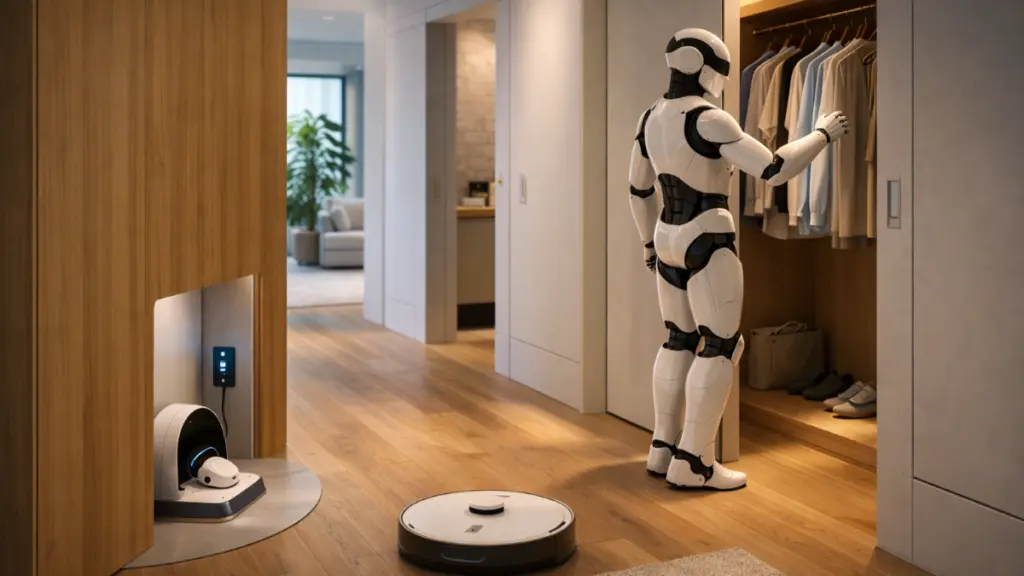
As robots multiply, architecture may evolve. Open floor plans, wide doorways and smooth flooring facilitate navigation; built‑in charging docks and storage closets keep machines out of sight. This shift echoes past infrastructural changes—think of how central heating and indoor plumbing reshaped home layouts. In the coming decade, we may see robot‑ready homes marketed alongside traditional smart homes, with packages that include network optimization, security hardening and maintenance services.
Public attitudes and affordability
Consumers are cautiously intrigued. A YouGov survey conducted after the 2025 CES found that 38 percent of Americans were interested in having a household robot to assist with chores. Interest was highest among young adults (52 percent for ages 18–34) and lowest among those over 55 (26 percent). Participants wanted robots mainly for floor cleaning (93 percent), dishwashing (87 percent) and laundry (86 percent), while support for caregiving or child care was lower (55 percent). Cost is a significant barrier: one‑third were willing to pay less than US$500, 20 percent between US$501 and US$1,000, and only a quarter would spend US$1,001 to US$5,000. Concerns include reliability (49 percent), privacy and data security (48 percent) and safety for family members (43 percent). When asked when robots would become common, only 7 percent said within two years; most expected six years or longer.
These attitudes reveal a gap between excitement and adoption. Specialized robots—vacuums, lawn mowers, window cleaners—are already mainstream, but general‑purpose humanoids remain expensive. Futurist Thomas Frey predicts that by 2030, early‑adopter households may own three to five robots, including advanced cleaners, lawn mowers, kitchen assistants and companion bots, while affluent families might have up to seven to ten. By 2035, as manufacturing scales and prices drop, the average household could have eight to twelve robots, including the first affordable humanoid helper. These projections highlight not only technological progress but also class divisions: robots may initially serve the wealthy before trickling down.
Trust, safety and the ‘robot constitution’
With machines moving into intimate spaces, governance becomes paramount. A 2024 paper from Google DeepMind introduced a Robot Constitution, a set of rules derived from Isaac Asimov’s laws but updated for real‑world safety. The constitution’s Foundational rules state that robots must not injure humans and must protect their existence, but prioritize self‑preservation over obedience when human commands could damage the robot. Safety rules prohibit robots from interacting with sharp or electrical objects and restrict tasks involving humans or animals. Embodiment rules limit robots to tasks within their physical capabilities—no lifting heavier objects than a book or performing two‑handed tasks with one arm. These guidelines reflect DeepMind’s recognition that embodied AI must be constrained by physical and ethical boundaries.
Other researchers urge transparency about autonomy versus teleoperation. A Medium article from IIT’s IEEE Computer Society suggests labeling teleoperated tasks clearly, defining no‑go zones in homes, processing data locally when possible and maintaining tamper‑evident logs. The article proposes a buyer’s checklist: understand which tasks a robot can perform autonomously versus those done by remote operators, verify independent safety testing and confirm that data is stored securely. This echoes the broader call for “privacy by design” in robotics, where sensor data is encrypted and processed locally to reduce the risk of leaks.
Robots as family and the question of attachment
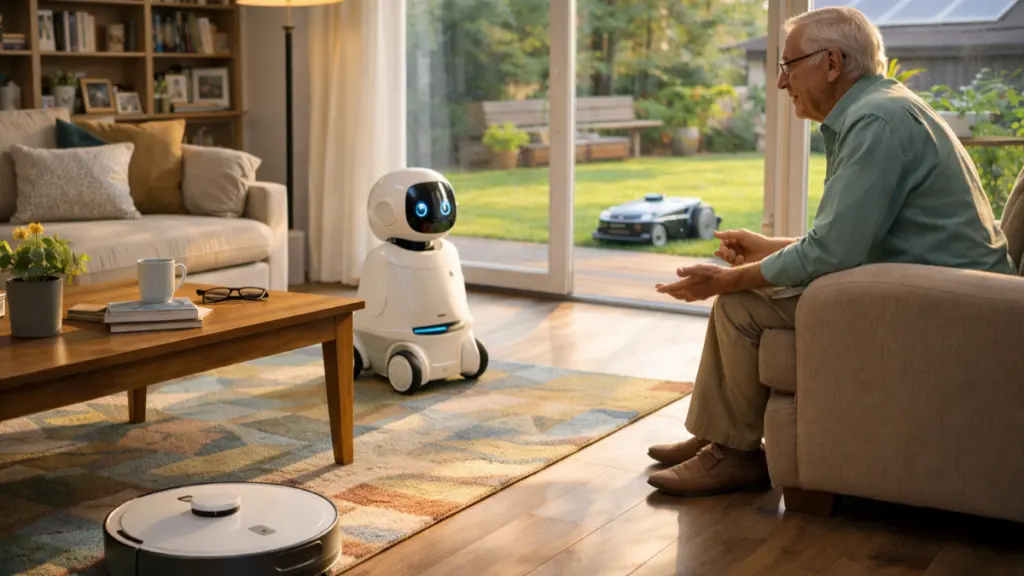
Once robots enter the home, they quickly become part of the family. A University of Guelph study chronicled families who used a reading robot called Luka. Even after children outgrew the device, most families kept it because it had acquired sentimental value; some held retirement ceremonies and repurposed Luka as a night light. Children referred to the robot as a “little brother” or pet, underscoring how easily technology integrates into family narratives. These stories raise questions about end‑of‑life policies for robots. If a device becomes an emotional companion, discarding it like an old appliance may feel inappropriate and create electronic waste. Designers and policymakers will need to consider rituals, recycling programs and perhaps even repair services that honour emotional attachments.
A systems view: connecting gadgets, mobility and ecology
Home robots are not isolated gadgets; they exist within complex systems. Sustainability must consider the gray energy embedded in manufacturing robots and the emissions from the data centers that power them. Mobility intersects when delivery robots and drones share sidewalks and streets, raising questions about urban design and accessibility. Design involves not only industrial aesthetics but also architecture and interior planning; as robots become common, houses will need wide doors, accessible storage and digital infrastructure. Ethics spans privacy, data rights and labour: are robots replacing human caregivers or augmenting them? Who is accountable when a teleoperated robot misbehaves? And how will we protect vulnerable populations from surveillance or malfunction?
Looking ahead: the domestic robotics ecosystem
By mid‑century, a typical home may host a fleet of specialized robots—cleaners, garden tenders, security patrols—alongside one or two humanoid generalists that can fetch, fold and cook. These machines will coordinate through AI platforms, learning from household routines and adapting to personal preferences. Homes will feature robot corridors and charging niches, much as today’s designs include walk‑in closets and media rooms. Owners will subscribe to software updates and maintenance services, akin to internet and utilities.
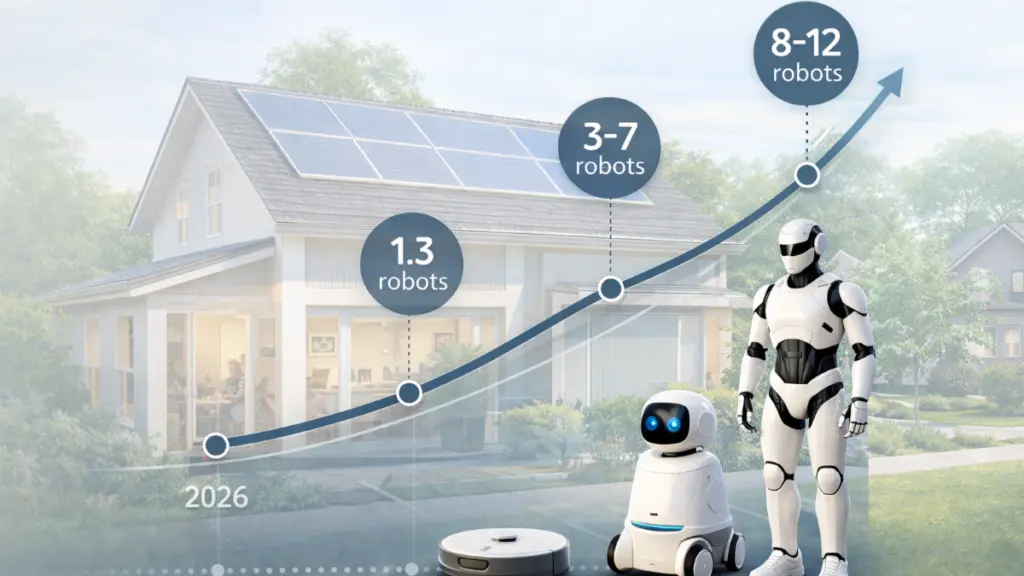
However, the path is neither smooth nor inevitable. Ethical frameworks like DeepMind’s Robot Constitution and teleoperation guidelines must evolve alongside capabilities. Policymakers will need to establish standards for data privacy, product liability and labor displacement. Designers will need to embed sustainability, ensuring that robots are repairable, recyclable and energy efficient. Consumers will need to decide which tasks to automate and which to preserve as human rituals. As UT Austin’s Peter Stone reminds us, acceptance will depend on whether robots fit into our lives without eroding our autonomy or dignity.
Closing thoughts
Home robots evoke both wonder and unease. Watching a machine fold towels and bake croissants at CES, one can imagine a future of leisure and care; reading about the energy footprint of AI or the emotional bonds families form with plastic companions reminds us that technology is never neutral. The next decade will determine whether domestic robots become ubiquitous, sustainable helpers or another layer of digital clutter. As readers of Teknalyze, our role is not just to marvel at innovation but to ask critical questions: Who benefits? Who is left behind? What values do we encode in our machines? The answers will shape not only the gadgets in our kitchens but also the culture of our homes.




Reader perspectives, questions, and reactions.
No comments yet. Start the conversation.
Comments are closed for this article.