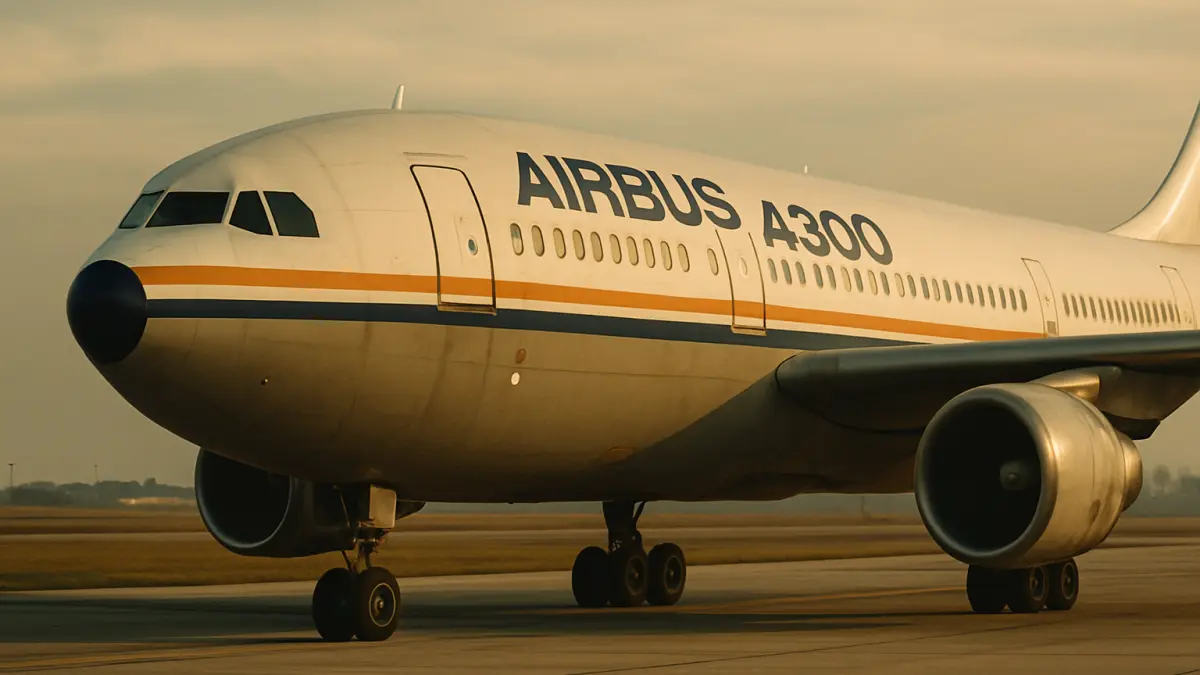

The sky was about to change on May 30, 1974. The Airbus A300 entered service, introducing a new approach to commercial aviation that challenged existing norms and laid groundwork for future aircraft design and airline operations. The Airbus A300 enters service not just as another plane but as a statement of intent from a new player in the aerospace industry.
At the time, the aviation market was dominated by American manufacturers, and airlines were grappling with rising fuel costs and increasing passenger demand. The A300 was the first twin-engine wide-body airliner, a bold design choice that balanced fuel efficiency with passenger capacity. This was not just a new aircraft; it was a solution to the growing economic pressures facing airlines.
The A300’s entry into service was a technical and strategic move. Its twin-engine configuration reduced fuel consumption compared to four-engine wide-bodies, and its wide-body design allowed airlines to carry more passengers per flight. This combination addressed two critical airline challenges: operational cost and capacity. The A300’s design also pushed advances in aerodynamics and materials, influencing aircraft engineering beyond its own model.
What changed because of the A300’s debut was the perception of what was possible in commercial aviation. It demonstrated that European aerospace collaboration could produce competitive, innovative aircraft. Airlines gained a new tool to optimize routes and costs, accelerating the shift toward more fuel-efficient fleets. The A300’s success paved the way for Airbus to become a major player, shaping the competitive landscape of the aviation industry for decades.
Today, the Airbus A300’s legacy is still felt. Its design principles, fuel efficiency, capacity optimization, and innovative engineering, are foundational in modern aircraft development. The A300 helped normalize twin-engine wide-bodies, a concept that underpins many current long-haul aircraft. Its influence extends beyond technology to industry dynamics, proving that innovation can emerge from new entrants challenging established giants.
Reflecting on the A300’s introduction reminds us that technological progress often comes from rethinking existing problems with fresh perspectives. It’s a reminder that efficiency and innovation go hand in hand, and that the future of aviation is shaped by those willing to push boundaries.