

Ten years ago, electric vehicles (EVs) were novelties — interesting but impractical, seen mostly as prototypes or luxury experiments.
Today, they’ve become a defining force in modern transportation, reshaping how we think about performance, energy, and sustainability.
Behind every EV’s minimalist dashboard lies a network of sensors, processors, and circuits working in concert to deliver what feels like magic: instant torque, near-silent motion, and an efficiency internal combustion could never match.
Let’s break down what actually powers that transformation — from drivetrains to software — and what’s coming next as the electric revolution accelerates.
Electric Drivetrains: Power Without Combustion
At the heart of every EV lies its electric drivetrain, a system that converts stored electrical energy into kinetic motion. Unlike internal combustion engines (ICEs), which rely on thousands of precisely timed explosions per minute, electric motors provide continuous torque through electromagnetic force — a far simpler and more elegant process.
How It Works
When current flows through copper windings inside the motor, it generates a magnetic field. This field interacts with permanent magnets (or induced magnetic fields) on the rotor, creating rotational motion. That’s your torque — delivered instantly, without the lag or vibration of gear shifts.
This is why EVs feel so quick off the line. Even a modest electric hatchback can achieve 0–60 mph times rivaling high-end sports cars, not through raw power alone, but through instantaneous torque availability.
Motor Types
- Permanent Magnet Synchronous Motors (PMSM):
Used in most modern EVs (Tesla Model 3, Hyundai Ioniq 6). They’re compact, efficient, and deliver smooth power delivery. - Induction Motors:
Popularized by early Teslas, these eliminate the need for permanent magnets (which use rare-earth metals like neodymium). They’re slightly less efficient but robust and cost-effective. - Switched Reluctance Motors:
An emerging alternative known for high torque density and reduced dependence on rare materials.
Simplified Gearboxes
Unlike ICEs that require multiple gears to stay within a narrow power band, electric motors operate efficiently across a wide RPM range. Most EVs use a single-speed gearbox, dramatically reducing mechanical complexity, weight, and maintenance. Some high-performance models, like the Porsche Taycan, use a two-speed setup to balance acceleration and top speed — but simplicity remains the rule.
The Inverter: EV’s Nervous System
The inverter acts as the brain of the drivetrain, converting the battery’s DC (direct current) into AC (alternating current) for the motor. It continuously adjusts voltage and frequency to control torque and speed, responding to millisecond-level data from throttle, traction, and stability sensors.
Modern inverters use silicon carbide (SiC) semiconductors, which reduce switching losses and improve efficiency by up to 5%. It sounds small, but over a 300-mile drive, that can mean several miles of extra range.
Batteries and Energy Storage: The Heart of an EV
If the motor is the heart of an EV, the battery is its bloodstream — and chemistry is its language.
Lithium-Ion Dominance
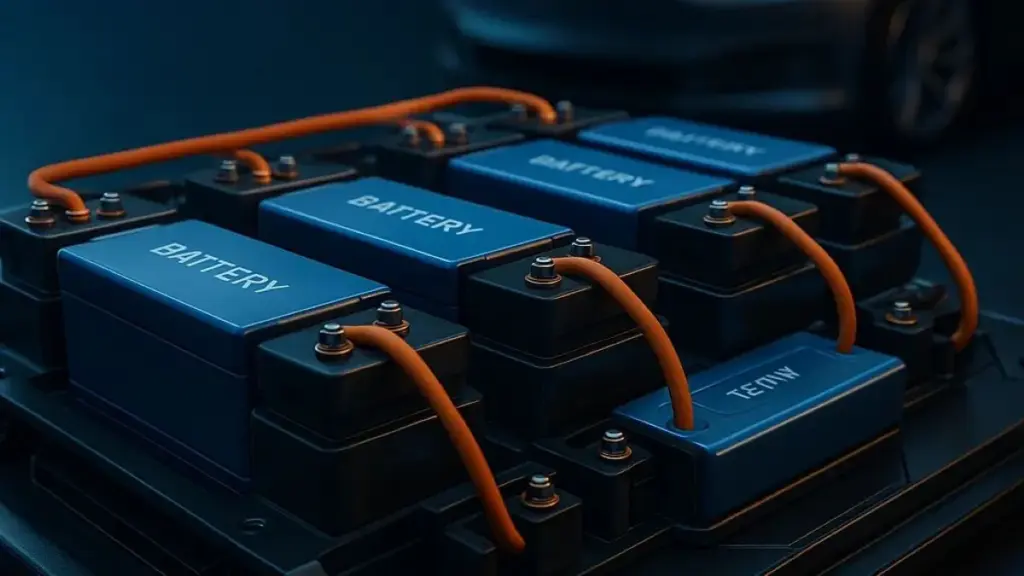
Today’s EVs overwhelmingly rely on lithium-ion batteries, each composed of hundreds or thousands of cells arranged into modules and managed by a Battery Management System (BMS).
Each cell includes:
- Anode: typically graphite
- Cathode: made from materials like nickel-manganese-cobalt (NMC) or lithium-iron-phosphate (LFP)
- Electrolyte: a liquid or gel that allows ions to move between electrodes
When discharging, lithium ions move from the anode to the cathode, generating electric current. Charging reverses the flow.
Battery Management System (BMS)
The BMS is the unsung hero of every EV — a software-defined guardian that monitors temperature, voltage, and charge across all cells. It ensures balanced performance, prevents thermal runaway, and maximizes longevity. Modern systems can even predict cell degradation using AI-based algorithms, allowing manufacturers to adjust charging curves via over-the-air updates.
Chemistries at a Glance
NMC (Nickel-Manganese-Cobalt): High energy density, long range; used in most premium EVs.
LFP (Lithium Iron Phosphate): Cheaper, safer, and longer-lasting; slightly lower range but now common in Teslas and BYD vehicles.
NCA (Nickel-Cobalt-Aluminum): A high-performance chemistry used in early Model S vehicles, balancing power and durability.
Beyond Lithium-Ion: What’s Next
The industry’s next frontier is solid-state batteries — replacing flammable liquid electrolytes with solid ceramics or polymers.
Benefits:
- 2× energy density
- Near-zero fire risk
- Full charge in under 10 minutes
- Lifespan exceeding 1,000 cycles
Toyota, QuantumScape, and Samsung SDI are leading development, with early commercialization expected around 2027–2028.
Charging Infrastructure: The New Fuel Network
Charging is the new refueling — and its ecosystem is expanding faster than any energy infrastructure in history.
Levels of Charging
- Level 1 (120 V):
Standard household outlet; adds 3–5 miles of range per hour. Best for overnight charging. - Level 2 (240 V):
Home and workplace chargers; adds 20–40 miles per hour. Most owners install one at home for convenience. - DC Fast Charging (400–800 V):
High-power stations like Tesla Superchargers or Electrify America. Add 200–300 miles in 30 minutes or less.
Connector Standards
The industry is converging on the CCS (Combined Charging System) and NACS (Tesla’s North American Charging Standard), the latter gaining adoption by Ford, GM, and others. This shift is making EV interoperability seamless — a key step toward mass adoption.
Smart Charging
Modern chargers aren’t just plugs; they’re networked devices. Smart charging allows:
- Load balancing: to prevent grid overload
- Time-of-use optimization: charging when electricity is cheapest
- App-based monitoring: schedule sessions or track costs remotely
Emerging systems use vehicle-to-home (V2H) and vehicle-to-grid (V2G) integration, letting EVs discharge energy during peak hours — effectively turning cars into mobile batteries for homes and utilities.
Regenerative Braking and Efficiency
One of the most elegant engineering achievements in EVs is regenerative braking.
When you lift your foot off the accelerator, the motor switches polarity and acts as a generator, converting the car’s kinetic energy back into electrical energy stored in the battery. This process can recapture up to 30% of energy that would otherwise be lost as heat in traditional brakes.
Driving Experience
“One-pedal driving” — common in cars like the Nissan Leaf or Tesla Model Y — lets drivers decelerate smoothly just by lifting off the accelerator. It’s intuitive, efficient, and extends brake life significantly.
Why EVs Are So Efficient
- Electric motor efficiency: ~85–90% (vs. 20–25% for gasoline engines)
- No idling losses: Power is consumed only when moving.
- Energy recovery: Regenerative braking reuses power.
This efficiency translates directly to lower operating costs — about one-third of what you’d spend fueling a comparable gas car.
Power Electronics and Control Systems
EVs are often described as “computers on wheels,” and nowhere is that truer than in their power electronics.
Inverters, Converters, and Chargers
- Inverter: Converts DC to AC for the motor.
- DC-DC Converter: Steps down high-voltage battery power to 12V for accessories.
- Onboard Charger: Manages AC input from the grid during charging.
All three must operate seamlessly to regulate voltage, current, and frequency in real time. Their reliability defines how smooth — and safe — the EV feels to drive.
Thermal Management
Heat is the enemy of efficiency. Modern EVs employ liquid cooling loops, glycol-based heat exchangers, and even heat pumps that reuse waste heat for cabin warmth. Some vehicles — like Hyundai’s E-GMP platform — share cooling circuits between the battery, inverter, and motor to optimize thermal balance dynamically.
Software-Defined Performance
Perhaps the biggest leap in EV engineering isn’t hardware — it’s software.
Through over-the-air (OTA) updates, manufacturers can now improve efficiency, range, and even acceleration remotely.
Tesla popularized this, but now every major automaker — from Ford to Hyundai to BMW — uses OTA for:
- Range calibration
- Charging optimization
- Stability and traction updates
- Infotainment improvements
Underneath it all, a central Vehicle Control Unit (VCU) orchestrates every subsystem — motor control, braking, safety sensors, and battery management — making the entire vehicle an integrated digital ecosystem.
Future Innovations and the Road Ahead
EV technology isn’t slowing down; it’s accelerating — both literally and figuratively.
Solid-State Batteries
These promise to double range and halve charging times. Their solid electrolytes also eliminate flammability risks, addressing one of the few remaining consumer fears about EVs.
800V Architectures
Vehicles like the Porsche Taycan and Hyundai Ioniq 6 already use 800-volt systems, reducing current flow (and heat) while enabling ultra-fast charging. Future 1,000V systems will push this even further.
AI and Predictive Systems
Next-gen EVs use AI-driven energy management to learn your habits — preconditioning batteries before charging, predicting optimal routes based on elevation and weather, and even balancing grid loads dynamically.
Vehicle-to-Everything (V2X)
Beyond powering homes or grids, EVs will soon communicate directly with infrastructure — syncing with traffic lights, detecting hazards ahead, or coordinating platoons of vehicles for safer highways.
Autonomous and Semi-Autonomous Integration
Electric drivetrains are inherently more compatible with autonomy. Their instant torque control and electrical stability make it easier for onboard AI to handle real-time driving corrections. As self-driving systems advance, EVs provide the most predictable mechanical foundation.
Why This Matters: The Bigger Picture
The transition to electric isn’t just about replacing fuel tanks with batteries — it’s about rethinking transportation as part of a connected energy ecosystem.
An EV can:
- Power your home in a blackout
- Communicate with your utility to stabilize the grid
- Update its own software overnight
- Integrate renewable energy directly through rooftop solar
This convergence of mobility + energy + data is what truly defines the electric age.
Conclusion: A Smarter, Cleaner Future
Electric vehicles are not a passing trend — they’re a technological convergence of decades of research in energy storage, power electronics, and software control. They deliver immediate torque, quiet performance, and the ability to evolve over time.
As the grid decarbonizes, battery chemistries improve, and charging networks proliferate, EVs will become the natural default — not because regulators demand it, but because they’re better machines.
Understanding the technology behind them isn’t just for engineers; it’s for anyone curious about the future of motion. Because once you’ve driven an EV, you realize it’s not just a new kind of car.
It’s a new kind of technology — one that moves us closer to a world where performance, intelligence, and sustainability finally align.




Reader perspectives, questions, and reactions.
No comments yet. Start the conversation.
Comments are closed for this article.