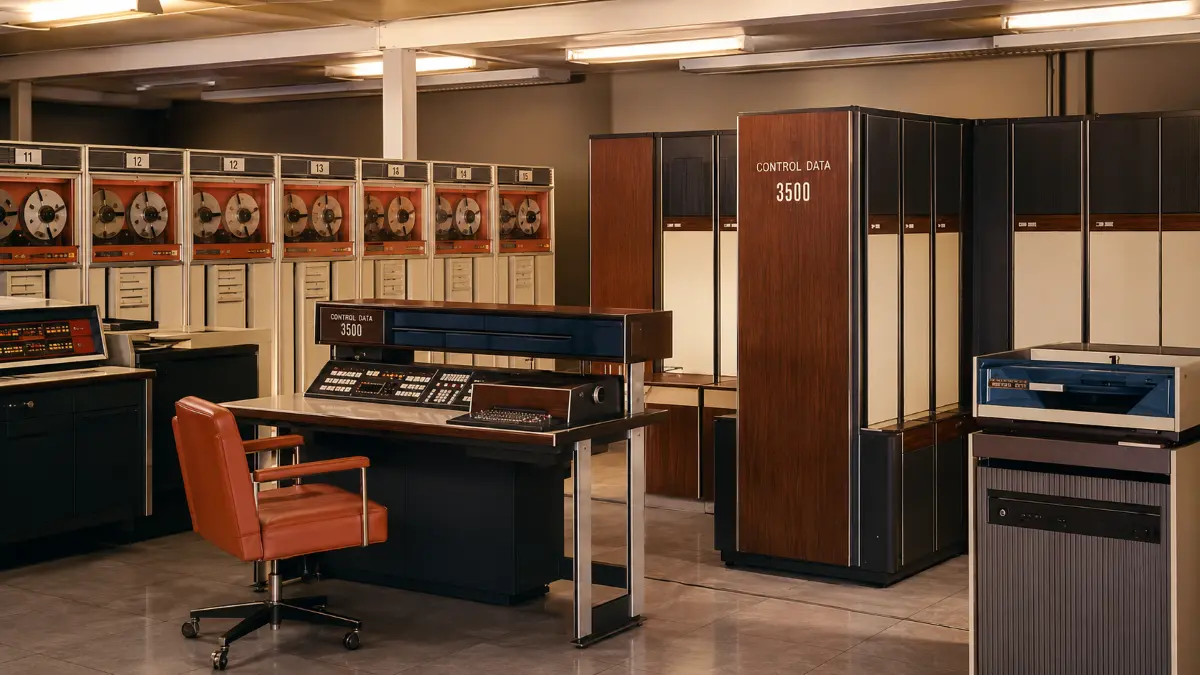

The story of modern supercomputing owes a debt to a company few outside tech circles remember today. On July 8, 1957, Control Data Corporation (CDC) was incorporated, planting a seed that would grow into some of the fastest computing machines of its era. CDC’s journey is not just about hardware but about pushing the boundaries of what computing speed and architecture could achieve in a time when computers were still room-sized curiosities.
Control Data Corporation emerged as a pioneer in supercomputers during a period when digital computing was transitioning from experimental labs to practical industrial tools. CDC’s significance lies in its ambition to build machines that could handle massive calculations faster than anything before. The company’s most notable figure, Seymour Cray, was instrumental in this quest. Throughout the 1960s, Cray developed computers at CDC that set speed records, proving that the limits of computation could be pushed further with innovative design and engineering.
At the time, the challenge was clear: scientific research, aerospace, and government agencies needed computational power that far exceeded what conventional mainframes could deliver. CDC’s machines addressed this by focusing on raw speed and efficiency, leveraging advanced circuitry and architectural innovations. This focus on performance helped CDC carve out a niche where computational speed was paramount, influencing how supercomputers were designed for decades.
The departure of Seymour Cray in 1972 to form Cray Research marked a turning point. While CDC had established the foundation, Cray Research would take the mantle of creating the world’s fastest computers in subsequent years. Still, CDC’s early work laid the groundwork for this evolution. The company’s approach to supercomputing, prioritizing speed through hardware innovation, set a template that others followed. CDC’s legacy is found in the DNA of every high-performance computing system that followed.
Today, Control Data Corporation’s contribution remains relevant because it represents the early phase of a continuous quest for speed and efficiency in computing. Modern supercomputers, cloud data centers, and AI accelerators all trace their lineage back to principles CDC helped pioneer. The company’s focus on pushing hardware limits is echoed in today’s efforts to optimize chip design, parallel processing, and system architecture. CDC’s story is a reminder that breakthroughs often come from dedicated efforts to solve specific technical challenges, in this case, how to crunch numbers faster and more reliably.
Looking back at the incorporation of Control Data Corporation on July 8, 1957, it’s clear that the company’s role was more than just a historical footnote. CDC helped define an era of computing where speed was king, and its influence can still be felt in the relentless drive for performance in today’s technology. The company’s journey underscores the importance of visionary engineering and the impact one organization can have on the trajectory of technology.