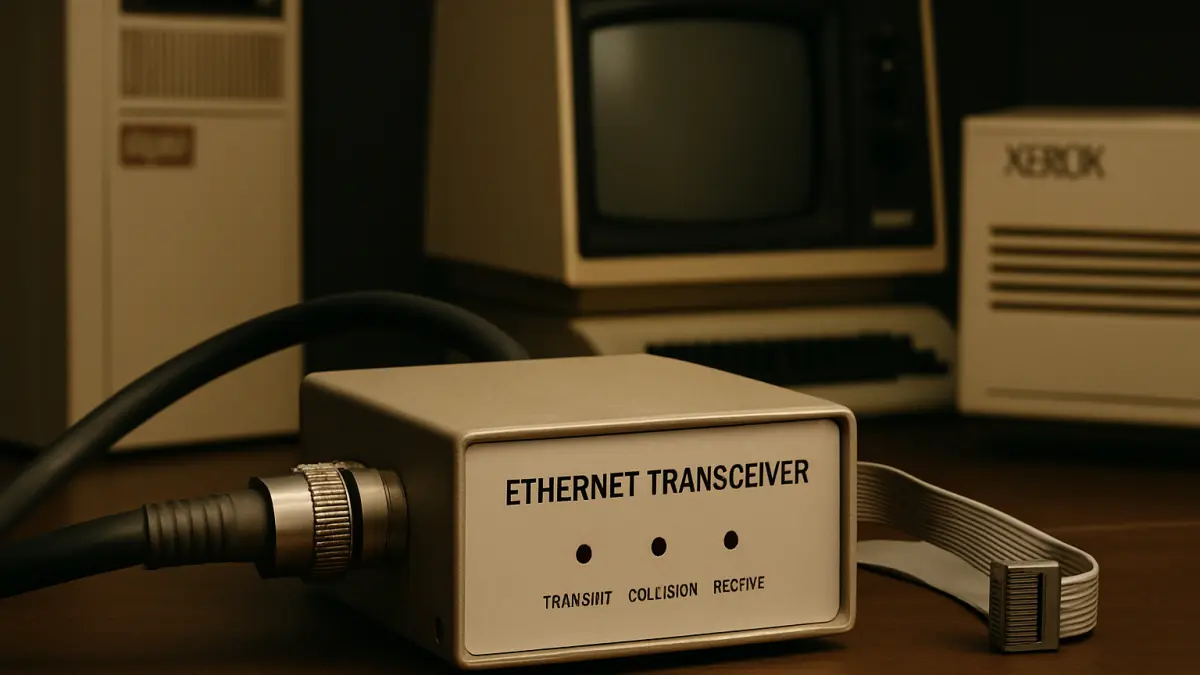

Picture a world where computers couldn’t easily talk to each other. No seamless file sharing, no streaming, no instant communication across devices. That’s the landscape before the Ethernet network specification emerged. On May 13, 1980, Digital Equipment Corporation, Intel, and Xerox jointly announced the Ethernet network specification, a technical blueprint that would become the backbone of modern networking.
At the time, networking was fragmented and proprietary. Different systems used incompatible methods, making it difficult for devices to connect and communicate efficiently. The announcement of the Ethernet network specification introduced a standardized way for computers to link up using a shared communication protocol. This was not just a technical document; it was a new language for machines, enabling them to understand each other’s signals over a network.
Why did this matter then? The Ethernet network specification solved a fundamental problem: how to create a reliable, scalable, and cost-effective local area network (LAN). By defining how data packets were formatted and transmitted over coaxial cables, it allowed multiple devices to share the same communication medium without constant collisions or data loss. This was a breakthrough in network design, making it possible to build networks that could grow with organizational needs.
The impact was immediate and profound. Businesses could now connect their computers into a single network, sharing resources like printers and files without complex, expensive setups. This standardization lowered costs and simplified network management. Over time, Ethernet evolved from coaxial cables to twisted pair and fiber optics, increasing speed and reliability, but the core principles from the original specification remained intact.
Today, Ethernet is the predominant networking standard for both business and home environments. It underpins everything from office intranets to internet connections, supporting speeds from the original 10 Mbps to multi-gigabit and beyond. The specification’s design principles, collision management, packet framing, and media access control—still influence how data moves across networks worldwide.
Why does this still matter? In an era dominated by wireless connections and cloud computing, Ethernet remains the gold standard for stable, high-speed, low-latency networking. It supports critical infrastructure, from data centers to smart homes, ensuring devices communicate reliably and efficiently. The Ethernet network specification laid the foundation for the interconnected world we live in, enabling everything from online collaboration to streaming entertainment.
Reflecting on this event reminds us that the standards we often take for granted are the result of deliberate engineering and collaboration. The Ethernet network specification was more than a technical announcement; it was a commitment to interoperability and scalability that continues to shape digital communication today.