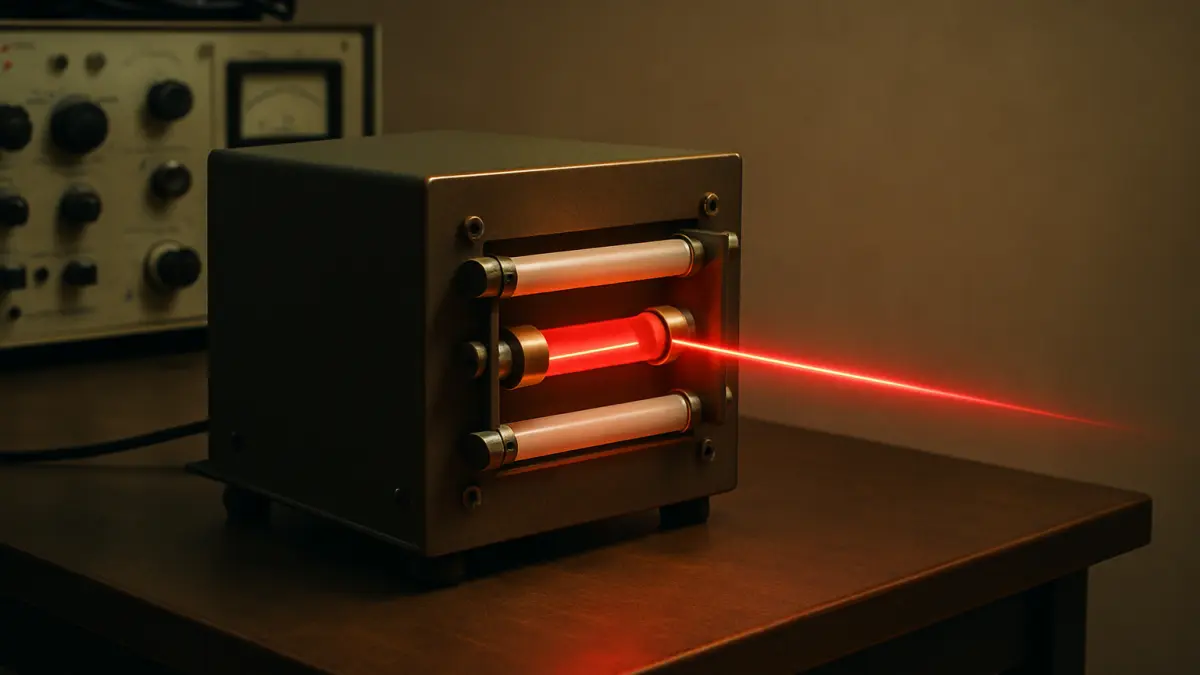

The moment a new kind of light flickered into existence on May 16, 1960, it wasn’t just a scientific curiosity. It was a pulse that would ripple through technology for decades. Physicist Theodore Maiman created the first laser light using a synthetic-ruby crystal device. While he wasn’t the first to theorize lasers or file patents, he was the first to build a working laser device. This wasn’t the narrow, continuous beam we picture today but a pulse of coherent light, a prototype that opened the door to a world of possibilities.
At the time, the significance of Maiman’s laser wasn’t immediately obvious outside specialized circles. The device produced light unlike anything before, highly focused, coherent, and monochromatic. This was a solution to a fundamental problem: how to generate light that could be controlled with unprecedented precision. Before lasers, light sources were broad and diffuse, limiting their usefulness in applications requiring exactness, from measurement to communication.
The creation of the first laser light marked a shift from theory to practice. It proved that the principles underlying laser operation could be harnessed in a tangible device. This breakthrough sparked a wave of innovation. Researchers quickly improved on Maiman’s initial pulse, developing continuous beams and different laser materials. The laser’s ability to deliver intense, focused energy transformed fields ranging from medicine to manufacturing, telecommunications, and scientific research.
What changed because of this first laser light was the very nature of light-based technology. Lasers enabled optical data transmission, precision cutting, and non-invasive surgeries. The coherent pulse Maiman generated was the seed of technologies that now underpin fiber-optic networks, barcode scanners, and even consumer electronics like DVD players. The laser’s precision and control addressed problems that conventional light sources could not, turning light into a tool for exact manipulation rather than just illumination.
Today, the legacy of Maiman’s first laser light is everywhere. The technology remains foundational in quantum computing, lidar systems for autonomous vehicles, and advanced manufacturing techniques. The laser’s evolution from a pulsed ruby crystal to diverse forms like semiconductor and fiber lasers highlights its adaptability and ongoing relevance. It’s a reminder that breakthroughs often begin with a simple proof of concept—a pulse of light that redefined what was possible.
Reflecting on this event reminds us that innovation is often about turning theory into reality. Maiman’s laser wasn’t the first idea, but it was the first working example. That distinction matters because it shifts technology from speculation to application. The first laser light is a testament to the power of experimentation and the enduring impact of creating something tangible that others can build upon.