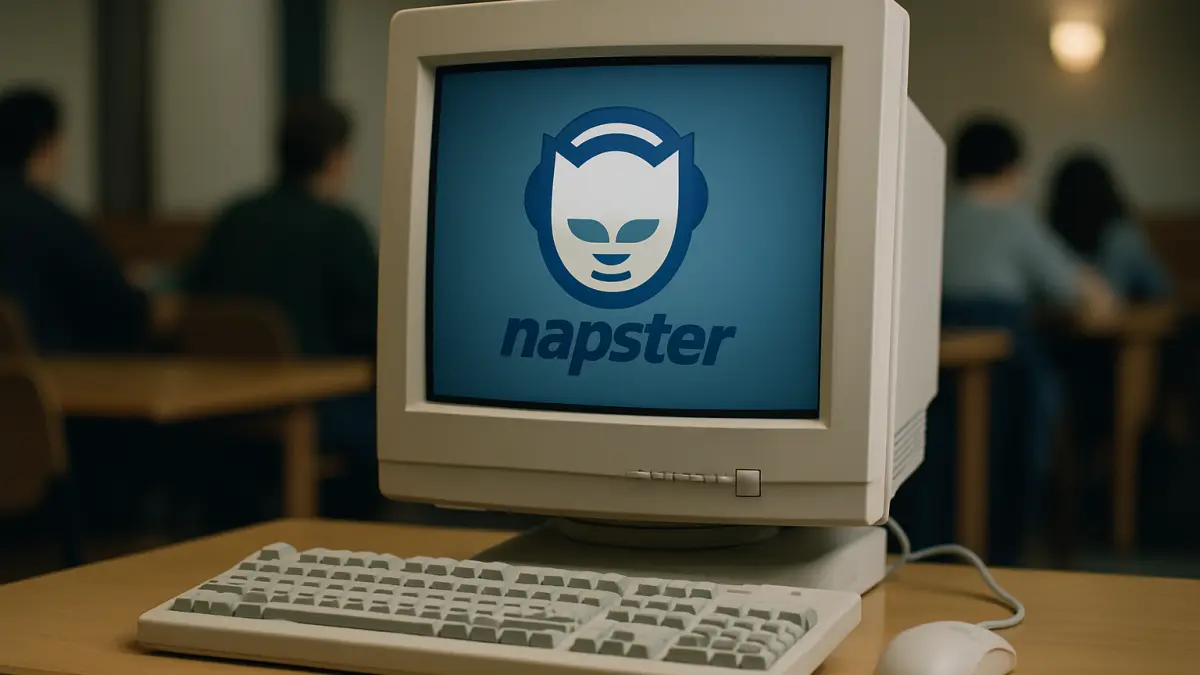

The digital music landscape owes a debt to a moment that felt almost cinematic in its simplicity and impact. On June 1, 1999, Shawn Fanning and Sean Parker released the filesharing service Napster, a platform that would redefine how music moved through the internet.
Napster launch 1999 introduced an unprecedented ease for users to copy and distribute MP3 music files. It wasn’t just a new tool; it was a fundamental shift in the mechanics of music consumption. College campuses quickly became the epicenters of this digital exchange, with students embracing the ability to share vast libraries of music at the click of a button. This was not merely about access, it was about reshaping the relationship between listeners and music.
At the time, Napster solved a problem that had long frustrated digital music enthusiasts: the lack of a straightforward, user-friendly way to share music online. Before Napster, digital music sharing was fragmented and technically complex. Napster’s peer-to-peer model streamlined this process, creating a decentralized network where users could connect directly without relying on central servers to host files. This approach made sharing faster and more scalable, but it also raised immediate legal and ethical questions.
The Recording Industry Association of America (RIAA) wasted no time. By December 7, 1999, just over six months after Napster’s release, the RIAA filed a lawsuit accusing the service of mass copyright infringement. This legal battle underscored the tension between emerging digital technologies and existing copyright frameworks. The lawsuit eventually forced Napster to shut down on September 3, 2002, but the damage, or rather, the transformation, was already done.
Napster’s influence extended far beyond its lifespan. It laid the groundwork for the digital music ecosystem we know today. The concept of freely sharing MP3s challenged traditional music distribution models and pushed the industry toward embracing digital formats and online sales. The service demonstrated the power of peer-to-peer networks and highlighted the need for new legal and business approaches to digital content.
Today, the legacy of Napster launch 1999 is visible in the streaming platforms and digital marketplaces that dominate music consumption. While the industry has moved toward licensed streaming, the user expectations shaped by Napster, instant access, vast libraries, and easy sharing, still drive innovation and competition. Napster also serves as a case study in how technology can outpace regulation, forcing industries to adapt rapidly or risk obsolescence.
Reflecting on this event reveals the complex interplay between technology, law, and culture. Napster wasn’t just a file-sharing tool; it was a catalyst that exposed the cracks in the music industry’s digital readiness. It challenged assumptions about ownership, access, and value in the digital age. More than two decades later, its story remains a critical chapter in understanding how digital technology reshapes creative industries.
Napster’s launch on June 1, 1999, reminds us that innovation often arrives with disruption. It forces us to rethink established systems and adapt to new realities. The echoes of that day still resonate in every playlist streamed and every song downloaded, marking a turning point in the ongoing evolution of music and technology.