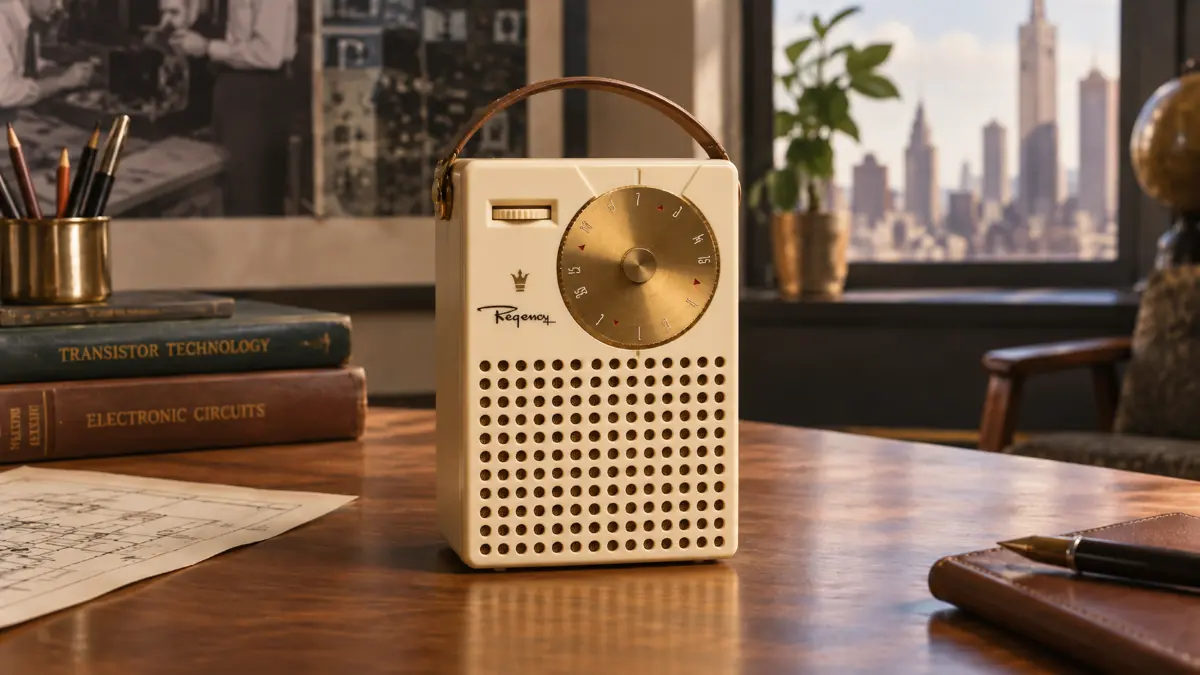

Imagine holding the future of portable sound in the palm of your hand. On November 1, 1954, the Industrial Development Engineering Associates (IDEA) company began selling the Regency TR-1, the world’s first commercial transistor radio. This wasn’t just a new gadget; it was a seismic shift in how people accessed and experienced audio technology.
The TR-1 came to life thanks to Texas Instruments, who designed and developed the transistor technology powering the device. Partnering with IDEA, they transformed a complex semiconductor innovation into a sleek, pocket-sized radio. The TR-1’s launch marked the start of the commercial transistor industry, selling over 100,000 units, a remarkable feat for a product so radically different from the bulky vacuum tube radios that preceded it.
Why did this matter at the time? Vacuum tube radios were heavy, fragile, and power-hungry, limiting portability and convenience. The transistor, a tiny semiconductor device, solved these problems by drastically reducing size and power consumption while improving durability. The TR-1’s release made it clear that radios could be truly portable and affordable, opening up new possibilities for personal entertainment and information access.
The impact was immediate and far-reaching. The TR-1 proved that transistor technology could be commercialized successfully, sparking a wave of innovation in consumer electronics. Radios became more accessible to a broader audience, no longer tethered to a stationary setup. This portability changed listening habits, allowing people to take music, news, and entertainment anywhere. It also set the stage for future portable devices, from walkie-talkies to the first portable TVs and eventually mobile phones.
What changed because of the TR-1 was more than just the radio market. It was a proof of concept for the transistor’s potential in mass-market electronics. The success of the TR-1 accelerated semiconductor research and development, leading to smaller, more efficient chips that power virtually every modern electronic device today. The transistor radio was a stepping stone toward the digital age, enabling the miniaturization and mobility that define current tech trends.
Why does the TR-1 still matter now? It embodies the moment when semiconductor technology transitioned from laboratory curiosity to everyday utility. The principles demonstrated by the TR-1, miniaturization, energy efficiency, and consumer accessibility, are foundational to today’s electronics ecosystem. Understanding this device helps us appreciate how far technology has come and why the transistor remains a cornerstone of innovation.
Reflecting on the TR-1, it’s clear this was more than a product launch. It was the beginning of a new era in electronics, one that prioritized user convenience and portability without sacrificing performance. The TR-1’s legacy is embedded in every smartphone, laptop, and wearable device, reminding us that big changes often start small, sometimes as small as a transistor.