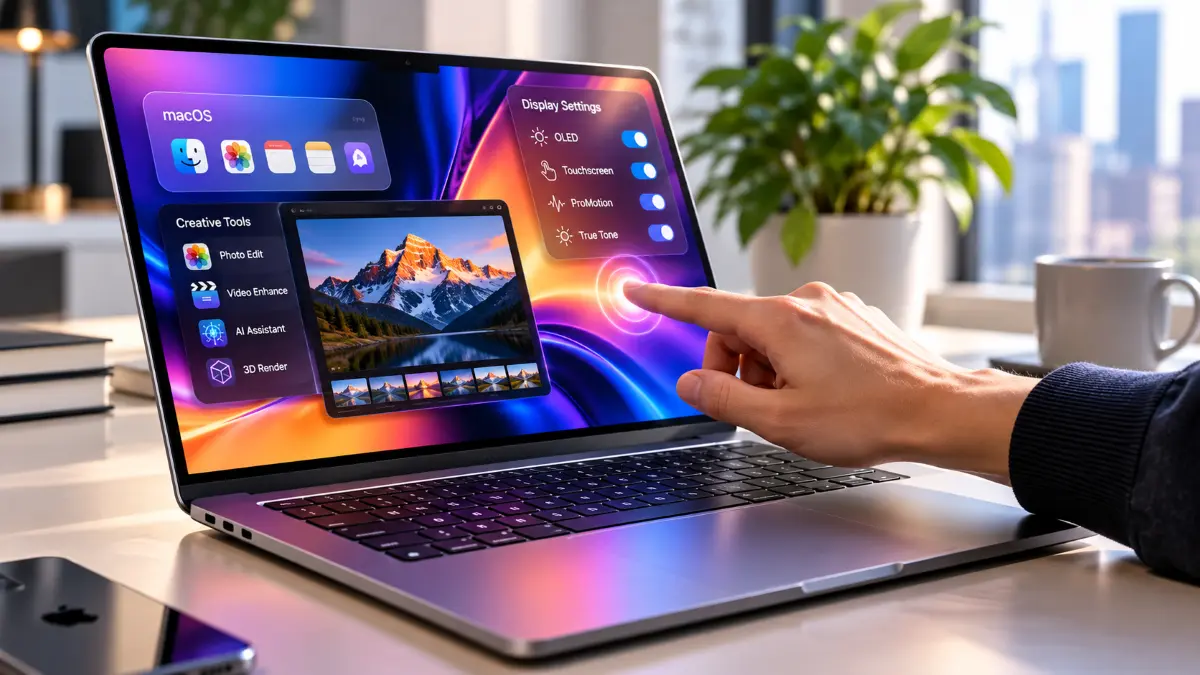

Apple is set to unveil its latest high-end MacBook Pro model today, reportedly branded as the MacBook Ultra. This new iteration introduces a significant design shift with the addition of an OLED touchscreen, marking a notable departure from the traditional MacBook Pro lineup. Alongside the touchscreen, the MacBook Ultra is expected to feature top-tier specifications aimed at professional users demanding the highest performance and display quality.
OLED Touchscreen Integration in MacBook Ultra
The standout feature of the MacBook Ultra is its OLED touchscreen, a first for Apple’s MacBook Pro series. This integration signals a move toward more interactive and versatile input methods beyond the conventional keyboard and trackpad setup. OLED technology offers superior contrast, deeper blacks, and more vibrant colors compared to traditional LCD panels, enhancing both visual fidelity and power efficiency. The touchscreen capability is likely to support multi-touch gestures, enabling more intuitive control and potentially new workflows for creative professionals and power users.
High-End Specifications Targeting Professional Users
Beyond the display, the MacBook Ultra is expected to pack advanced hardware tailored for demanding workloads. While specific details remain under wraps, the new model will likely continue Apple’s trend of leveraging its custom Apple Silicon chips, optimized for performance and energy efficiency. This combination of powerful processing and an OLED touchscreen aims to deliver a seamless experience for tasks such as video editing, 3D rendering, and software development, where both display quality and input flexibility are critical.
How the Touchscreen Changes the MacBook Experience
The addition of a touchscreen on a MacBook Pro raises questions about how Apple will integrate this feature within macOS. Unlike iOS or iPadOS, macOS has traditionally not been optimized for touch input, relying instead on keyboard and trackpad interactions. Apple may introduce new interface elements or gestures to make touch input more natural on the MacBook Ultra, potentially blending touch with existing input methods. This could open new possibilities for app developers to create more interactive and touch-friendly macOS applications, expanding the ecosystem’s versatility.
What Remains Unchanged in the MacBook Ultra
Despite the new touchscreen, the MacBook Ultra is expected to retain the core design language and build quality that define Apple’s MacBook Pro line. The physical keyboard, trackpad, and port selection are likely to remain consistent with previous models, ensuring that users who prefer traditional input methods are not forced to adapt. Additionally, the MacBook Ultra will continue to run macOS, preserving compatibility with the vast library of existing Mac software without requiring developers to overhaul their applications immediately.
Strategic Implications for Apple’s Laptop Lineup
Introducing an OLED touchscreen MacBook Pro under the MacBook Ultra name suggests Apple is positioning this model as a premium flagship distinct from the standard MacBook Pro. This move could be aimed at professionals who seek cutting-edge technology and are willing to invest in enhanced hardware capabilities. By pioneering touchscreen integration on a MacBook, Apple may be testing the waters for broader adoption of touch input across its laptop lineup, potentially influencing future Mac designs and software development priorities.
What to Watch for Next
As the MacBook Ultra launches, attention will focus on how well Apple balances touchscreen functionality with macOS usability. Early reviews and developer feedback will be crucial in assessing whether the touchscreen enhances productivity or introduces complexity. Additionally, the pricing and availability of the MacBook Ultra will indicate how Apple positions this model within its broader Mac ecosystem. Developers and users alike will be watching closely to see if this marks the beginning of a new era for Mac laptops or remains a niche offering for high-end professionals.