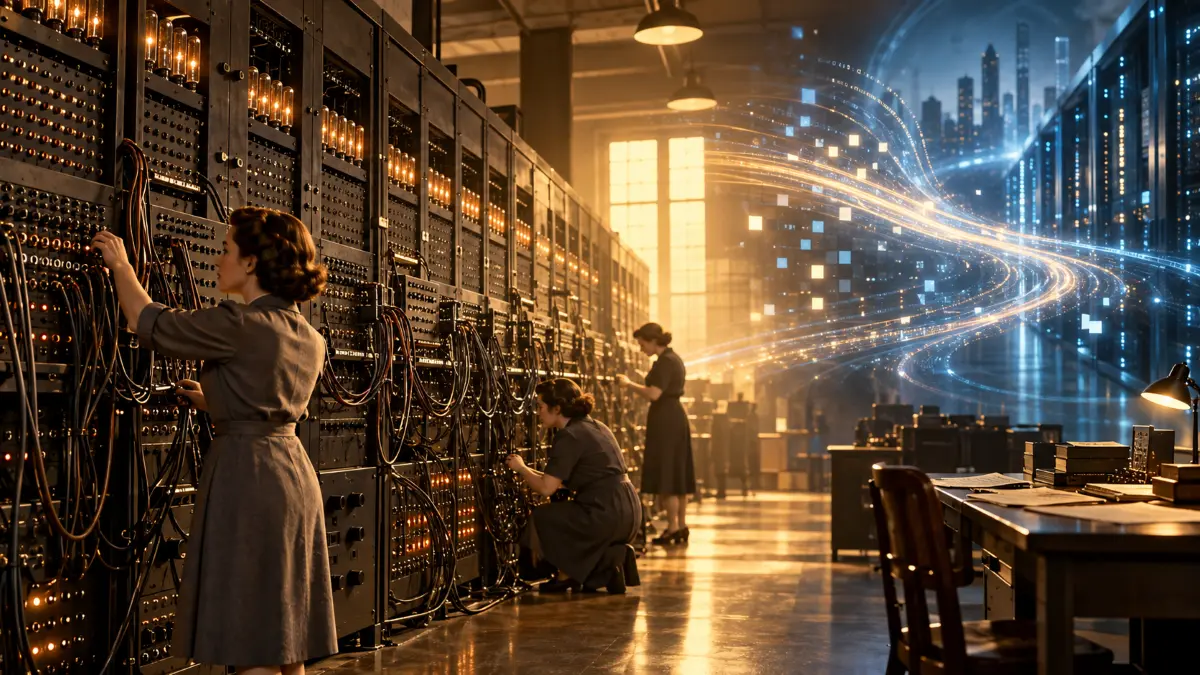
The hum of massive vacuum tubes and blinking lights faded on May 27, 1959, when MIT officially shut down the Whirlwind computer. This was no ordinary shutdown, it marked the conclusion of one of the earliest and most influential real-time digital computers ever built. The Whirlwind wasn’t just a machine; it was a testbed for ideas that still resonate in computing today.
Whirlwind’s shutdown closed a chapter that began in the late 1940s when the project was conceived to address a critical problem: how to process data and respond instantly. At a time when most computers were batch processors, Whirlwind introduced real-time computing, allowing immediate input processing and output generation. This capability was revolutionary for applications requiring rapid decision-making and control, such as military defense systems.
Why did this matter? Whirlwind was the first computer to operate continuously and reliably enough to be used in real-world scenarios. It pioneered core technologies like magnetic core memory, which replaced unreliable and slow vacuum tube memory. This innovation drastically improved speed and stability, setting a new standard for memory design that dominated for decades. The machine’s architecture also influenced the development of interactive computing, moving away from the punch-card era toward more dynamic human-computer interaction.
The shutdown in 1959 didn’t mean Whirlwind’s influence disappeared. On the contrary, it signaled a transition. The lessons learned from Whirlwind’s design and operation fed directly into the creation of the Semi-Automatic Ground Environment (SAGE) system, a massive air defense network. The SAGE system’s success depended on Whirlwind’s real-time processing and reliable memory, proving that Whirlwind was more than a prototype, it was a foundation stone for future computing infrastructure.
Today, the Whirlwind computer shutdown is a reminder of how early computing tackled the challenge of immediacy and reliability. Modern systems, from real-time financial trading platforms to autonomous vehicles, owe a debt to the principles Whirlwind established. Its shutdown marks the end of an experimental phase but underscores the lasting framework it provided for real-time systems.
Reflecting on Whirlwind’s shutdown helps us appreciate the evolution of computing beyond raw power. It was about solving the problem of time, how to make machines that think and react as fast as the world demands. That challenge remains at the heart of today’s technology, proving the Whirlwind’s legacy is still very much alive.