

Opening: a stadium transformed into a digital beehive
Standing on the field at Levi’s Stadium during the week leading up to Super Bowl LX, the scale of the operation feels more like a tech convention than a sporting event. The broadcast compound resembles a mobile data center—banks of trucks lined with 75 miles of cable and staffed by 700–800 crew members who spend days setting up an environment that can be broken down in just two hours. Once inside the bowl, cranes hoist 4K HDR videoboards that are 70 % larger than their predecessors and packed with 300 % more pixels. Giant LED ribbon boards wrap around the deck, while 64 RGB lighting fixtures from Musco can bathe the stadium in any color. It’s an immersive upgrade designed not just for television but for fans in the stands, and it sets the scene for the most technologically ambitious Super Bowl yet.
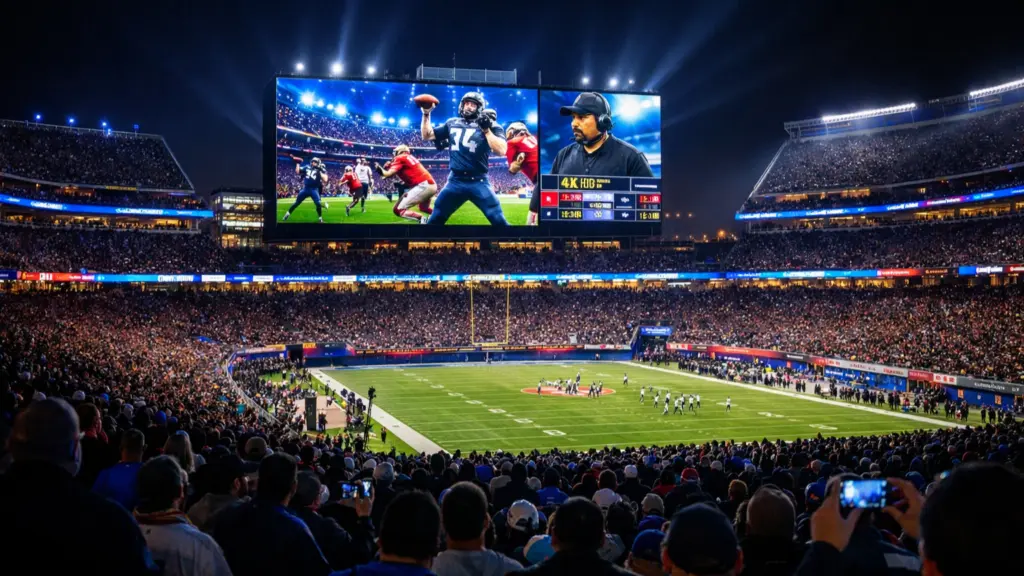
Table of Contents
Behind‑the‑scenes broadcast: a camera ecosystem built by Sony

At the heart of Super Bowl LX’s broadcast lies a massive fleet of more than 175 Sony cameras deployed across the stadium. The inventory reads like a production house’s wish list: 37 HDC‑5500/4300 broadcast cameras, 18 point‑of‑view (POV) cameras, 5 cinema cameras, 2 pan‑tilt‑zoom (PTZ) cameras, 3 aerial/specialty rigs, 11 VENICE 2 digital cinema cameras, 3 BURANO cameras, and even an FR7 remote camera for the halftime show. NBC also integrates Alpha mirrorless bodies such as the α1 II and α9 III, pairing them with high‑speed E‑mount lenses for sideline stills and slow‑motion replays. This array allows producers to capture standard broadcast angles while exploring creative shots: aerial views from cable‑suspended rigs, cinematic shallow‑depth‑of‑field close‑ups of quarterbacks, and high‑frame‑rate footage for ultra‑slow replays.
Sony’s involvement extends beyond cameras. Through its July 2024 partnership with the NFL, the company supplies Hawk‑Eye replay servers, virtual measurement systems, and coaches’ headsets. The headsets, based on Sony’s 1000X series, are ruggedized for the field, provide active noise cancellation, and now serve as the primary communication device for coaching staffs across all 32 teams. On game day they connect with the stadium’s private wireless network to deliver clear, low‑latency audio—critical when making split‑second decisions with tens of millions watching.
How the camera network works
Every camera in the network feeds into a Network Device Interface (NDI) over IP infrastructure. Signals are encoded at high bitrates and routed through a central switch, allowing directors to cut between 4K and 1080p feeds and apply instant replays from multiple angles. VENICE 2 and BURANO cameras bring the cinematic look with shallow depth‑of‑field, while the HDC‑5500 supports high‑frame‑rate capture, enabling 8× slow motion without sacrificing resolution. POV cameras are mounted in pylons, goal posts, and even inside the chains to capture unique perspectives.
The control room sits within Levi’s new ST 2110‑based production facility, which ties together broadcast, in‑venue video boards, and digital signage. Operators can send any camera feed to the big screens, mobile apps, or network broadcast. This unification reduces latency between the live action and on‑screen displays, making replays and graphic overlays appear almost instantaneously for fans in the stadium and those watching from home.
Hawk‑Eye, SkeleTRACK and the end of the chain gang
One of the most significant changes at Super Bowl LX is the use of Hawk‑Eye’s Virtual Measurement system. Instead of bringing a chain crew onto the field to measure first downs, the league now relies on six 8K optical‑tracking cameras mounted on the stadium’s roof. These cameras triangulate the ball’s position within milliseconds and render a virtual line‑to‑gain marker that officials can view on tablets and broadcast can overlay on screen. According to the NFL, the system shaves roughly 40 seconds off each measurement compared to the traditional chain method, improving game flow. The measurements are generated at the Art McNally GameDay Central Officiating Center and transmitted back to the field.

Hawk‑Eye’s technology doesn’t stop there. Its SkeleTRACK player tracking system creates a 3D skeleton of each athlete by monitoring 29 body points and simultaneously tracks the ball’s exact position. When combined with RFID wearables from Zebra Technologies embedded in uniforms and balls, the system produces rich positional data used for Next Gen Stats, officiating, and player health analysis. This synergy enables the league to generate thousands of data points per play and inform not just broadcast graphics but also training and safety initiatives. For example, by analyzing player posture and velocity, the NFL can evaluate the effectiveness of new helmets and rule changes.
Trade‑offs in virtual measurement
Replacing the chain gang with optical tracking introduces engineering trade‑offs. Optical systems require clear sight lines and robust calibration; weather, camera vibrations, or obstructed views can degrade accuracy. To mitigate these risks, the NFL installed redundant cameras and integrated the system into the league’s existing replay booths, ensuring officials can cross‑check measurements before making calls. Critics worry that fans will miss the drama of the chain measurement, but the time savings and consistency argue otherwise. Moreover, optical measurement eliminates human placement errors and offers better integration with broadcast overlays.
Stadium connectivity: Wi‑Fi 7, private 5G and a fiber backbone
For fans, the most visible upgrade may be the ability to share and stream without frustration. Levi’s Stadium and its partners laid miles of fiber optic cable and installed nearly 1,500 Wi‑Fi 7 access points, providing high‑speed connectivity to roughly 65,000 spectators. Cisco engineers built this network to handle 35–40 terabytes of uploads—a staggering increase from the 300 gigabytes of data shared at Super Bowl XLVI in 2012. Matt Swartz of Cisco likens the upgrade to “adding lanes to a highway during rush hour”.

At the same time, Verizon—the Official 5G Network of the NFL—completed nearly 200 individual projects around the Bay Area to expand C‑band and mmWave capacity. The company installed a dedicated C‑band small cell at the ride‑share area to ensure strong service as fans arrive and depart. Verizon’s “offense” deploys 5G Ultra Wideband across the region so fans can share real‑time photos and streams, while its “defense” operates a Network Command Center to monitor traffic and interference 24/7. The network also supports private 5G lanes for coach communications and broadcast production.
Data centers and control rooms
Feeding these networks are multiple data centers. The 49ers operate three facilities: one at their practice site and two at the stadium. The newest was built as part of a $200 million renovation and powers the huge video boards and back‑of‑house systems. The production control room uses IP‑based ST 2110 routing to distribute 4K signals to the videoboards and streamers. By embracing IP video, Levi’s Stadium reduces the need for legacy SDI cabling and simplifies distribution of high‑resolution content to screens throughout the venue.
Engineering trade‑offs in connectivity
High‑density Wi‑Fi requires careful channel planning to avoid interference between 1,500 access points. Engineers tuned transmit power and antenna patterns so devices roam between cells seamlessly. Wi‑Fi 7’s wider channels and multi‑link operation provide redundancy but demand more spectrum. Private 5G solves latency‑sensitive needs but requires dedicated licensed spectrum and network slicing, adding cost. The combination of Wi‑Fi and 5G provides flexibility: fans use Wi‑Fi for bulk uploads, while coaches and production crews rely on private 5G for guaranteed throughput.
Stadium upgrades: video boards, lighting, and audio
The physical stadium also underwent major renovations ahead of the game. Two new 4K HDR videoboards on the north and south ends became the largest in the NFL. Each board is 70 % larger and offers 300 % more pixels than its predecessor, giving fans a detailed view of replays and statistics. An expanded network of LED ribbon boards totaling over 55,000 square feet wraps the seating bowl. The stadium’s lighting system features 64 RGB LED fixtures capable of dynamic color sequences, allowing synchronized light shows during introductions and halftime.
The audio system received additional subwoofers and amplifiers for better bass and clarity. All of this is controlled via the new ST 2110 control room, which can mix broadcast audio, in‑stadium PA, and digital signage into a unified workflow. Fans benefit from a cohesive sensory experience—clearer sound, brighter visuals, and coordinated content across all displays.
Beyond entertainment, the $200 million renovation improved Wi‑Fi and a new Distributed Antenna System (DAS) to support 5G. Additional club suites, revamped concessions with mobile ordering, and updated restrooms offer comfort enhancements. Sustainability upgrades include energy‑efficient lighting and low‑flow plumbing fixtures, continuing Levi’s Stadium’s pursuit of LEED Gold standards.
Cybersecurity: defending the digital stadium
As connectivity increases, so do threats. Recognizing this, the NFL and the San Francisco 49ers created a cyber command center inside Levi’s Stadium. This makeshift operations room houses cybersecurity personnel and monitoring tools to defend against AI‑powered attacks. Costa Kladianos, the 49ers head of technology, noted that AI‑driven threats are a newer concern than previous years. Cisco and other partners secure all stadium networks and communications. The command center monitors network traffic, screens for anomalies, and coordinates with law enforcement if an incident arises.
Accessibility: making the game inclusive for all

Technological advances at Super Bowl LX go beyond the able‑bodied fan. The NFL partnered with OneCourt and Ticketmaster to pilot a tactile device for blind and low‑vision fans. The handheld board presents a raised miniature football field; vibrations indicate the ball’s location, while real‑time audio commentary provides context. The system feeds off the same tracking data used for Next Gen Stats—combining camera‑based and RFID positional information. For roughly ten fans at Levi’s Stadium, this technology turns the game from an abstract radio broadcast into an interactive tactile experience. The pilot highlights how big‑data streams can be repurposed for accessibility, a promising sign for future inclusive features.
Player safety and analytics: AI and advanced helmets
Beyond broadcast and fan experience, technology at Super Bowl LX also helps protect players. The NFL’s Digital Athlete program, developed with Amazon Web Services, aggregates video, positional, and biometric data to model injury risks. Machine‑learning algorithms analyze player posture, exertion, and collision forces to inform rule changes and training regimens. For instance, data from previous seasons led to modifications like the ban on the hip‑drop tackle and adjustments to the kickoff formation.
The league also encourages adoption of next‑generation helmets. The LIGHT Helmets Apache Pro, weighing just 2.5–3 pounds and using 3D‑printed lattice structures, offers high impact absorption and ranks near the top of NFL and Virginia Tech safety ratings. Injury analysis indicates that targeted technological interventions have contributed to a 17 % reduction in concussions since 2023. On Super Bowl Sunday, each team’s equipment manager works with sensor‑laden helmets, digital communications gear, and on‑site AI systems to monitor health in real time.
Engineering trade‑offs: performance versus complexity
Deploying 175 cameras is a logistical feat. Each additional camera increases the richness of coverage but also adds failure points, requires operators, and consumes bandwidth. NBC mitigates these issues by using IP video routing and remote‑production workflows; still, the redundancy increases cost and power consumption. The decision to adopt Hawk‑Eye virtual measurement trades the drama of chain pulls for efficiency and accuracy but depends on complex calibration and redundant sensors. Upgrading connectivity to Wi‑Fi 7 and 5G demands expensive hardware and careful planning to avoid interference, but it enables fan experiences and operations that would be impossible on legacy networks.
There’s also the question of resolution. Many cameras support 4K or 8K capture, but the broadcast still goes out in 1080p or 4K depending on distribution. Shooting in higher resolutions future‑proofs the content and allows for flexible cropping in replay, yet it drives up storage and processing requirements. The stadium’s new data centers and ST 2110 infrastructure are built to handle this overhead, but the investment is significant. Similarly, the energy demands of large 4K boards and RGB lighting are mitigated by high‑efficiency LEDs and sustainable power sources.
Broader implications: data, experience, and the business of football
For fans, the improvements translate to smoother mobile experiences—seamless uploading, streaming, and access to real‑time stats. Levi’s Stadium’s new networks promise living‑room‑quality internet for tens of thousands of devices simultaneously. The 4K videoboards and immersive lighting keep fans engaged during breaks, while the OneCourt tactile device demonstrates how the same tracking data can empower fans with disabilities. For those watching at home, NBC’s cinematic shots and accurate measurement overlays create a polished broadcast that enhances understanding of the game.
Players benefit from better safety monitoring and the ability to review plays on high‑resolution tablets seconds after they occur. Coaches use private 5G headsets and tablets to communicate and adjust strategy in real time, while front offices analyze positional and biometric data to inform training, recovery, and roster decisions. Even advertisers gain: dynamic ribbon boards and targeted in‑app messages enable new revenue streams.
The infrastructure also positions Levi’s Stadium and the Bay Area as a testbed for future mega‑events, including the 2026 FIFA World Cup. Upgraded connectivity and control rooms will support soccer broadcasts and international audiences. The stadium’s sustainability features align with broader industry goals to reduce environmental impact, using efficient lighting and water management. The success of this Super Bowl’s tech deployment could influence how other venues approach upgrades—balancing fan experience, player safety, and operational efficiency against cost and complexity.
Cross‑domain insights: hardware meets software
What makes Super Bowl LX extraordinary is not any single technology but rather the integration of disparate systems. Hardware—cameras, fiber networks, sensors, and helmets—generates torrents of data. Software—video codecs, AI algorithms, and cloud analytics—processes that data into insights. Design—from the architecture of Levi’s Stadium to the layout of the control room—ensures that technologies blend into a cohesive environment. Usage patterns—how fans share content, how coaches call plays, how officials make decisions—drive requirements back into engineering. For example, the 4K boards needed new architectural support; the coach headsets required coordination with frequency planners; the tactile device adapted Next Gen Stats into a haptic interface. Each innovation influences the others, creating a virtuous cycle of feedback and refinement.
Conclusion: technology as the new playbook
Super Bowl LX represents a watershed moment where engineering, data, and design converge to elevate both the game and its surrounding spectacle. As the NFL continues to embrace optical tracking, AI‑powered injury prevention, and multi‑gigabit networks, the line between sports and technology blurs. The decisions made this week—investments in broadcast infrastructure, connectivity, accessibility, and sustainability—will echo into future seasons and other sports. Fans will come to expect stadium Wi‑Fi that rivals home broadband, broadcasts that feel like feature films, and statistics that explain the why behind every play. Coaches and players will lean on digital analytics as heavily as they lean on conditioning. And engineers will keep balancing innovation against complexity to ensure that the spectacle remains both magical and reliable.
What remains constant is the thrill of the game. Technology enhances, augments, and safeguards that thrill; it does not replace it. In that sense, the systems powering Super Bowl LX are not just upgrades but part of a broader shift in how we experience sporting events. They are the invisible plays behind the plays, enabling athletes to perform at their peak and fans—regardless of ability—to feel every moment.
Beyond the wires and code, these investments reflect a commitment to community. Upgraded transit connectivity, sustainable power, and inclusive design benefit Bay Area residents long after confetti settles. The Super Bowl draws the world’s attention to Santa Clara, but the real victory may be how these technologies leave the stadium more capable and connected for concerts, soccer matches, and everyday visitors. In that sense, the 2026 championship offers a blueprint for venues everywhere: technology should serve not just the event, but the people and the place that host it.




Reader perspectives, questions, and reactions.
No comments yet. Start the conversation.
Comments are closed for this article.