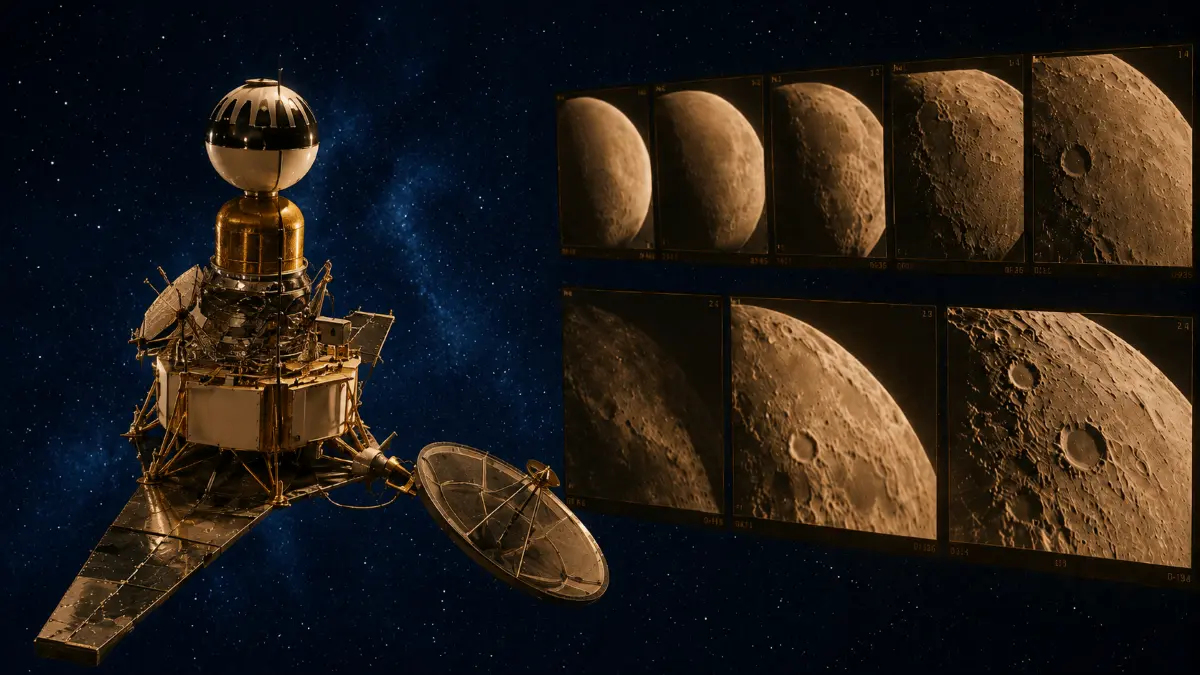

The moon had always been a distant mystery, its surface blurred and grainy through Earth’s telescopes. Then, on July 31, 1964, Ranger 7 sent back the first close-up photographs of the moon, with images 1,000 times clearer than anything ever seen from earth-bound telescopes. This was not just a leap in clarity; it was a seismic shift in how humanity could observe and understand our celestial neighbor.
Ranger 7 was part of the Ranger program, a series of early space probes designed to gather detailed lunar data. The photographs it transmitted were the first to reveal the moon’s surface in unprecedented detail, capturing craters, ridges, and plains with sharpness that transformed scientific understanding. Before this, lunar observation relied heavily on telescopes limited by Earth’s atmosphere, which distorted and blurred images. Ranger 7 bypassed these limitations by sending a spacecraft directly to the moon, equipped with cameras that could transmit high-resolution images back to Earth.
At the time, this breakthrough was critical. The space race was accelerating, and detailed lunar reconnaissance was essential for planning manned missions. The clarity of Ranger 7’s images provided mission planners with reliable data on landing sites, surface conditions, and potential hazards. This was a clear example of how imaging technology could solve a practical problem: how to safely land humans on a foreign body with no prior direct visual data.
The impact of Ranger 7’s photographs rippled beyond lunar exploration. It set a new standard for remote sensing technology, demonstrating the power of sending instruments directly to a target rather than relying on distant observation. This principle underpins modern planetary exploration, Earth observation satellites, and even deep-space telescopes. The mission proved that high-resolution imaging from space could unlock details impossible to see from the ground, opening the door to a new era of scientific discovery.
Today, the legacy of Ranger 7’s lunar photographs still matters. The high-resolution imaging techniques pioneered then have evolved into the sophisticated cameras on current lunar orbiters and rovers. These tools continue to map the moon’s surface with even greater precision, supporting ongoing scientific research and future exploration plans. Moreover, the mission highlighted the importance of data quality in space exploration, influencing how agencies design instruments and prioritize data transmission.
In a broader sense, Ranger 7’s success underscores the value of direct observation in technology development. It’s a reminder that overcoming environmental limitations, like Earth’s atmospheric distortion, requires innovative approaches that bring sensors closer to the source. This principle applies across fields, from medical imaging to autonomous vehicles, where proximity and clarity are crucial.
Looking back, Ranger 7’s photographs were more than just images; they were a technological statement. They showed what was possible when engineering met ambition, and how clarity in data could lead to clarity in understanding. The mission’s crisp lunar images still inspire how we approach exploration and imaging today.