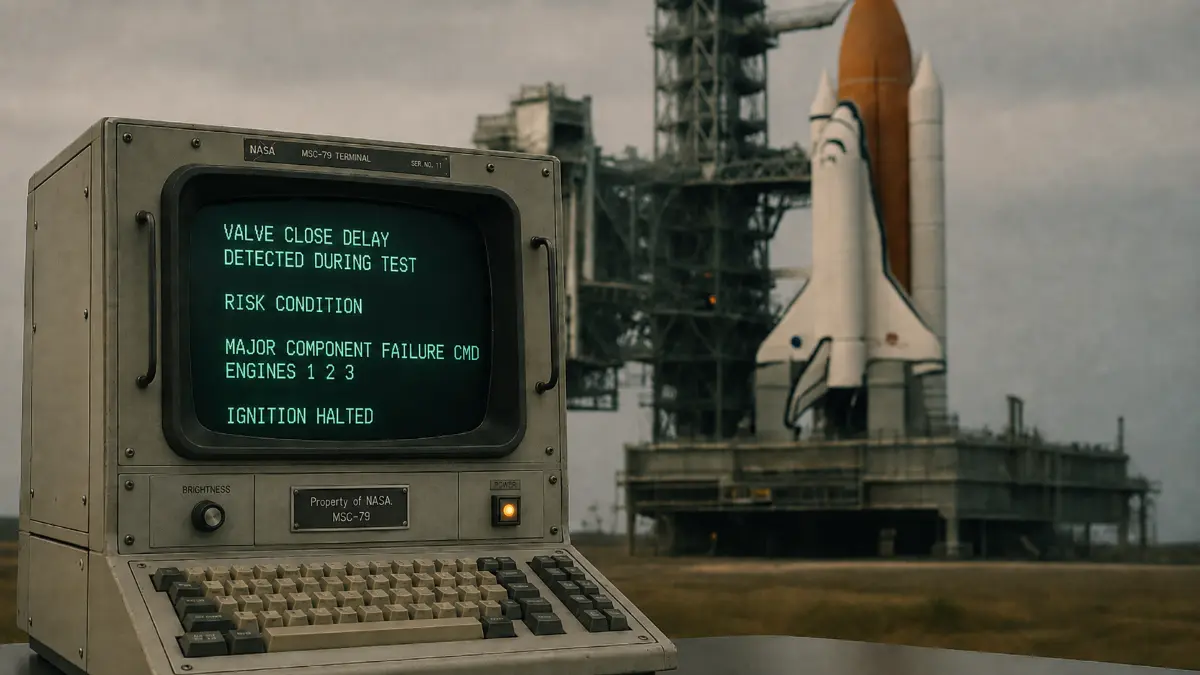

The countdown to a space shuttle launch is a symphony of precision, timing, and technology. On August 4, 1988, just seconds before ignition, a computer stopped the space shuttle Discovery from firing its engines. This wasn’t a glitch or a false alarm. It was a calculated intervention by the shuttle’s computerized controllers that prevented a major failure.
The computer detected that a valve wasn’t closing fast enough during an engine test. Recognizing the risk, it sent a major component failure command to all three engines, effectively halting the ignition sequence. This event was part of NASA’s rigorous safety protocols, especially critical since Discovery’s flight was the first after the Challenger disaster in 1986.
At the time, this moment underscored the growing reliance on automated systems to manage complex aerospace operations. Human reaction times and manual checks simply couldn’t match the speed and precision of a computer monitoring hundreds of parameters in real time. The computer’s ability to make a split-second decision to abort the launch sequence was a clear demonstration of how automation could safeguard human lives and expensive technology.
This wasn’t just about stopping a launch; it was about preventing a catastrophic failure that could have led to loss of life and hardware. The shuttle’s computerized controllers were designed to monitor critical engine components, and their intervention showed how embedded intelligence could act as a final gatekeeper. It solved a fundamental problem: how to ensure that no launch proceeds if even a single critical system is out of spec.
The implications extended far beyond this single test. The event validated the approach of integrating real-time diagnostics and automated safety checks into aerospace systems. It paved the way for more sophisticated onboard computers that could handle increasingly complex scenarios without human input. This shift was essential for the future of space exploration, where missions would become longer, more distant, and less forgiving of human error.
Today, the legacy of that computer stop lives on in the automated safety systems of modern spacecraft and even in commercial aviation. The principle remains the same: real-time monitoring combined with automated intervention can prevent disasters before they happen. As aerospace technology advances toward autonomous spacecraft and crewed missions to Mars, these early lessons in automation and safety protocols are more relevant than ever.
The 1988 incident with Discovery’s engine test is a reminder that behind every successful launch is a network of fail-safes designed to catch the smallest anomaly. It highlights the critical role of computers not just as tools for calculation but as active guardians of mission integrity.
Reflecting on this event, it’s clear that the future of aerospace depends on trusting machines to make instant decisions when stakes are highest. The computer that stopped Discovery wasn’t just halting a launch; it was setting a standard for how technology protects us in the most extreme environments.