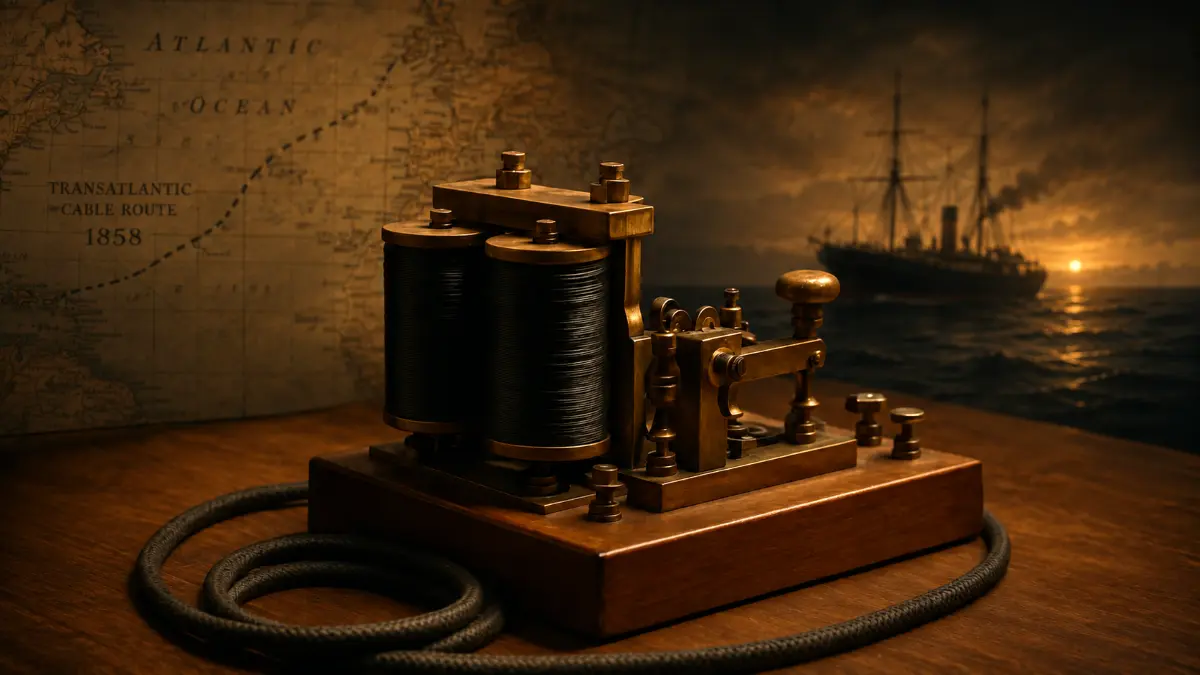

The idea of instant communication across continents once seemed like science fiction. On August 5, 1858, American merchant Cyrus West Field proved otherwise by completing the first successful transatlantic telegraph cable. This cable, laid just two months after construction began, connected Europe and North America with a thin line of copper wire beneath the Atlantic Ocean.
Field’s success came after four failed attempts, each one highlighting the immense technical challenges of underwater telegraphy. The cable itself operated for just over a month before failing, but its brief life was enough to demonstrate that transatlantic communication was feasible. This was not just a technical curiosity; it was a proof of concept that would reshape global communication.
At the time, messages between continents took weeks by ship. The transatlantic telegraph cable promised to shrink that delay to minutes. This was a breakthrough in overcoming the physical barriers of distance and geography. The cable’s completion marked the first time information could flow nearly instantaneously across the ocean, opening new possibilities for diplomacy, commerce, and journalism.
The technical hurdles were enormous. Laying thousands of miles of cable on the ocean floor required innovations in cable insulation, signal transmission, and ship-based cable-laying techniques. Early cables were fragile and prone to failure, and the 1858 cable’s short operational life underscored the need for improvements. Yet the event proved the concept was sound, inspiring further investment and innovation.
Cyrus West Field’s next move was to secure funding for a more durable, permanent cable. That effort culminated in 1866 with a cable that would operate reliably for decades. This laid the foundation for the global telegraph network that would connect continents and eventually evolve into the global communications infrastructure we rely on today.
The 1858 cable’s importance lies in its role as a technological trailblazer. It demonstrated how engineering could conquer natural obstacles to connect distant parts of the world. The event accelerated the development of undersea cable technology, which remains the backbone of international data transmission even in the age of satellites and fiber optics.
Today, undersea cables carry over 95% of international internet traffic, making the 1858 cable a distant but direct ancestor of the digital age’s global connectivity. The principles of signal transmission, cable durability, and oceanic deployment pioneered then still inform modern subsea cable engineering. The event also highlights the interplay between technological ambition and practical execution, success often requires persistence beyond initial failure.
Reflecting on this moment reminds us that the foundations of our connected world were laid by bold efforts to solve complex engineering problems. The first transatlantic telegraph cable was more than a wire in the ocean; it was a leap toward the instantaneous, global communication we now take for granted.