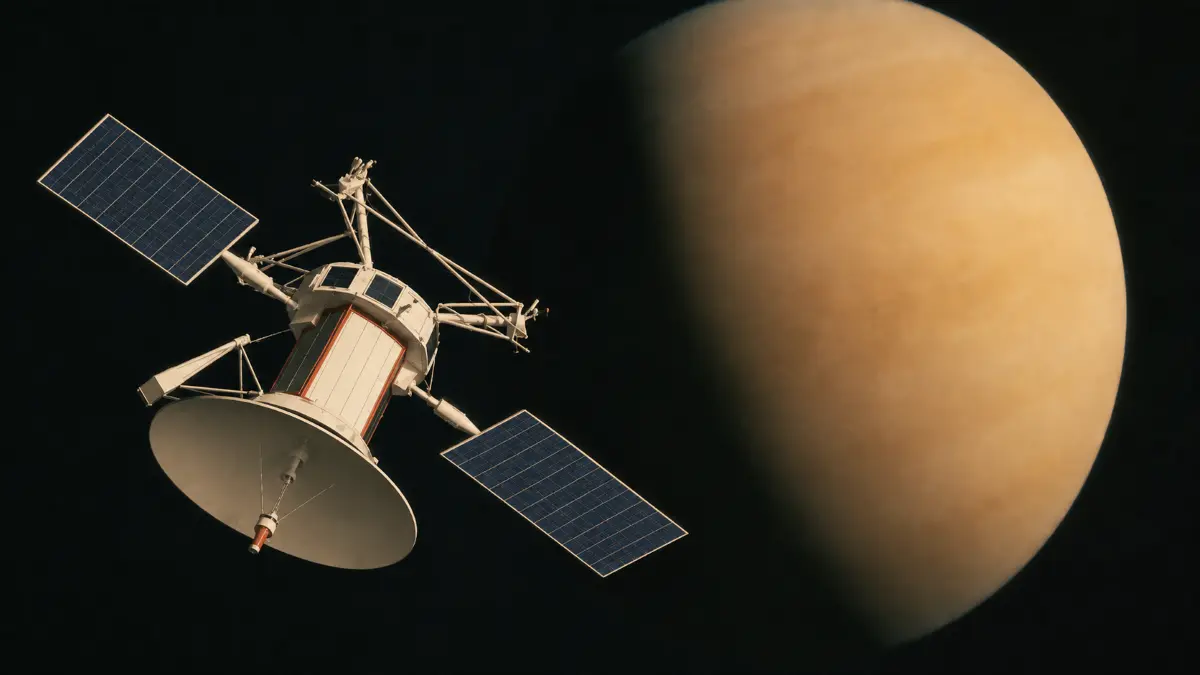

The Magellan space probe reaching Venus on August 10, 1990, marked a turning point in planetary exploration. This mission was not just another spacecraft arriving at a distant world; it was a technological leap that redefined how we map and study planetary surfaces under extreme conditions.
At the time, Venus presented a formidable challenge. Its dense cloud cover rendered optical imaging useless, and its surface conditions, temperatures hot enough to melt lead and crushing atmospheric pressure, made direct exploration nearly impossible. The Magellan space probe’s arrival offered a new way forward. Equipped with synthetic aperture radar, it could pierce through the thick Venusian atmosphere and produce detailed surface maps. This was the first time humanity could see Venus’ terrain with such clarity and precision.
Why did this matter so much in 1990? Before Magellan, our knowledge of Venus was limited to blurry images and rough topographic data. Magellan’s radar mapping revealed vast volcanic plains, towering mountain ranges, and impact craters, reshaping scientific theories about Venusian geology and volcanic activity. It also provided clues about the planet’s atmospheric evolution and its stark contrast with Earth, despite their similar size and composition. This data helped scientists understand why Venus became a runaway greenhouse world, a cautionary tale for climate science.
The impact of Magellan’s mission extended beyond Venus itself. The success of radar mapping from orbit set a new standard for planetary exploration. It demonstrated how radar could overcome atmospheric obstacles, a technique later adopted for other missions targeting planets and moons with thick atmospheres or obscuring dust. Magellan’s data also fueled decades of research, influencing models of planetary formation and tectonics.
Today, the legacy of the Magellan space probe endures. Its high-resolution maps remain some of the most detailed images of Venus’ surface, still serving as a reference point for new missions and studies. As space agencies plan future Venus exploration, including landers and atmospheric probes, Magellan’s pioneering radar technology and the scientific groundwork it laid continue to guide mission design and objectives.
In a broader sense, Magellan’s mission underscores the value of innovative sensing technologies in space exploration. It showed that overcoming environmental barriers requires not just sending spacecraft but equipping them with tools tailored to the unique challenges of each world. This mindset drives current efforts to explore icy moons, gas giants, and exoplanets.
Looking back, the Magellan space probe reaching Venus was more than a milestone in space history. It was a demonstration of how technology can unlock secrets hidden by nature’s toughest conditions. Its success reminds us that every new tool expands the horizon of what’s knowable, pushing the boundaries of exploration ever further.