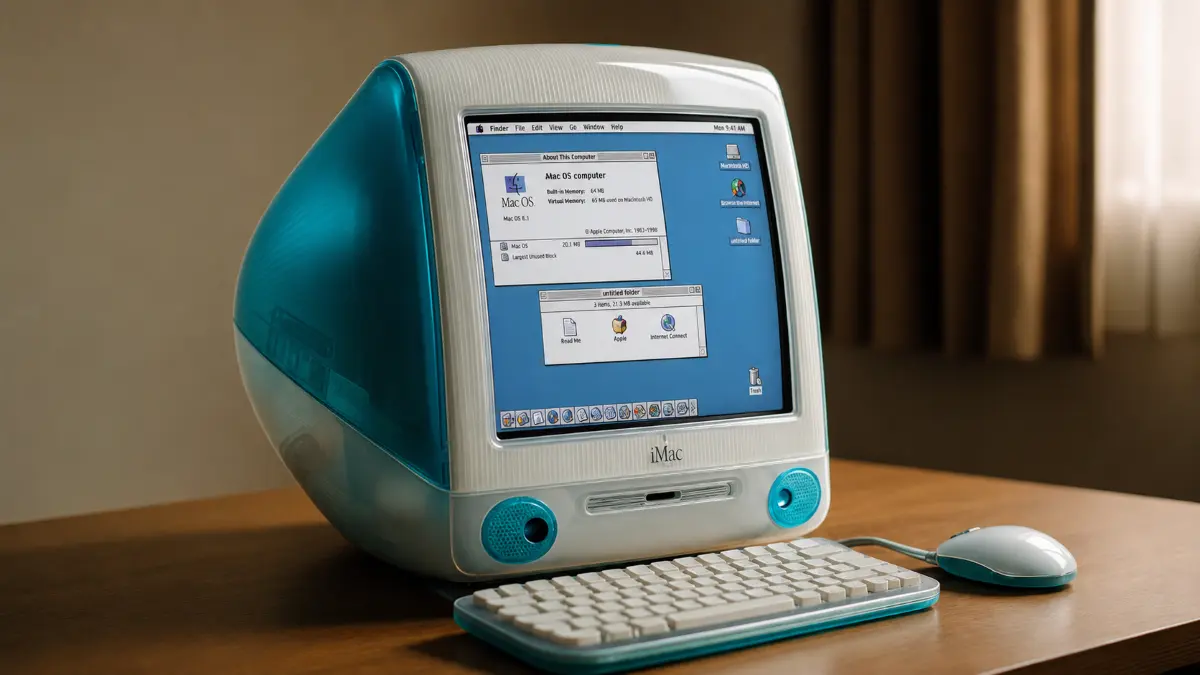

In a world dominated by beige boxes and legacy ports, the iMac G3 arrived like a splash of color and a jolt of modernity. On August 15, 1998, Apple launched the original iMac G3, instantly recognizable by its translucent “Bondi Blue” case. But beyond aesthetics, this machine rewrote the rules of PC design and connectivity.
The iMac G3 was the first commercially successful computer to drop legacy ports and the floppy drive entirely, relying solely on USB for peripheral connections. At the time, this was a bold move that drew criticism. USB was still an emerging standard, and many users and industry insiders doubted its readiness to replace the tried-and-true serial, parallel, and PS/2 ports. The floppy drive, a staple for data transfer and software installation, was also considered indispensable by many.
Yet, Apple’s gamble paid off. By committing to USB, the iMac G3 forced the industry to take the new standard seriously. Peripheral manufacturers began focusing on USB-compatible devices, and PC makers followed suit, accelerating the phase-out of older ports. The iMac’s design eliminated the clutter of multiple connectors, simplifying the user experience and setting a precedent for future computers.
This shift was more than cosmetic or convenience-driven. Legacy ports had limitations in speed, compatibility, and ease of use. USB offered a universal, hot-swappable interface that could support a broad range of devices with a single connector type. The iMac G3’s embrace of USB helped solve the problem of peripheral fragmentation and compatibility headaches that had plagued users for years.
Over time, USB evolved into an indispensable standard, powering everything from keyboards and mice to external storage and audio devices. The iMac G3’s influence extended well beyond Apple’s ecosystem, shaping the design and functionality of Windows PCs and countless peripherals. And as for the beige PC? It quickly became a relic of the past, replaced by machines that prioritized style, simplicity, and forward-looking technology.
Today, the iMac G3’s legacy lives on in the universal connectivity standards we take for granted. USB’s dominance is a direct result of Apple’s willingness to discard legacy baggage and push a new standard into the mainstream. The iMac G3 wasn’t just a colorful computer; it was a catalyst for a cleaner, more efficient, and more user-friendly approach to device connectivity.
Looking back, the iMac G3’s release on August 15, 1998, reminds us that innovation often requires shedding old habits and taking risks on emerging technologies. It’s a lesson that still resonates in today’s tech landscape, where the balance between legacy support and future-proofing remains a critical design challenge.