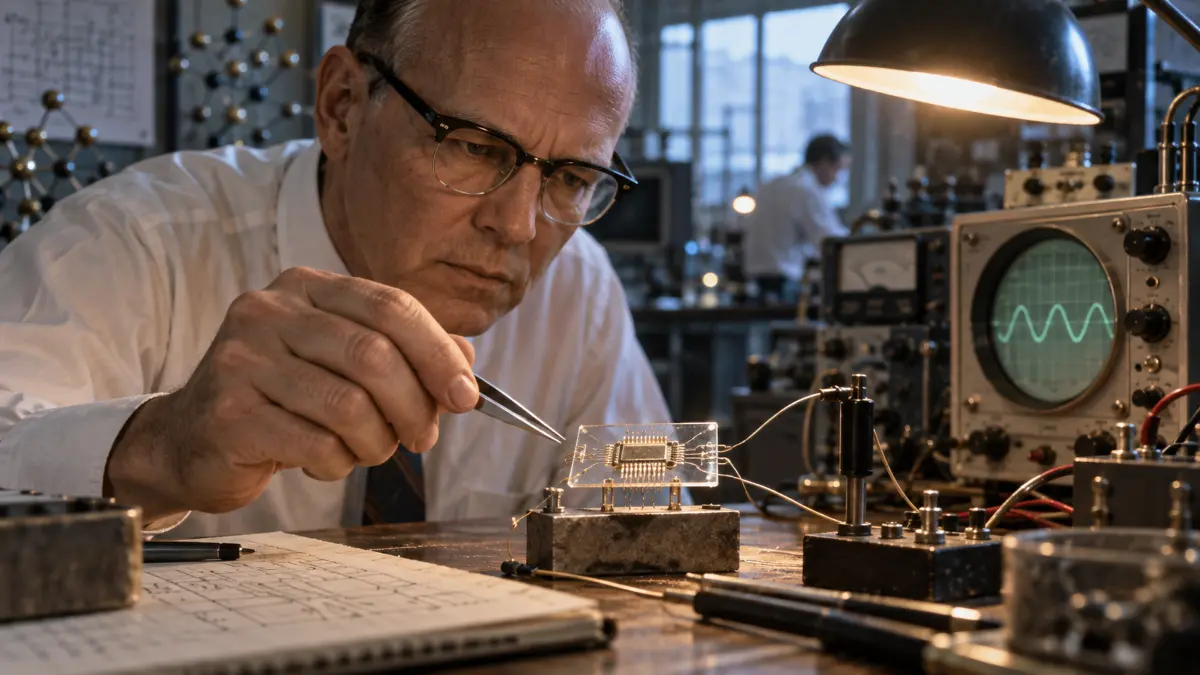

The future of electronics was quietly born in a Texas Instruments lab on September 12, 1958. Jack Kilby demonstrated the first working integrated circuit, a compact, reliable solution that would soon become the backbone of all digital technology. This was not just a new gadget; it was a fundamental shift in how circuits were designed and built.
Before Kilby’s demonstration, electronic devices relied on bulky assemblies of individual components wired together. This approach was not only inefficient but also prone to failure and limited in scalability. Kilby’s integrated circuit combined multiple electronic components, transistors, resistors, and capacitors, onto a single piece of semiconductor material. This innovation addressed the critical problem of miniaturization and reliability, enabling far more complex and powerful devices.
At the time, the integrated circuit was a radical departure from traditional circuit design. It solved a pressing challenge: how to keep pace with the growing demand for smaller, faster, and more energy-efficient electronics. Kilby’s prototype showed that it was possible to integrate all necessary components into one chip, dramatically reducing size and cost while improving performance.
The impact of this demonstration rippled through the tech world. It paved the way for the microelectronics industry, leading to the development of microprocessors, memory chips, and eventually the entire digital revolution. Without Kilby’s integrated circuit, the explosion of personal computing, mobile devices, and the internet would have been impossible.
Today, the integrated circuit remains the foundation of nearly all modern electronics. From smartphones to satellites, from medical devices to automotive systems, integrated circuits enable the complex functions we take for granted. Kilby’s work continues to influence chip design, manufacturing processes, and the relentless push toward more powerful and efficient computing.
Reflecting on that September day in 1958, Kilby’s integrated circuit demonstration was more than a technical milestone. It was a blueprint for innovation, showing how rethinking the basics can unlock new horizons. The integrated circuit didn’t just solve a problem; it opened a door to the digital age.