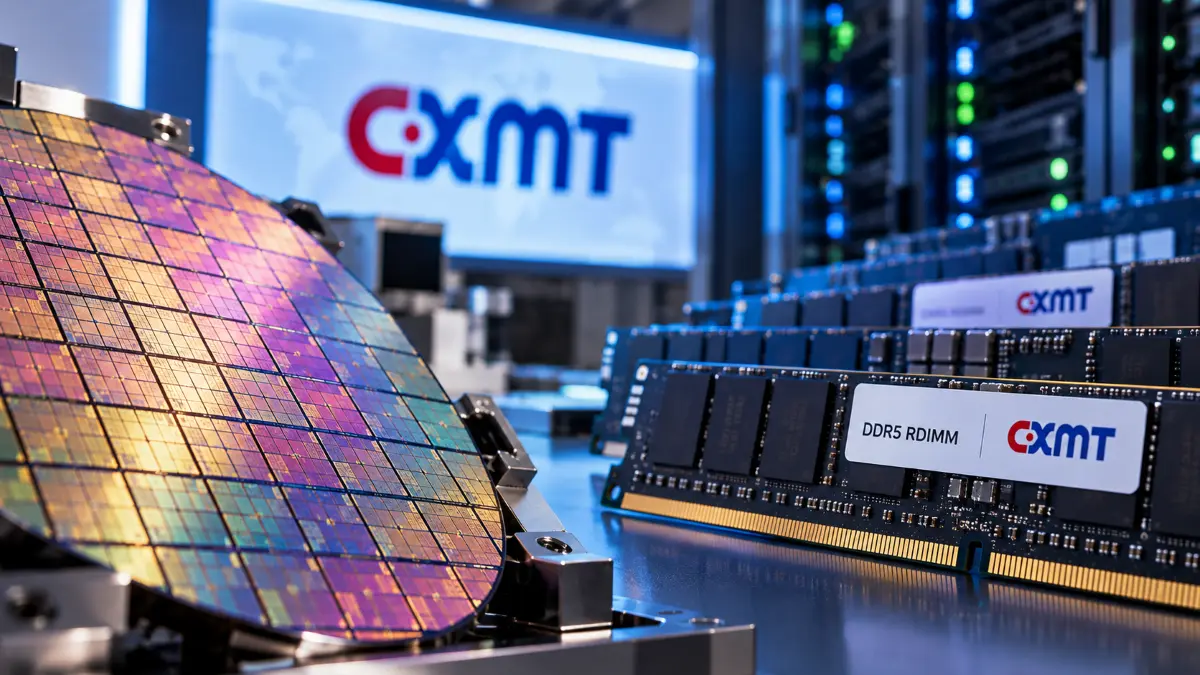

ChangXin Memory Technologies (CXMT), a prominent Chinese memory chipmaker, has announced significant progress in its development of 4F² DRAM technology. At the Integrated Circuits and Chiplet Conference in Shanghai on October 10, 2026, CXMT President Cao Kanyu revealed plans to introduce next-generation DDR5 Registered Dual In-line Memory Modules (RDIMMs) for servers by the end of this year.
Understanding 4F² DRAM Architecture
The term “4F²” refers to the area occupied by each memory cell, with “F” representing the minimum feature size in semiconductor manufacturing. Traditionally, DRAM cells are designed using a 6F² architecture, meaning each cell occupies six times the square of the minimum feature size. By reducing this to 4F², CXMT aims to decrease the cell area by approximately one-third, potentially increasing memory density within the same physical space.
Achieving this reduction involves employing vertical surrounding-gate transistors, which address issues like leakage and short-channel effects. Additionally, CXMT is exploring hybrid bonding techniques to optimize the integration of memory cells and peripheral logic, further enhancing performance and efficiency.
Implications for Server Memory
The transition to 4F² DRAM architecture is particularly significant for server memory modules. Servers require high-density, reliable memory solutions to handle demanding workloads such as data analytics, artificial intelligence, and large-scale virtualization. By increasing memory density, CXMT’s 4F² DRAM could enable servers to accommodate more memory within the same physical footprint, potentially improving performance and reducing latency.
However, the successful deployment of this technology in server environments depends on several factors beyond theoretical density improvements. Server memory modules must undergo rigorous testing to ensure compatibility with various processors and motherboards, as well as to meet reliability standards for continuous operation. CXMT’s planned DDR5 RDIMMs will need to demonstrate stability and performance under these demanding conditions to gain acceptance in the server market.
Competitive Landscape
CXMT’s announcement places it in direct competition with established memory manufacturers like Samsung and SK hynix, both of which are also developing 4F² DRAM technologies. Samsung, for instance, has been focusing on high-bandwidth memory solutions for AI and data center applications, while SK hynix has been enhancing its DRAM offerings to meet the growing demands of enterprise customers. CXMT’s entry into this space could intensify competition, potentially leading to faster innovation and more diverse product offerings in the server memory market.
What to Watch Next
As CXMT progresses with its 4F² DRAM development, industry observers should monitor several key aspects:
- Product Specifications: Details regarding the performance metrics, capacities, and speeds of the upcoming DDR5 RDIMMs will be crucial in assessing their competitiveness.
- Manufacturing Yields: The efficiency and scalability of CXMT's manufacturing processes will impact the availability and cost-effectiveness of the new memory modules.
- Market Adoption: The willingness of server manufacturers and data centers to integrate CXMT's products will depend on factors such as reliability, performance, and cost.
- Regulatory Approvals: Compliance with international standards and certifications will be necessary for CXMT's products to gain widespread acceptance in global markets.
In conclusion, CXMT’s advancement in 4F² DRAM technology represents a significant development in the memory industry, with the potential to influence server memory solutions. While the theoretical benefits are promising, the practical implementation and market reception will determine the impact of this innovation.