
Hewlett Packard Enterprise (HPE) is set to make history by deploying its Spaceborne Computer-4 (SBC-4) to the Moon’s south pole, marking the first high-performance computing (HPC) benchmarks conducted on the lunar surface. This mission, scheduled for late 2026, aims to test the viability of advanced computing technologies in the harsh lunar environment, paving the way for future lunar exploration and the development of a sustainable lunar economy.
Mission Overview
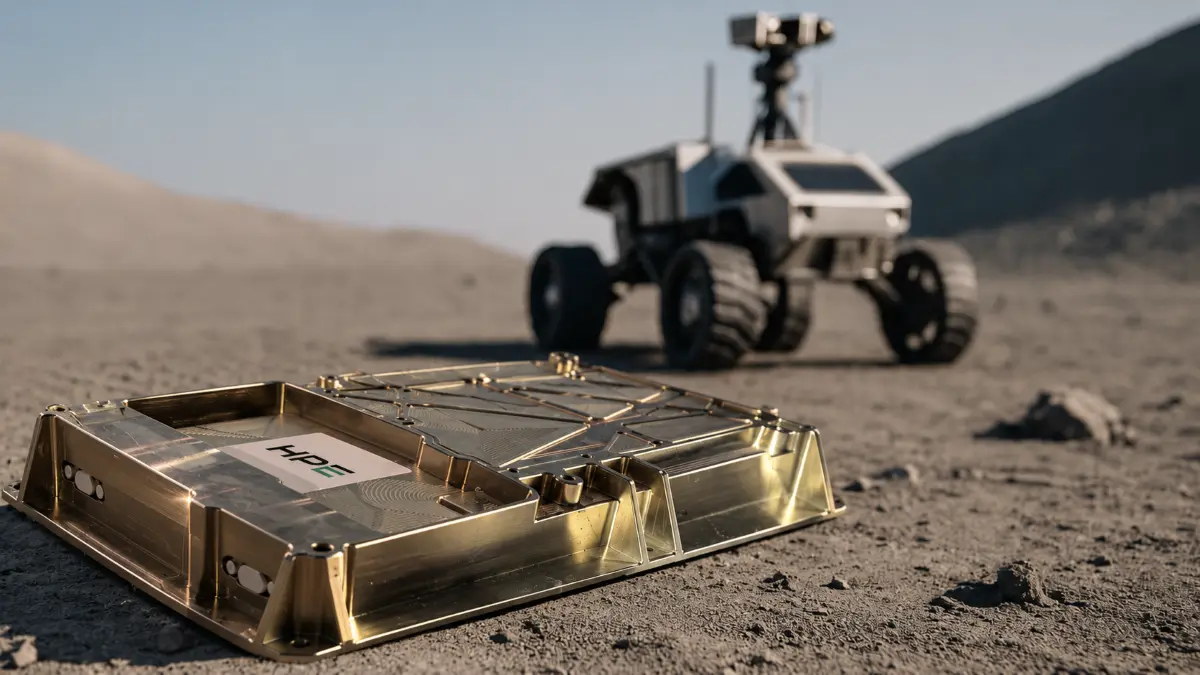
The SBC-4 will be integrated into Astrolab’s Flexible Logistics and Exploration (FLIP) rover, which is part of NASA’s Commercial Lunar Payload Services (CLPS) initiative. The mission is slated to launch aboard Voyager Technologies’ Griffin-1 lander, targeting a landing near the lunar south pole. Once on the lunar surface, the FLIP rover will deploy the SBC-4 to perform a series of AI and HPC tasks, including:
- Running High Performance LINPACK (HPL) and High Performance Conjugate Gradient (HPCG) benchmarks to assess computational capabilities.
- Processing large language models (LLMs) for insights and visual data analysis.
- Conducting LiDAR data processing for mapping, navigation, and terrain analysis.
- Deploying an AI services container to demonstrate scalable AI applications at the lunar edge.
These experiments aim to evaluate the performance and reliability of advanced computing systems in the lunar environment, providing valuable data for future missions.
Technical Specifications
The SBC-4 is a compact, fanless compute module designed specifically for space applications. It features a low-power 64-bit CPU, GPU, and Kioxia solid-state storage, all housed in a lightweight, self-contained chassis. The system utilizes a space radiator for cooling, as traditional fans are impractical in the vacuum of space. Its design ensures durability against the extreme thermal fluctuations and radiation present on the lunar surface.
Collaboration and Objectives
This mission represents a collaboration between HPE, Astrolab, NASA, and Deloitte. NASA’s Federated Learning for Unbounded and Intelligent Decentralization (FLUID) experiment will coordinate three AI models trained on data from Earth, the Moon, and the International Space Station. Additionally, Deloitte’s Silent Shield system will provide near real-time predictive cyber-analytics and anomaly detection. These collaborative efforts aim to demonstrate the feasibility of autonomous lunar operations and the potential for edge computing in space exploration.
Implications for Future Lunar Missions
The successful deployment and operation of SBC-4 on the Moon could revolutionize lunar exploration by enabling real-time data processing and decision-making on the lunar surface. This capability would reduce the dependency on Earth-based communication, allowing for more autonomous and efficient missions. Furthermore, the data gathered from this mission will inform the development of infrastructure for a sustainable lunar economy, supporting activities such as mining, construction, and scientific research.
What to Watch Next
As the mission approaches, attention will be focused on the integration and testing phases of the SBC-4 and the FLIP rover. Key milestones include the successful launch, lunar landing, and the commencement of benchmark tests. The performance data collected will be critical in assessing the viability of deploying advanced computing systems in extraterrestrial environments and will have broader implications for future space missions.
In summary, HPE’s Spaceborne Computer-4 mission represents a significant step forward in space computing, with the potential to transform lunar exploration and establish a foundation for future endeavors in the lunar economy.