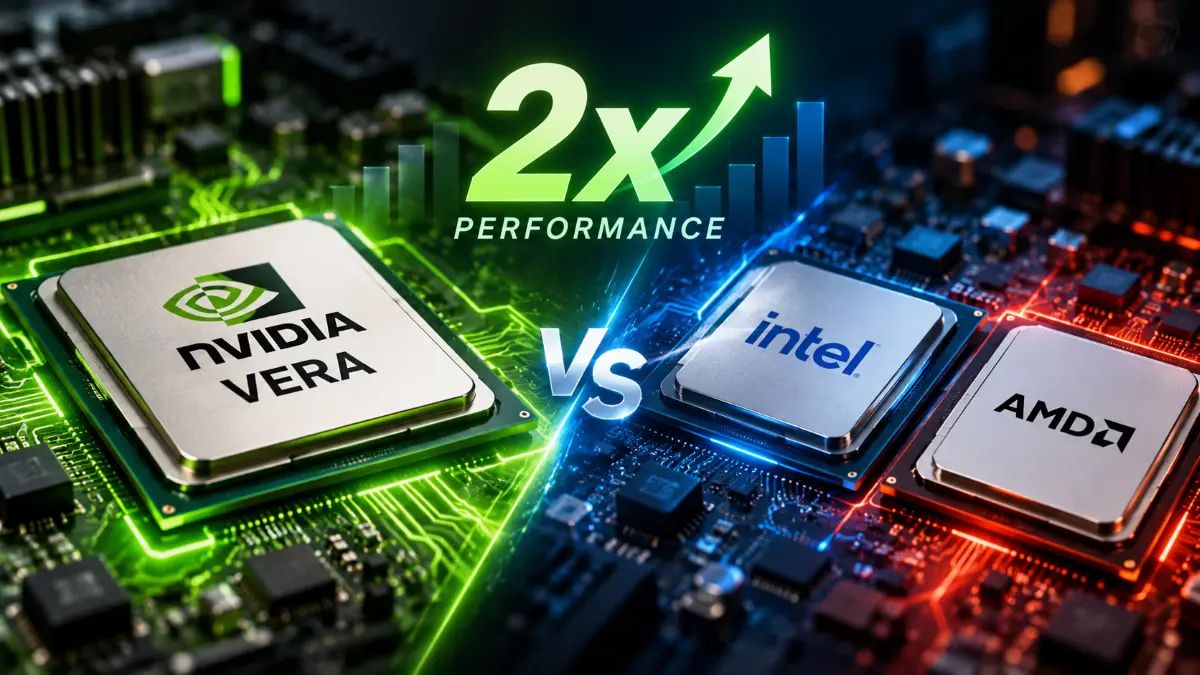

Modal, a leading AI infrastructure provider, has announced the integration of Nvidia’s Vera CPU into its systems, following internal tests that demonstrated up to twice the throughput of comparable Intel and AMD processors. This strategic move underscores a growing trend in AI workloads that demand high single-threaded performance and efficient memory handling.
Modal’s Shift to Nvidia’s Vera CPU
In early tests, Modal observed that Nvidia’s Vera CPU significantly outperformed existing x86 hardware in handling long-running AI agents. These agents, which require substantial orchestration and tool management, benefit from Vera’s architecture optimized for such tasks. Modal’s CEO, Erik Bernhardsson, indicated plans to operate a mixed fleet, utilizing Vera alongside existing Intel and AMD CPUs, and assigning workloads to the processor best suited for each task.
Technical Advantages of Nvidia’s Vera CPU
Nvidia’s Vera CPU is engineered to excel in agentic AI workloads, emphasizing high single-threaded performance and substantial memory bandwidth. The custom Olympus cores deliver a 10-wide instruction frontend and a neural branch predictor, facilitating efficient processing of complex AI tasks. Additionally, the LPDDR5X memory subsystem provides 1.2 TB/s of memory bandwidth, supporting the rapid data access needs of AI applications.
Comparative Performance Benchmarks
Independent benchmarks have highlighted Vera’s competitive edge. For instance, Phoronix’s tests revealed that Vera achieved up to 1.5 times the performance of a latest-generation 128-core x86 chip in agentic AI workloads. This performance boost is attributed to Vera’s architectural design, which prioritizes the specific demands of AI agent tasks.
Implications for AI Infrastructure
The adoption of Nvidia’s Vera CPU by Modal signifies a potential shift in AI infrastructure design. As AI workloads become increasingly complex, processors optimized for specific tasks, like Vera, may offer advantages over traditional x86 architectures. This trend could influence future server designs and deployment strategies, emphasizing the need for hardware tailored to the unique requirements of AI applications.
What to Watch Next
As Nvidia’s Vera CPU gains traction in the AI sector, it will be crucial to monitor its adoption across various AI infrastructure providers. Comparative performance analyses between Vera and other processors, such as AMD’s Venice and Intel’s upcoming Diamond Rapids, will provide deeper insights into the evolving landscape of AI hardware. Additionally, observing how software ecosystems adapt to these specialized processors will be key to understanding their broader impact on AI development.