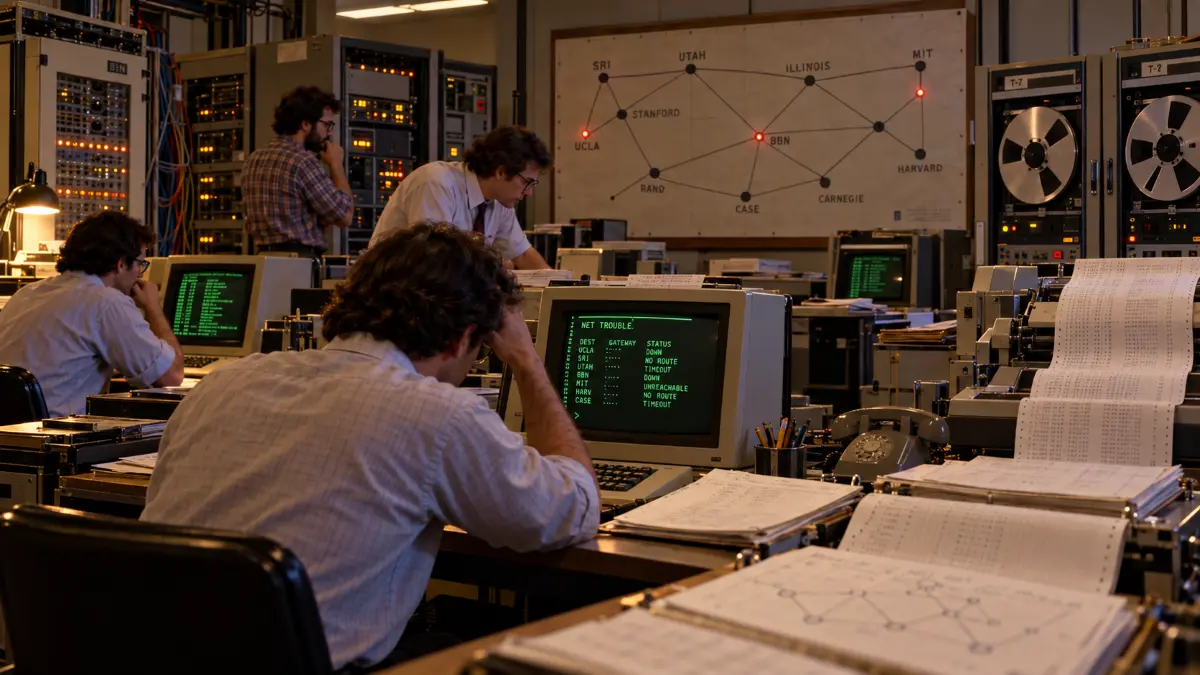
On October 29, 1969, a computer at the University of California, Los Angeles (UCLA), transmitted a message to another computer at the Stanford Research Institute (SRI) in Menlo Park, California. The message was supposed to be the word “LOGIN,” but the receiving system crashed after just two letters: “LO.” Despite this unexpected interruption, the experiment marked a defining milestone in computing history: the first host-to-host message transmitted across ARPANET, the pioneering network that helped lay the foundations of today’s Internet.
The achievement was the result of years of research into computer networking and packet switching, a technology that allowed information to be transmitted between computers over shared communication links. At a time when computers were expensive, room-sized machines typically operated as isolated systems, ARPANET introduced a radically different possibility: geographically separated computers could communicate and share resources through a network.
Connecting Two Computers Across California
The historic transmission took place between UCLA and the Stanford Research Institute, approximately 350 miles apart. UCLA’s Network Measurement Center, led by Professor Leonard Kleinrock, operated one of ARPANET’s first network nodes. At SRI, a research team led by Douglas Engelbart was developing technologies for interactive computing and information sharing.
The person who initiated the transmission was Charley Kline, a UCLA student programmer working under Kleinrock’s supervision. At the receiving end, Bill Duvall, an SRI researcher, monitored the connection and confirmed the arrival of each character over a telephone conversation with Kline.
The experiment involved attempting to log in remotely to the SRI computer from UCLA. Kline typed the letter “L,” and Duvall confirmed that it had arrived. The letter “O” followed successfully, but when Kline attempted the next character, the receiving system crashed. The intended word “LOGIN” was interrupted after just two letters, leaving “LO” as the first message successfully transmitted between the two hosts.
The technical problem was resolved, and the team successfully completed the login attempt later that evening. Although the initial transmission was incomplete, the experiment demonstrated that computers at separate institutions could exchange information through the emerging ARPANET infrastructure.
The Technology Behind the First Transmission
ARPANET was developed with funding from the Advanced Research Projects Agency (ARPA), an organization within the U.S. Department of Defense. Its purpose was to investigate advanced computer networking and enable research institutions to share expensive computing resources more efficiently.
One of the network’s most important innovations was its use of packet switching, an approach in which information is divided into smaller units that can travel through a network before being reconstructed at the destination. This differed from traditional circuit-switched telephone systems, which established a dedicated communication circuit for a call.
The first ARPANET nodes used specialized computers called Interface Message Processors (IMPs), developed by Bolt Beranek and Newman (BBN). These machines served as the network’s switching infrastructure, connecting host computers and managing the transmission of data between locations.
The UCLA and SRI computers communicated through their respective IMPs over a dedicated communication link. The successful exchange demonstrated the feasibility of connecting different computing systems through a shared network architecture, an essential step toward the interconnected digital environment that would emerge in subsequent decades.
From Two Nodes to a Growing Research Network
The October 29 transmission was only the beginning. By the end of 1969, ARPANET had expanded to four nodes: UCLA, Stanford Research Institute, the University of California, Santa Barbara, and the University of Utah.
The growing network allowed researchers to explore remote computing, resource sharing, and communication between geographically separated institutions. During the following years, ARPANET supported important developments in network protocols and applications, including electronic mail, which became one of its most influential uses.
However, the original ARPANET did not operate using the same protocols that define today’s Internet. Its early communication systems relied on technologies such as the Network Control Program (NCP). The transition to TCP/IP on January 1, 1983, was a major milestone that enabled more flexible communication between interconnected networks and helped establish the technical foundation of the modern Internet.
This distinction is important because the 1969 experiment did not create the Internet in its present form. Instead, it demonstrated a practical networking concept that would contribute to the development of the global system we use today.
Why the First ARPANET Message Still Matters
The significance of the first ARPANET message extends far beyond the two letters transmitted that evening. The experiment showed that computers could communicate over long distances through a packet-switched network, challenging the assumption that computing resources needed to remain isolated within individual institutions.
Over time, networking technologies evolved to support communication between universities, research laboratories, businesses, and eventually households around the world. The development of TCP/IP, the Domain Name System, and the World Wide Web transformed these early networking foundations into an infrastructure supporting billions of connected devices.
Modern activities such as sending email, accessing cloud services, streaming video, participating in online meetings, and browsing websites depend on networking principles developed and refined through decades of research. Although today’s Internet is vastly more complex than ARPANET, the 1969 experiment represents an important early demonstration of the interconnected computing model that made these services possible.
A Two-Letter Message That Made History
Looking back at October 29, 1969, the first ARPANET transmission illustrates how major technological advances can begin with modest experiments. Charley Kline and Bill Duvall were not attempting to launch a worldwide communications revolution. They were testing whether one computer could establish a remote connection with another.
The system crashed after transmitting “LO,” but the technical setback did not diminish the achievement. The researchers corrected the problem, completed the connection, and continued developing a network that would become an essential part of computing history.
The first ARPANET message was not the birth of the modern Internet in a single moment. It was a crucial early step toward a world in which computers, information, and people could be connected across vast distances.