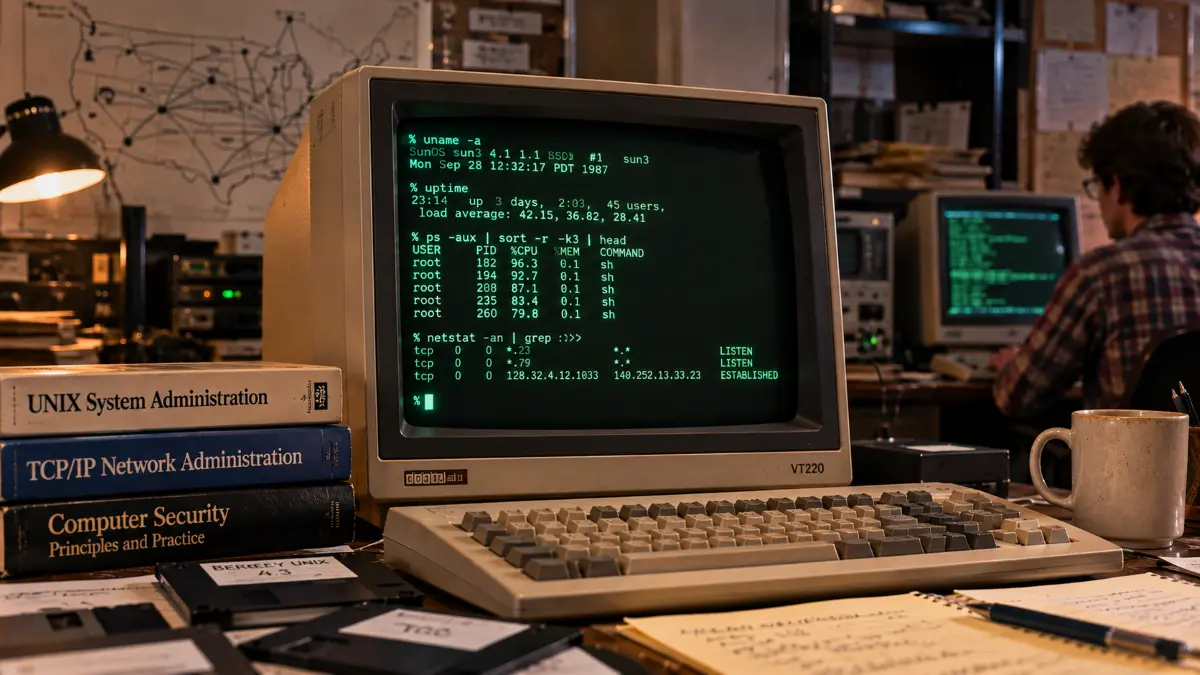

The Internet was still a fragile experiment in 1988 when a Cornell University graduate student named Robert Morris unleashed a self-replicating worm that would expose the network’s vulnerabilities in a way no one had anticipated. On November 2, 1988, the Morris Worm began its unintended rampage, infecting roughly 6,000 computers, about 10 percent of the Internet at the time, and causing widespread disruption.
Morris’s original goal was straightforward: to measure the size of the early Internet by counting how many machines would respond when the worm connected to them. But a programming error turned this research tool into a digital contagion. Instead of quietly collecting data, the worm replicated uncontrollably, clogging network traffic and crashing machines across government and university systems for two days. The fallout was immediate and severe.
At the time, the event was a wake-up call for the tech community. The Internet was barely understood by many of its users, and security was an afterthought. The Morris Worm exposed how fragile the network’s infrastructure was and how little thought had been given to protecting interconnected systems from malicious or even accidental attacks. The worm’s spread highlighted the need for better security protocols and more robust defenses against self-propagating code.
The consequences for Morris were personal as well as professional. Cornell dismissed him, and he faced legal repercussions including three years of probation and a $10,000 fine. But the broader impact was on the emerging field of cybersecurity. The Morris Worm forced researchers and organizations to rethink how they approached network security. It was one of the first widely recognized examples of a worm causing real damage, setting the stage for the development of intrusion detection systems, firewall technologies, and more rigorous software testing practices.
What changed because of the Morris Worm was not just technical safeguards but also the mindset around Internet safety. It underscored the fact that vulnerabilities could be exploited at scale, even unintentionally, and that the Internet’s growth needed to be matched by advances in security awareness and infrastructure resilience. The incident also catalyzed the formation of the Computer Emergency Response Team (CERT), a critical institution for coordinating responses to cybersecurity incidents.
Today, the Morris Worm remains a reference point in cybersecurity education and policy. It reminds us that even well-intentioned code can have unintended consequences and that vigilance is essential in a connected world. The worm’s legacy is visible in the layered security models and proactive threat monitoring that underpin modern networks. It also serves as a cautionary tale about the ethical responsibilities of researchers working with powerful technologies.
Looking back at the Morris Worm, it’s clear that this early experiment in self-replicating code was more than a glitch, it was a catalyst for a security paradigm that continues to evolve. The Internet’s resilience today owes much to the lessons learned from that chaotic two-day episode. It’s a reminder that in technology, progress often comes through hard-earned experience.