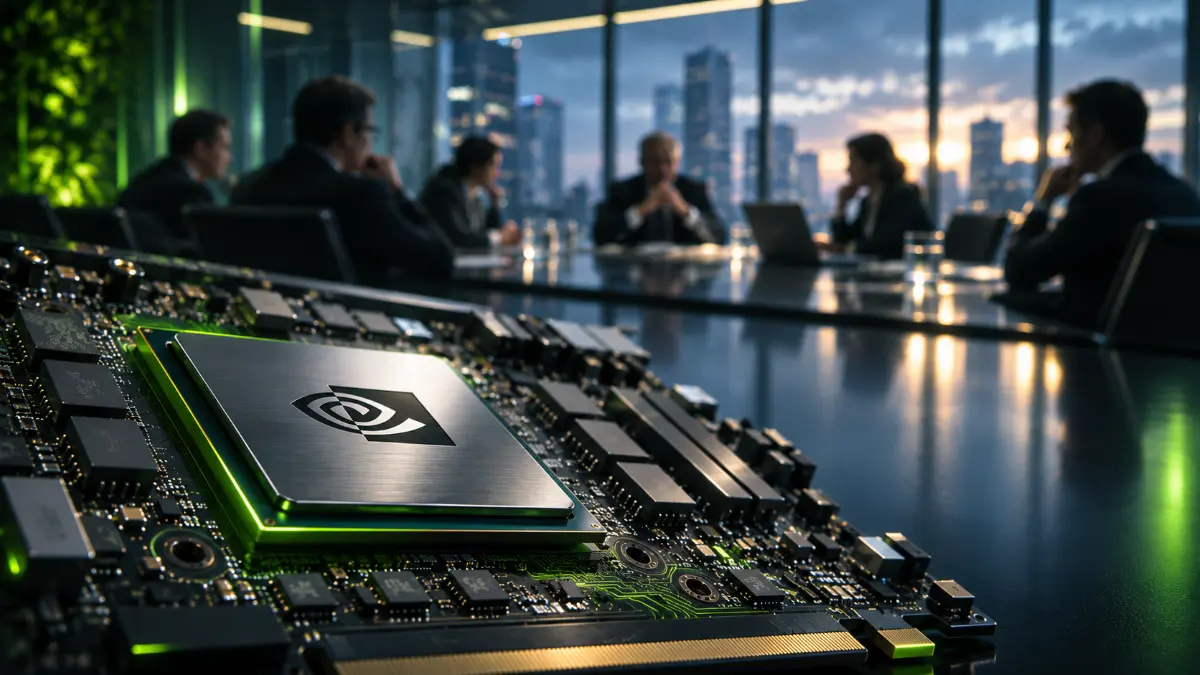

Nvidia is facing one of the most significant leadership challenges in its history as its board considers the future of co-founder and CEO Jensen Huang following reports involving personal relationships, potential conflicts of interest, and alleged foreign intelligence activity. According to Reuters and other major news organizations, Nvidia’s directors reportedly met on November 11, 2026, to discuss whether Huang should remain chief executive. The developments follow an independent investigation announced by the company on November 8, initially focused on reports that Huang may have been targeted by a foreign intelligence operation.
The situation has also prompted speculation about potential successors, including Apple’s senior hardware executive Johny Srouji. With Nvidia occupying a central position in the global artificial intelligence infrastructure market, uncertainty surrounding its longtime leader has attracted considerable attention from investors and technology companies.
What Triggered Nvidia’s Leadership Crisis?
The controversy began with reporting about Huang’s relationship with Alice Huang, a former executive associated with Singapore-based cloud computing company Megaspeed International. According to reporting attributed to The New York Times, U.S. intelligence officials investigated concerns that Alice Huang was connected to Chinese intelligence activities. Megaspeed has also faced scrutiny over whether restricted Nvidia computing hardware could have reached Chinese customers.
These are serious allegations, but they require important distinctions. Public reporting has not established that Jensen Huang knowingly assisted a foreign intelligence operation or improperly disclosed Nvidia’s confidential information. On November 8, Nvidia reportedly announced that a committee of independent directors, supported by outside legal counsel, would investigate the circumstances. The company stated that it had no reason at that time to believe national security or Nvidia’s proprietary information had been compromised and expressed confidence in Huang and his leadership team.
Additional Reports Raise Corporate Governance Questions
The situation intensified after reporting attributed to The New York Times described another alleged relationship involving Kimberly Powell, Nvidia’s vice president of healthcare, who reportedly had a professional reporting relationship with Huang. The report was said to cite five people who had worked at Nvidia, raising questions about potential conflicts of interest and the standards governing relationships between senior executives and employees.
Such concerns can extend beyond personal conduct when a company’s chief executive has influence over compensation, promotions, reporting structures, and business decisions. For corporate boards, the central issue is whether executive conduct creates legal, operational, reputational, or governance risks requiring intervention. The reported relationship has not, by itself, established that company policies were violated or that improper employment decisions occurred.
Nvidia’s Board Considers Its Options
Reuters reportedly indicated that Nvidia’s board was meeting to consider Huang’s future, representing a significant change from its earlier public expression of support. Under Nvidia’s corporate bylaws, a majority of directors can remove the chief executive, although any decision would involve substantial considerations surrounding business continuity and investor confidence.
Huang co-founded Nvidia in 1993 and has led the company through its transformation from a graphics processor developer into a dominant supplier of AI computing infrastructure. His influence extends across the company’s product strategy, software ecosystem, customer relationships, and long-term technology roadmap. Replacing a founder who has led a business for more than three decades would therefore involve more than appointing a new executive. Nvidia would also need to preserve continuity across engineering, manufacturing partnerships, and major customer commitments. As of the reporting reviewed, the board’s final decision had not been publicly confirmed.
Could Apple’s Johny Srouji Become Nvidia’s Next CEO?
Among the executives reportedly being considered is Johny Srouji, Apple’s senior vice president of Hardware Technologies. Srouji has played a major role in Apple’s custom silicon strategy, overseeing the development of processors used across the company’s iPhone, iPad, and Mac product families. His experience includes semiconductor architecture, engineering leadership, and coordinating complex chip development programs with manufacturing partners.
That background could make him a candidate for a company whose competitive position depends on delivering increasingly sophisticated AI processors and computing platforms. However, Srouji’s reported consideration does not establish that he has accepted an offer or intends to leave Apple. Other names discussed in succession reporting include Nvidia Chief Financial Officer Colette Kress, potentially as an interim leader, and senior engineering executive Ian Buck. The choice between an internal successor and an external executive would carry different implications for Nvidia’s organizational continuity and future strategic direction.
Why Nvidia’s Leadership Matters to the AI Industry
Nvidia’s position in the technology sector makes the situation unusually consequential. Its GPUs and accelerated computing platforms power AI training and inference infrastructure operated by major cloud providers, research organizations, and enterprises. The company’s competitive strength also extends beyond semiconductor hardware. Its CUDA software ecosystem, networking technology, and integrated computing systems create a platform that customers rely on for developing and deploying AI applications.
A leadership transition would not automatically disrupt those technologies or existing customer commitments. However, it could introduce uncertainty around long-term product priorities, capital allocation, strategic partnerships, and organizational structure. Competitors such as AMD and companies developing custom AI accelerators may also monitor whether a change in leadership creates opportunities in a market where Nvidia has maintained a substantial advantage.
Investors React to the Uncertainty
The reports have reportedly affected market sentiment. Reuters described substantial declines in Nvidia shares following the latest developments, including an extended-trading drop of more than 8% after reports that the company was preparing for a possible leadership change. The broader decline in Nvidia’s market valuation was attributed to investor concerns about governance, succession planning, and the potential consequences of losing a chief executive closely associated with the company’s growth.
However, market movements should not be interpreted as evidence that any allegation has been proven or that Nvidia’s underlying technology business has deteriorated. Investors will also be evaluating the company’s upcoming financial results, customer demand for AI infrastructure, and its ability to maintain product development schedules.
What Happens Next?
Several developments will determine how the situation unfolds. Nvidia’s board must decide whether Huang will continue as chief executive and how the independent investigation will proceed. Any leadership transition would also require decisions about interim management, succession, and communication with employees, customers, and investors. Separately, questions surrounding alleged foreign intelligence activity and potential semiconductor export-control violations may continue to attract regulatory scrutiny.
These investigations and governance considerations should be treated as distinct matters, with conclusions based on verified findings rather than speculation. For Nvidia, the immediate priority will be maintaining confidence in its leadership and ensuring that the uncertainty does not interfere with engineering operations or customer commitments.
A Defining Test for Nvidia’s Corporate Governance
Jensen Huang has been central to Nvidia’s identity and success for more than three decades. His leadership helped transform the company into a major force in graphics computing, data centers, and artificial intelligence. The current controversy demonstrates the challenges companies face when a founder’s influence becomes deeply embedded in their strategic direction.
Regardless of whether Huang remains CEO, Nvidia’s board must balance accountability, business continuity, and the interests of shareholders, employees, and customers. The outcome could shape Nvidia’s leadership structure for years to come, but the more immediate question is whether the company can maintain stability and confidence while its board addresses the allegations and determines its next steps.