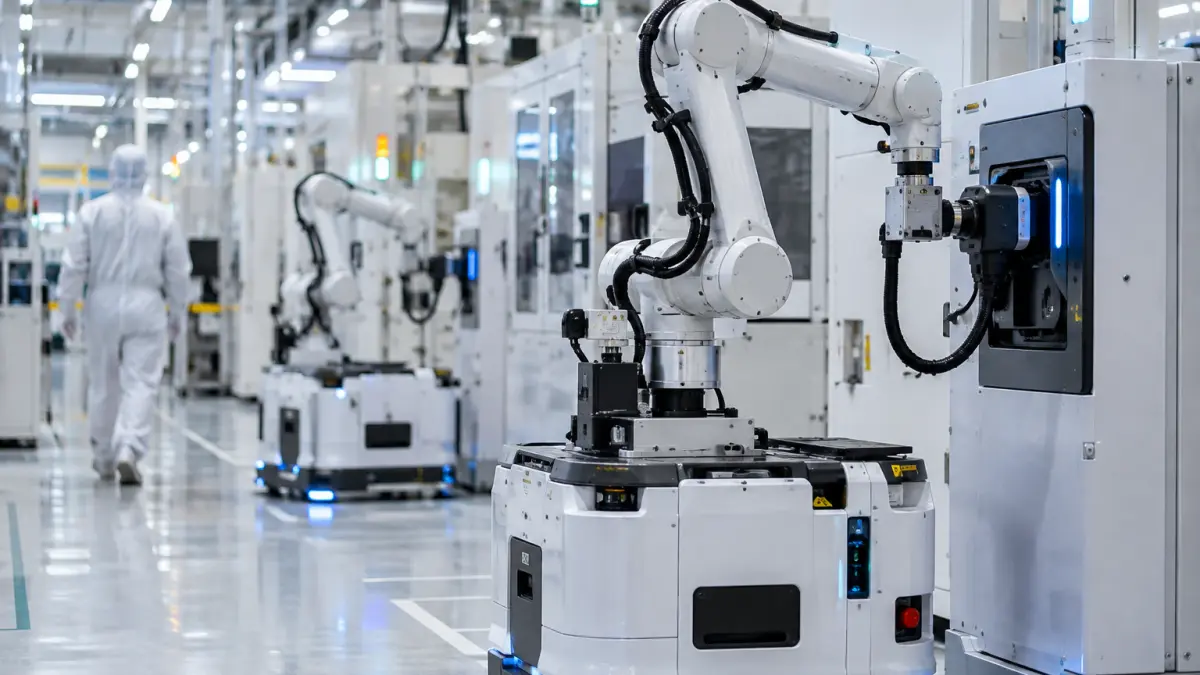

Three of the world’s largest memory chip manufacturers, Samsung Electronics, SK hynix, and Micron Technology, are collaborating on an initiative to standardize charging infrastructure for mobile robots used inside semiconductor fabrication facilities. The effort aims to address a growing obstacle to factory automation: robots from different manufacturers often require incompatible charging equipment, increasing costs and complicating operations.
Working with the semiconductor industry association SEMI, the companies are seeking common technical specifications that would allow different robotic platforms to share charging infrastructure. The initiative could be particularly valuable for older semiconductor plants, where expanding automation without major renovations is becoming increasingly important as manufacturers scale production to meet demand for advanced memory and AI-related hardware.
Why Semiconductor Factories Need More Flexible Automation
Modern semiconductor fabrication plants, commonly known as fabs, depend on precisely coordinated material movement between hundreds of manufacturing and inspection steps. Silicon wafers must travel between processing equipment while maintaining strict contamination controls, making reliable transportation essential to production efficiency.
Newer fabs often incorporate automated material-handling systems (AMHS), including overhead transport systems designed to move wafer carriers between manufacturing tools. However, older facilities may have limited automation infrastructure, particularly when moving materials between floors or through areas not originally designed for automated transport.
Mobile robots offer a potentially more flexible alternative. Autonomous mobile robots (AMRs) can transport materials through designated factory routes, while mobile manipulators combine mobility with robotic arms capable of handling specific tasks. Humanoid robots are also being explored for environments originally designed around human workers, although their practical role in semiconductor manufacturing remains less established.
Unlike fixed conveyor or overhead systems, mobile robots can potentially be introduced incrementally, reducing the need for extensive structural modifications. Their effectiveness, however, depends on reliable navigation, integration with factory control systems, and the ability to recharge without interrupting production schedules.
The Hidden Problem: Incompatible Robot Chargers
As semiconductor manufacturers introduce robots from multiple suppliers, charging infrastructure has become an increasingly complicated operational issue.
Different robotic platforms may use different battery voltages, connectors, charging interfaces, and communication protocols. A charging station designed for one manufacturer’s robot may not support another model, even when both perform similar transportation tasks.
For large facilities operating mixed robotic fleets, this fragmentation creates several problems. Each robot platform may require dedicated charging stations, spare components, maintenance procedures, and monitoring systems. Factory operators must also allocate space for equipment that may serve only a limited number of machines.
The challenge is especially significant in older fabs, where floor space is already constrained by production equipment and existing infrastructure.
Charging incompatibility can also limit operational flexibility. If one robot type cannot use an available charging station, fleet-management software must account for those restrictions when assigning tasks and scheduling charging cycles.
Standardization could reduce these constraints by making charging equipment interoperable across different robotic platforms.
Samsung, SK Hynix, and Micron Pursue a Common Standard
To address the problem, Samsung Electronics, SK hynix, and Micron Technology have reportedly established a consultative initiative in cooperation with SEMI, the international association supporting semiconductor manufacturing standards.
The effort focuses on developing common technical requirements for charging mobile robots operating inside semiconductor facilities.
Several areas are particularly important:
- Battery specifications: Defining compatible electrical requirements and charging characteristics across different robotic platforms.
- Charging equipment: Establishing common requirements for charging stations, physical interfaces, and related hardware.
- Communication protocols: Enabling robots and charging stations to exchange information about charging status, power requirements, and operating conditions.
- Battery management systems: Aligning essential monitoring and safety functions associated with battery charging and operation.
These elements are closely connected. Physical compatibility alone does not guarantee that two devices can charge safely or efficiently.
A robot and charging station must also communicate correctly, negotiate appropriate power delivery, and respond to conditions such as overheating, battery faults, or interrupted connections.
The initiative therefore involves more than creating a universal charging connector. It aims to establish a technical framework that could support reliable charging across equipment from different suppliers.
The precise specifications, implementation requirements, and adoption timeline have not yet been established in the information available.
Why Charging Standardization Matters for Production Efficiency
In semiconductor manufacturing, equipment availability directly influences production scheduling and operational efficiency.
Mobile robots must complete transportation tasks while minimizing delays, avoiding congestion, and maintaining sufficient battery capacity for assigned workloads.
When charging infrastructure is fragmented, operators may need to maintain additional stations to accommodate different robot models. This can increase capital expenditure while making maintenance and fleet coordination more complicated.
A common charging standard could allow manufacturers to deploy shared charging areas and optimize how robots are assigned to available stations.
For example, a facility operating robots from three suppliers could potentially use compatible charging infrastructure rather than maintaining three separate systems.
Such interoperability would not eliminate the need for fleet-management software or operational planning, but it could simplify one of the underlying infrastructure requirements.
It may also make it easier to introduce new robot suppliers without redesigning existing charging areas.
Older Semiconductor Fabs Could Benefit Most
One of the initiative’s most practical applications involves modernizing existing semiconductor plants.
Building a new fab allows manufacturers to incorporate automation infrastructure into the original facility design. Retrofitting an older plant is considerably more difficult because production areas, transport routes, and equipment layouts are already established.
Mobile robots can provide a way to automate selected material-handling tasks without installing entirely new overhead transportation systems.
However, charging stations still require physical space, electrical connections, and safe access routes.
Standardized equipment could help reduce the amount of dedicated infrastructure required to support a mixed robotic fleet, making incremental automation projects more practical.
This approach could also extend the useful life of existing manufacturing facilities by allowing operators to improve material movement without replacing large portions of their production infrastructure.
The Role of SEMI in Industry-Wide Adoption
SEMI’s involvement is important because semiconductor manufacturing depends heavily on interoperability between equipment supplied by different companies.
The organization develops and maintains technical standards covering areas such as equipment communication, factory automation, safety, and manufacturing processes.
A common robot-charging framework developed through an industry standards process could provide equipment manufacturers with consistent requirements when designing future products.
However, establishing a standard does not automatically guarantee universal compatibility.
Robot manufacturers would need to adopt the specifications, while semiconductor operators would have to evaluate how the new requirements fit their existing equipment and infrastructure.
Legacy robots could also require adapters, hardware modifications, or replacement charging systems, depending on the final technical design.
The initiative’s success will therefore depend on broad participation from robotics suppliers, not only the three memory manufacturers leading the effort.
Could Standardization Accelerate Industrial Robotics?
The collaboration could have implications beyond charging infrastructure.
One obstacle to deploying large robotic fleets is the difficulty of integrating machines from different manufacturers into a unified operating environment.
Charging compatibility addresses only one part of that challenge, but it can provide a foundation for more flexible fleet operations.
If semiconductor manufacturers can reduce infrastructure fragmentation, they may find it easier to test different robotic platforms, expand automation gradually, and avoid dependence on a single equipment supplier.
This could create opportunities for robotics companies offering specialized solutions for wafer transportation, inspection support, and factory logistics.
The initiative also reflects a broader industrial trend toward modular automation, where companies combine equipment from multiple suppliers rather than relying exclusively on proprietary systems.
Nevertheless, charging interoperability should not be confused with complete robot interoperability. Navigation systems, safety controls, task scheduling, and factory communication protocols still require separate integration.
What Happens Next?
The next stage will involve translating the proposed standardization goals into detailed technical specifications that robotics manufacturers can implement.
Important questions remain about the electrical requirements, physical charging interfaces, communication methods, and safety certification processes that will form part of the eventual standard.
It is also unclear how quickly existing robot suppliers could adopt the specifications or whether semiconductor manufacturers will require compliance for future equipment purchases.
Pilot deployments and interoperability testing will be important in determining whether shared charging infrastructure can deliver meaningful cost savings and operational improvements.
A Practical Step Toward More Automated Chip Manufacturing
Samsung, SK hynix, and Micron compete intensely in the global memory market, but their cooperation on robot charging reflects a shared interest in reducing the complexity of semiconductor manufacturing.
As chip factories become more automated, the ability to integrate equipment from different suppliers will become increasingly important. Standardizing charging infrastructure may appear less significant than developing faster processors or more advanced memory, but factory efficiency depends on countless supporting systems operating reliably together.
For older fabs in particular, compatible charging equipment could make robotic automation easier to expand without extensive infrastructure changes.
The real significance of this initiative is not simply allowing different robots to share a charger. It is removing a practical barrier that could otherwise slow the adoption of flexible, large-scale automation across semiconductor manufacturing.