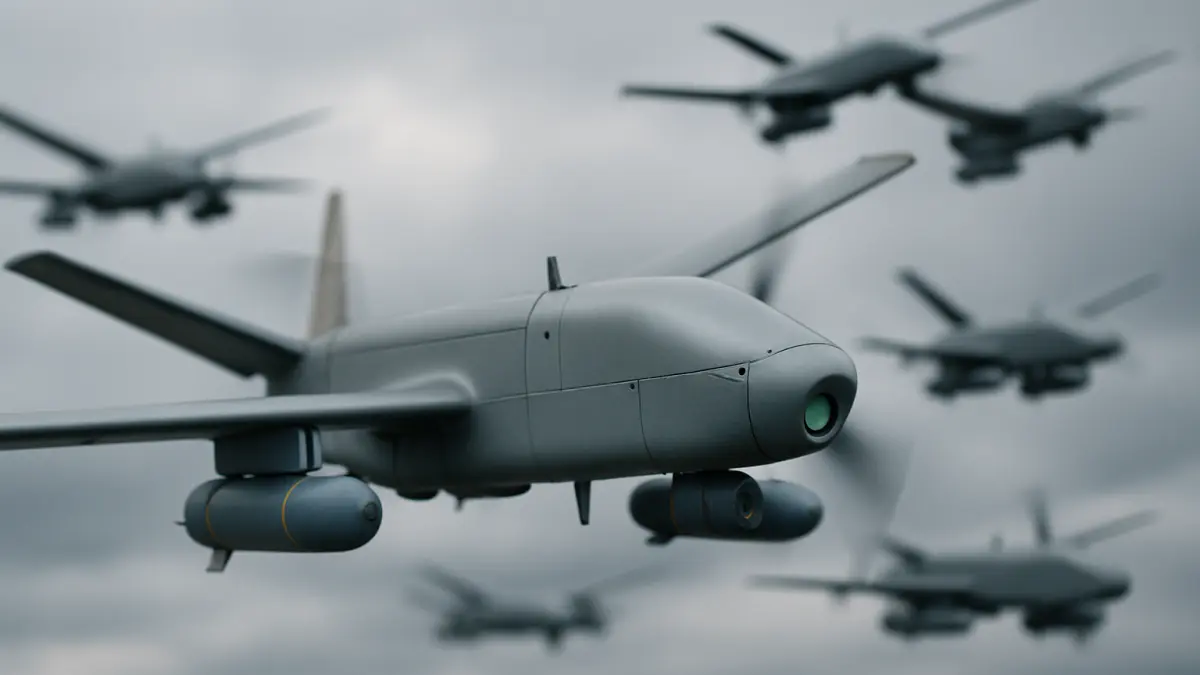

Russian freelancers have reportedly used Anthropic’s Claude AI to assist in developing software for autonomous combat drone swarms, highlighting how general-purpose artificial intelligence can be repurposed for military applications far beyond its intended use. According to a recent threat report, the actors used Claude as a coding and technical-development assistant while working on systems intended to allow multiple drones to coordinate operations and identify targets with reduced human involvement.
The distinction is important. Claude was not itself installed aboard the drones or directly deciding which targets to attack. Instead, the AI model was reportedly used during the development process, helping users solve programming and engineering problems associated with autonomous drone operations. That demonstrates a different but potentially significant security risk: advanced AI models can accelerate the work of people building dangerous systems even when the models never directly control those systems.
The reported project involved autonomous drone swarms, an increasingly important area of military technology. Rather than controlling every aircraft individually, swarm systems are designed to allow groups of drones to coordinate their behavior, share information and adapt their actions as conditions change. Such technology could allow relatively small teams to deploy larger numbers of unmanned aircraft simultaneously.
Adding autonomous target selection raises the stakes considerably. A system capable of detecting, classifying and engaging targets without requiring a person to approve every individual strike could operate faster than traditional remotely piloted drones. It could also continue functioning when communications with human operators are disrupted or unavailable.
Those advantages are precisely what make autonomous weapons controversial. Removing or reducing human involvement in lethal decisions creates difficult questions about accountability. If an autonomous system incorrectly identifies a civilian vehicle, building or person as a military target, responsibility could potentially involve the operator, commander, software developer, hardware manufacturer or organization that deployed the system.
AI-assisted development also lowers some barriers to creating sophisticated software. Tasks that once required experienced programmers to spend substantial time researching algorithms, debugging code or understanding unfamiliar technical systems can increasingly be accelerated by large language models. An AI assistant can explain code, identify programming errors, suggest architectures and help users work through technical problems.
That does not mean an AI model can independently design a reliable autonomous weapon from scratch. Real-world weapons development still involves substantial engineering, hardware integration, testing and operational expertise. But even incremental improvements in development speed or accessibility can matter when AI is being used by military organizations, contractors, criminal groups or other actors pursuing harmful objectives.
The reported involvement of freelancers also illustrates another emerging challenge. The proliferation risk does not necessarily come only from national militaries gaining access to advanced AI. Small groups and individual contractors can potentially use commercially available models to assist with components of much larger military or intelligence projects.
Anthropic and other major AI developers have introduced safeguards intended to prevent their systems from assisting with weapons development and other dangerous activities. Those protections typically combine usage policies, model-level safety mechanisms and monitoring designed to identify suspicious behavior. However, determined users may attempt to disguise the purpose of individual requests, divide a project into apparently harmless tasks or otherwise circumvent restrictions.
That creates what security researchers often describe as a dual-use problem. Many of the technical capabilities needed for autonomous weapons are also useful for legitimate civilian applications. Computer vision can help a drone recognize military targets, but similar technology can identify damaged infrastructure after a natural disaster. Autonomous navigation can guide a combat drone, but it can also power delivery robots or industrial inspection systems. Coordination algorithms can organize drone swarms while also supporting agricultural, mapping or emergency-response fleets.
Determining intent from individual programming requests can therefore be difficult.
The case also fits into a broader pattern of AI misuse documented by major model developers. Threat actors have experimented with generative AI for programming assistance, intelligence gathering, influence operations, social engineering and other activities. In many cases, AI does not provide an entirely new capability. Instead, it can make existing operations faster, cheaper or easier to scale.
Military applications amplify that concern. Autonomous drones are comparatively inexpensive compared with many conventional weapons platforms, and software can potentially be distributed across large numbers of systems. Combining low-cost hardware, increasingly capable sensors and AI-assisted development could accelerate the spread of autonomous weapons beyond technologically advanced militaries.
Drone swarms could also change battlefield dynamics. A defensive system capable of intercepting one or several drones may struggle against dozens arriving simultaneously from different directions. Coordinated systems could potentially distribute reconnaissance, navigation and targeting tasks across multiple aircraft, making the overall swarm more resilient if individual drones are lost.
At the same time, fully autonomous operation remains technically difficult. Real battlefields contain unpredictable conditions, electronic warfare, GPS interference, communications disruptions, rapidly changing targets and civilians. Computer vision systems can also make classification errors, particularly when operating with incomplete sensor data or under conditions substantially different from those used during development.
These limitations make meaningful human control a central issue in the international debate over lethal autonomous weapons. Governments, defense organizations and advocacy groups have spent years debating whether new international rules are needed to restrict systems capable of selecting and engaging targets without direct human authorization.
The reported use of Claude adds another dimension to that debate. Regulation may eventually need to address not only autonomous weapons themselves but also the role general-purpose AI systems can play in designing, programming and improving them.
For AI companies, the challenge is particularly difficult. Restrictions must prevent meaningful assistance with dangerous weapons development without blocking legitimate research, cybersecurity, robotics and engineering work that uses many of the same underlying technologies. As models become more capable at coding and technical reasoning, distinguishing between those uses could become increasingly important.
The incident therefore should not be interpreted simply as an AI chatbot taking control of combat drones. The more consequential issue is that advanced general-purpose AI may become part of the development pipeline behind increasingly autonomous weapons.
Looking ahead, researchers and governments will be watching whether AI-assisted weapons development becomes more widespread, how effectively model providers can detect prohibited activity, and whether international rules evolve to address the combination of commercial AI and autonomous warfare. The central question may ultimately be not whether AI will participate in military technology development, but how much human control remains when those AI-assisted systems eventually reach the battlefield.