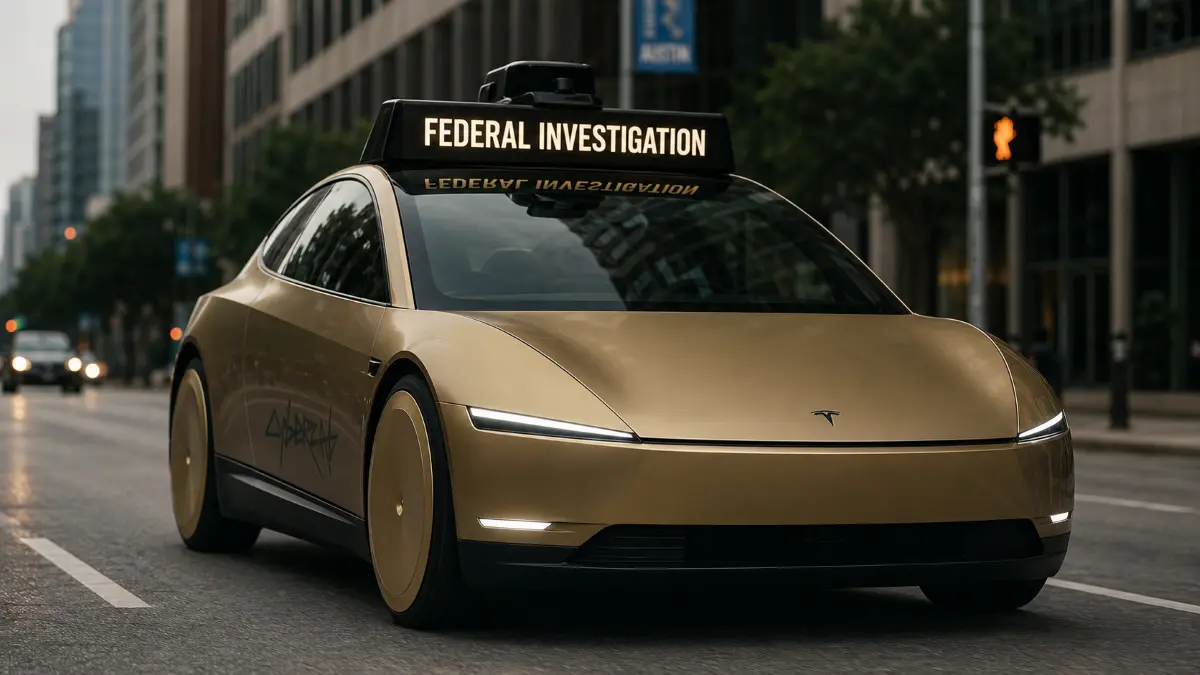

Tesla’s ambitious Cybercab rollout has drawn immediate federal scrutiny, with the National Highway Traffic Safety Administration (NHTSA) opening an audit into roughly 1,000 of the company’s purpose-built autonomous taxis. The action came as Tesla began commercially deploying a small number of Cybercabs in Austin, Texas, putting one of the company’s most important autonomous-driving projects under a regulatory spotlight almost as soon as vehicles reached public streets.
At the center of NHTSA’s review is an unusual aspect of the Cybercab itself. The two-seat vehicle is designed specifically for autonomous operation and does not have permanently installed conventional controls such as a steering wheel, brake pedal, accelerator pedal, or mirrors. NHTSA is examining the process and technical information Tesla used to certify that the Cybercab complies with federal vehicle safety requirements, including Tesla’s determination that certain Federal Motor Vehicle Safety Standards may not apply to the vehicle.
That distinction is particularly important for purpose-built robotaxis. Traditional federal vehicle standards were largely developed around vehicles designed for human drivers, while autonomous vehicles can eliminate hardware that has been standard for decades. NHTSA’s audit could therefore become an important test of how existing safety regulations apply to a new generation of vehicles designed from the beginning to operate without a driver.
Tesla began offering Cybercab rides in limited areas of Austin on September 3 and has indicated that it intends to gradually expand the service to additional vehicles and locations. Texas registration records showed 420 autonomous Tesla vehicles registered in the state as of Friday morning, including 45 Cybercabs. The relatively small initial deployment gives Tesla an opportunity to gather operational data, but the NHTSA review introduces another variable into the company’s expansion plans.
The Cybercab is central to Tesla’s broader strategy of transforming autonomous driving from a feature offered in consumer vehicles into a transportation service. Unlike Tesla’s Model Y robotaxis, the Cybercab is a purpose-built autonomous vehicle whose design assumes that a human driver will not need to take control. That makes regulatory approval and safety certification especially significant as Tesla attempts to move from limited deployments toward a much larger commercial network.
The NHTSA action also highlights a broader challenge facing the autonomous vehicle industry. Companies are developing vehicles and software faster than many traditional automotive regulations were designed to accommodate. Regulators must determine how requirements written around steering wheels, pedals, mirrors, and human drivers should apply when those components are intentionally removed.
Other autonomous vehicle developers have faced similar regulatory questions. NHTSA has been developing policies intended to accelerate autonomous vehicle deployment while maintaining federal safety oversight, including exemption mechanisms for vehicles that depart from conventional design requirements. Tesla’s approach to certifying the Cybercab will therefore be closely watched not only by regulators, but also by competitors developing their own purpose-built robotaxis.
For Tesla, the stakes extend beyond the first Cybercabs operating in Austin. Autonomous transportation has become a major part of the company’s long-term growth strategy, and any requirement for additional testing, certification changes, design modifications, or regulatory approvals could affect how quickly Cybercab expands to additional markets.
The audit does not by itself establish that the Cybercab is unsafe or that Tesla violated federal regulations. Instead, NHTSA is examining the technical and certification basis behind Tesla’s compliance claims. The outcome could help clarify how federal safety rules will be applied to vehicles that abandon many of the physical controls that have defined automobiles for more than a century.
As Tesla moves ahead with its Cybercab service, the key question is no longer simply whether autonomous technology can operate without a driver. It is whether the regulatory framework can evolve quickly enough to accommodate vehicles designed around that assumption, while still providing the safety oversight expected on public roads.