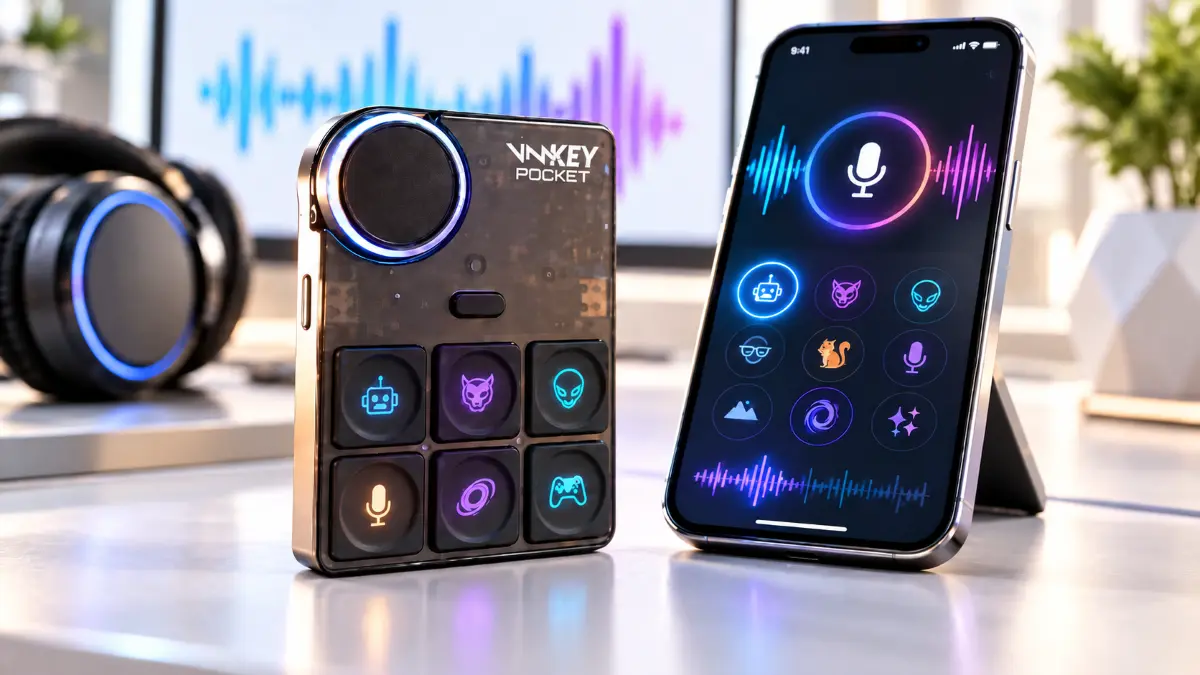

Voicemod is expanding its real-time voice-changing technology to smartphones with a new compact hardware device designed for iOS and Android. The pocket-sized accessory represents a significant shift for the company, bringing technology previously associated largely with PCs and its console-focused hardware into the rapidly growing world of mobile gaming, streaming, and social content creation.
The concept is straightforward: instead of relying entirely on software running on the phone, the device provides dedicated hardware for applying voice effects in real time. Users can speak through a connected microphone or headset and have their voice transformed before the audio reaches a game, voice chat, livestream, or compatible communication app.
That approach could address one of the biggest challenges facing voice-changing software on smartphones. Mobile operating systems place tighter restrictions on how one application can intercept or modify audio being used by another app. A hardware-based solution can potentially bypass some of those limitations by processing the audio before it reaches the phone, effectively presenting the altered voice as an external audio source.
For gamers, that could mean using a modified voice during multiplayer sessions without depending on native voice-changing support inside individual games. Content creators could similarly use effects while recording videos, livestreaming, participating in social platforms, or creating character voices without returning to a desktop editing workflow.
Real-time performance is particularly important. Traditional audio effects can be applied after a recording is complete, but live communication requires extremely low latency. Even a relatively small delay between speaking and hearing the processed voice can make conversations feel unnatural. Dedicated hardware gives Voicemod greater control over that processing pipeline and could help keep latency low enough for gaming and live interaction.
The device also expands the potential audience for Voicemod. The company’s technology has built much of its reputation around PC gaming, Discord-style communication, streaming, and more recently console hardware. Smartphones represent a considerably broader market, particularly among younger users who increasingly create, play, communicate, and livestream primarily from mobile devices.
Voice customization itself is also becoming a more prominent part of online identity. Users can adopt character voices, exaggerated effects, robotic sounds, altered pitches, or other audio personas for gaming and social interactions. For streamers and creators, those effects can become part of a recognizable character or content format rather than simply a novelty.
The move is especially relevant as mobile gaming becomes increasingly sophisticated. Competitive multiplayer games that once required PCs or consoles now have substantial mobile audiences, while smartphones have become powerful enough to handle gaming, recording, streaming, and communications simultaneously. An external audio processor could add another creative layer without consuming as many of the phone’s own computing resources.
Compatibility, however, will be crucial. Mobile accessories must work across different phone generations, connection standards, headsets, microphones, games, and communication apps. iOS and Android also handle external audio devices differently, meaning the quality of the experience may depend heavily on how seamlessly Voicemod integrates with each platform.
Physical design matters as well. A mobile accessory loses much of its appeal if users need multiple adapters, cables, or a complicated setup. Voicemod’s decision to make the device compact suggests portability is central to the product. Ideally, users could carry it alongside a phone and headset and activate voice effects without building a desktop-style audio setup.
There are broader implications for content creation. Mobile creators increasingly produce entire videos, podcasts, livestreams, and social posts without using a traditional computer. Real-time voice processing could allow creators to perform characters, disguise their voices, add comedy effects, or produce more elaborate audio directly from a smartphone.
Privacy could become another use case. Some users may prefer not to reveal their natural voice during public gaming sessions or online communities. Voice modification can provide an additional layer of identity separation, although it should not be considered a complete anonymity or privacy solution.
Voicemod’s expansion also reflects a larger shift in consumer audio technology. Features once requiring professional equipment or desktop software are increasingly moving into compact devices, smartphones, earbuds, and creator-focused accessories. Real-time processing is becoming portable, making sophisticated audio manipulation accessible outside studios and gaming PCs.
The company will still need to demonstrate that dedicated hardware offers enough advantages over software-only voice-changing apps. If the device provides noticeably lower latency, better audio quality, broader app compatibility, and simpler operation, it could justify carrying an additional accessory. If those advantages are limited, consumers may prefer applications that require no extra hardware.
Another factor will be the range and quality of available voices. Voicemod has built its platform around a library of real-time effects and customizable voices, and bringing that ecosystem to mobile hardware could make the accessory more compelling than a basic pitch-changing device. Integration with existing Voicemod accounts, voice libraries, soundboards, and customization tools could further strengthen its appeal.
Strategically, the device positions Voicemod at the intersection of several expanding markets: mobile gaming, creator hardware, livestreaming, social communication, and personalized digital identity. Rather than treating voice modification as a desktop gaming feature, the company is betting that customized audio can become part of everyday mobile communication.
What to watch next is how the device performs under real-world conditions. Latency, audio quality, battery impact, iPhone and Android compatibility, supported apps, connection requirements, and pricing will ultimately determine whether it becomes a useful tool for mobile creators and gamers or remains a specialized accessory.
If Voicemod can make changing a voice on a smartphone as immediate as applying a visual filter to a photo or video, the device could help move real-time voice effects from a gaming niche into a much broader category of mobile creative tools.