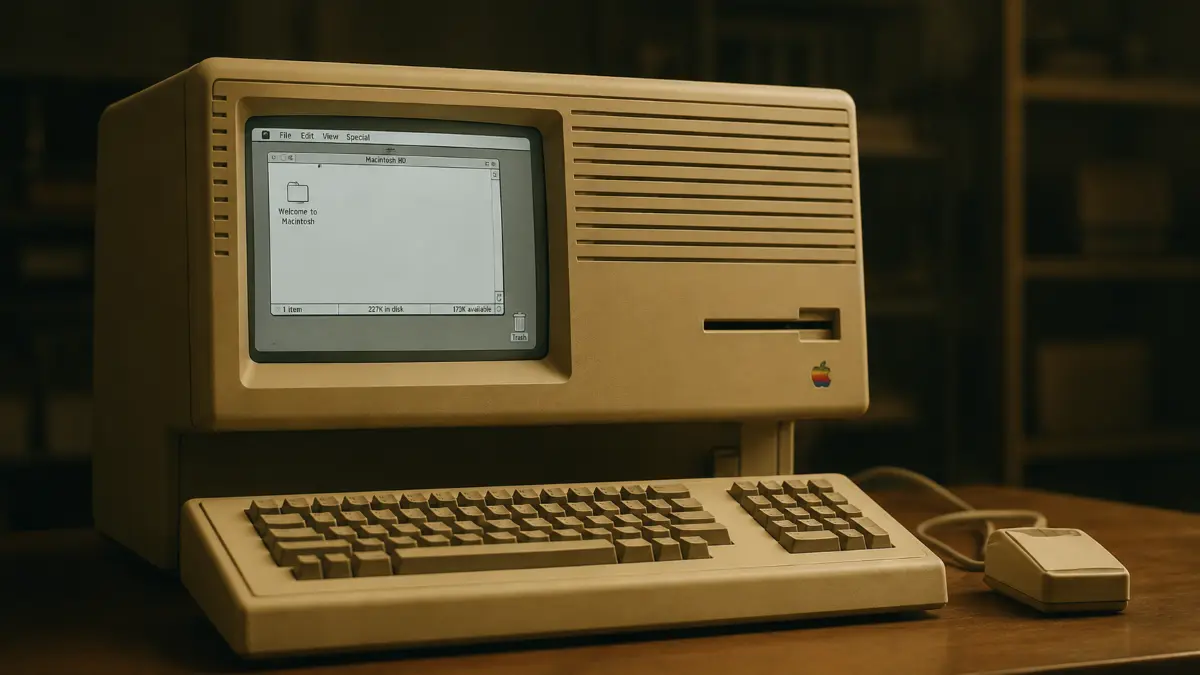

The future of computing didn’t arrive with a bang on July 30, 1979. Instead, it started quietly in Apple’s labs with the birth of the Lisa project. This was the first commercial computer designed around a graphical user interface (GUI), a concept that would redefine how humans interact with machines. The Apple Lisa graphical user interface wasn’t just a new feature; it was a fundamental shift in computing’s language.
On this day, Apple began work on the Lisa, originally planned to retail for $2,000 and ship in 1981. The reality, however, was far from the initial vision. The Lisa launched in 1983 with a price tag of $10,000, a steep barrier for most consumers. It also faced a shortage of software and hardware reliability issues that hampered its success. Yet, the Lisa’s technology was far ahead of its time, planting seeds that would influence future operating systems and computer designs, including Apple’s own Macintosh.
At the time, personal computers were dominated by command-line interfaces, requiring users to memorize and type commands. The Lisa’s graphical user interface introduced windows, icons, menus, and pointers, elements that made computers accessible to a broader audience. This was a critical step toward democratizing computing, moving away from the intimidating text-based systems to visual environments that users could navigate intuitively.
Despite its commercial failure, the Lisa’s GUI was a prototype for what was to come. It solved a fundamental problem: how to make complex computing tasks manageable for everyday users. The Lisa’s interface allowed users to interact with software through direct manipulation of graphical elements, reducing the learning curve and increasing productivity. This approach laid the groundwork for modern operating systems, where the GUI is now a standard.
The Lisa’s influence extended beyond Apple. Its innovations inspired the development of the Macintosh, which refined the GUI concept and achieved greater commercial success. The Macintosh brought graphical interfaces to the masses, proving that the Lisa’s vision was not just viable but essential. Today’s operating systems, from Windows to Linux desktops, owe a debt to the concepts first tested on the Lisa.
Why does the Lisa still matter? Because it represents a moment when technology shifted from being a tool for specialists to a platform for everyone. The challenges it faced, high cost, limited software, hardware issues, are reminders that innovation often comes with growing pains. But the Lisa’s legacy is the user-centric design philosophy that drives modern computing. It showed that the future of technology lies in making machines more human-friendly.
Looking back, the Lisa was less a commercial product and more a technological experiment that expanded the boundaries of what computers could do. Its story is a lesson in how early innovation shapes the evolution of technology, even when immediate success is elusive. The graphical user interface it introduced remains one of the most important breakthroughs in computing history, influencing how we work, create, and communicate today.
July 30, 1979, marks the start of this journey, a reminder that sometimes the most impactful technologies begin as ambitious experiments that challenge the status quo. The Lisa’s story encourages us to look beyond immediate outcomes and appreciate the long-term impact of pioneering ideas.