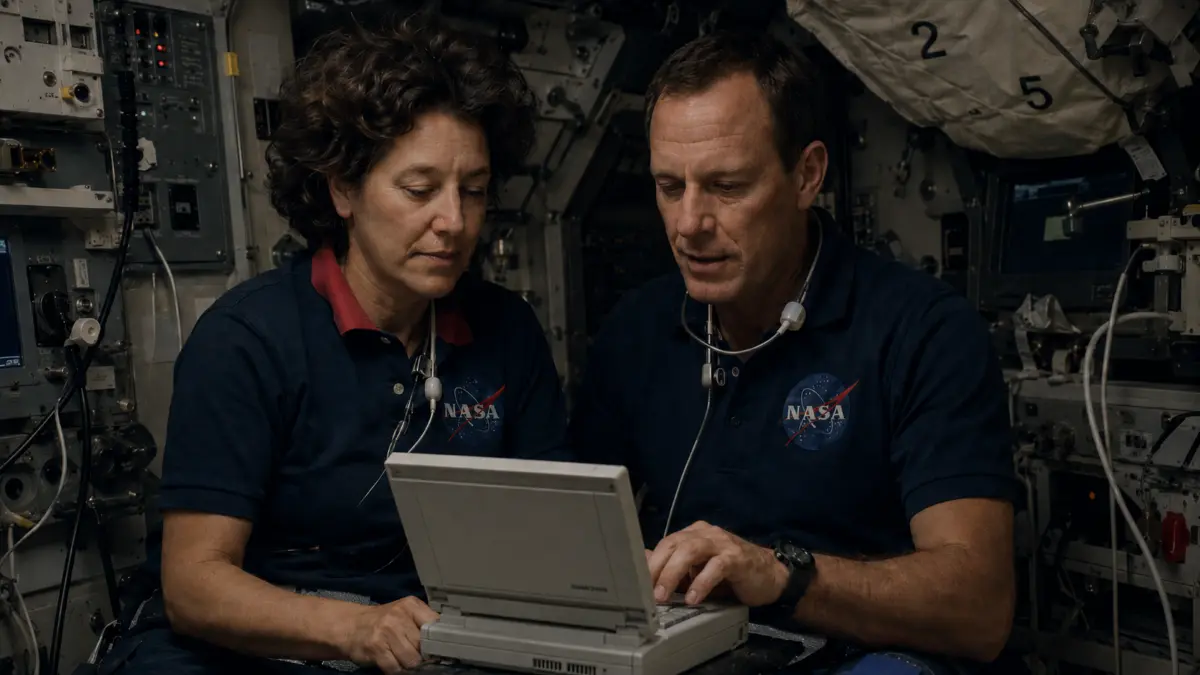

Imagine sending an email from hundreds of kilometers above Earth, orbiting at 28,000 kilometers per hour. On August 9, 1991, astronauts aboard the Space Shuttle Atlantis did just that, using an Apple Macintosh Portable to send what is considered the first email from space. This moment wasn’t just a quirky milestone; it was a glimpse into how digital communication would extend beyond our planet.
The astronauts Shannon Lucid and James C. Adamson used the AppleLink online service to send their message. At a time when the internet was still in its infancy for most people, this event demonstrated the potential for reliable, real-time digital communication in space. The Macintosh Portable, a relatively bulky and power-hungry device by today’s standards, became the first computing tool to bridge Earth and orbit in a new way.
Why did this matter then? Space missions have always been communication-intensive, relying on radio transmissions and specialized, often bulky hardware. Sending an email from space using a commercially available computer and an online service hinted at a future where astronauts could maintain more seamless contact with mission control and loved ones. It was a step toward integrating consumer technology into the harsh environment of space, reducing the need for specialized, costly equipment.
This event also highlighted the growing importance of digital communication protocols and networks beyond Earth. The use of AppleLink, a precursor to modern internet services, showed that even in 1991, the infrastructure was evolving to support more sophisticated data exchanges from space. This laid the groundwork for the complex communication systems used in today’s International Space Station and future deep-space missions.
The implications extended beyond just convenience. Reliable email from space meant faster data sharing, better coordination, and improved safety for astronauts. It also opened the door for more interactive and immediate communication, which is crucial when dealing with the unpredictable challenges of spaceflight. The event was a subtle but clear signal that space missions would increasingly rely on digital tools that were once considered purely terrestrial.
Today, the legacy of that first email still resonates. Space agencies and private companies now depend on advanced communication networks that evolved from these early experiments. The integration of consumer-grade technology into space operations has only accelerated, with laptops, tablets, and smartphones becoming part of astronauts’ daily toolkit. Moreover, the concept of sending data back and forth between Earth and orbit laid the foundation for future interplanetary internet systems.
Looking back, the first email sent from space was more than a novelty. It was an early proof of concept that digital communication could transcend the boundaries of our planet, making space a little less isolated. It’s a reminder that sometimes, the most profound technological shifts start with a simple message sent from an unexpected place.
As we continue to push deeper into space, the humble email from Atlantis remains a symbol of how connectivity shapes exploration. It’s a testament to the power of technology to keep us linked, no matter the distance.