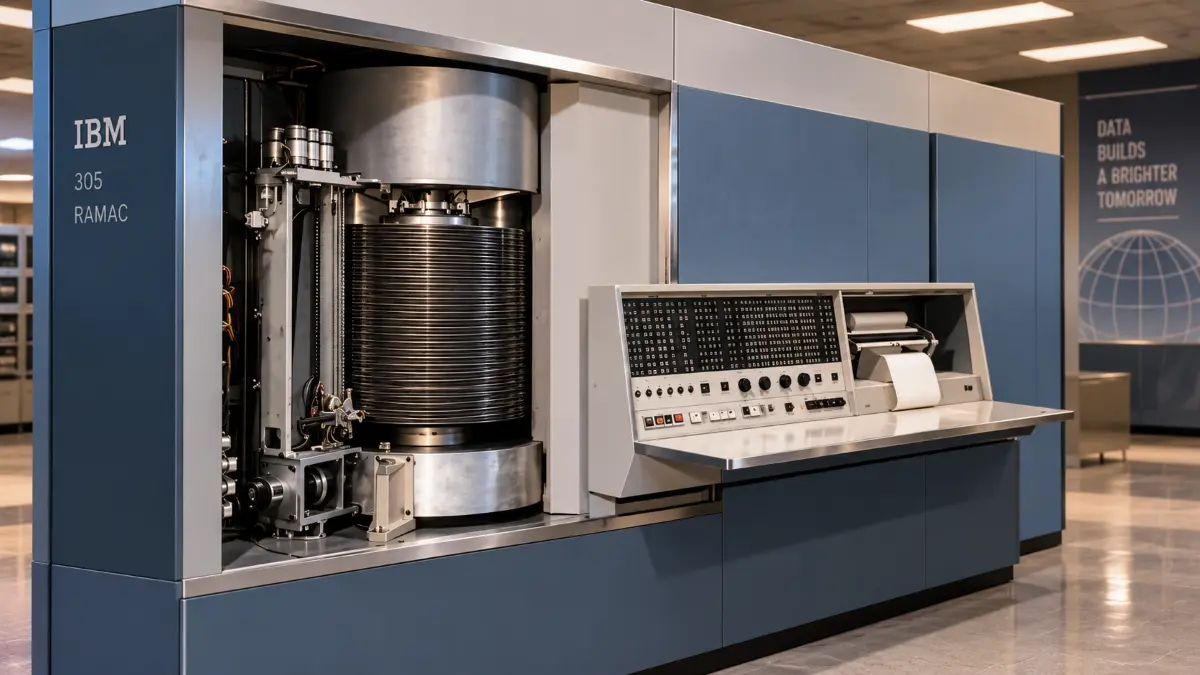

September 13, 1956, marked a quiet but profound shift in computing with the introduction of the IBM 305 RAMAC, the first commercial computer to use disk storage. This wasn’t just another machine release. It was the moment when data storage moved from bulky, slow magnetic tapes and punch cards to a more dynamic, random-access medium.
The IBM 305 RAMAC (Random Access Method of Accounting and Control) addressed a fundamental problem of early computing: how to quickly and efficiently access large volumes of data. Prior to disk storage, computers relied heavily on sequential access methods, meaning data retrieval was slow and cumbersome. The RAMAC’s 24-inch diameter disk platters spinning at 1,200 rpm allowed data to be read or written in any order, slashing wait times and boosting productivity.
At the time, the RAMAC’s disk storage capacity was a mere 5 megabytes, spread across 50 platters. While tiny by today’s standards, this was a breakthrough. It enabled businesses to handle complex accounting and inventory tasks with unprecedented speed and flexibility. The system’s ability to randomly access data meant it could serve multiple users and applications more effectively than any previous technology.
What changed because of the IBM 305 RAMAC was the very architecture of data management. Disk storage became the foundation for modern databases, enterprise computing, and ultimately the digital economy. It introduced the concept of direct access storage devices (DASD), which replaced slower, linear tape systems in nearly every industry. This shift allowed software developers to build more sophisticated applications that could interact with data in real time, laying groundwork for everything from transaction processing to multimedia storage.
Today, the legacy of the IBM 305 RAMAC is visible everywhere, from the solid-state drives in laptops to the massive data centers powering cloud computing. The principle of random access remains a cornerstone of data storage technology. While physical disks have evolved dramatically, the fundamental problem RAMAC solved, making data instantly accessible, continues to drive innovation.
Reflecting on the IBM 305 RAMAC reminds us that breakthroughs often come from rethinking old constraints. By challenging the limits of data access, IBM set a new standard that still shapes our digital lives. It’s a reminder that the technologies we take for granted have deep roots in solving very practical problems.