
The Large Hadron Collider (LHC) powered up at CERN, the European Organization for Nuclear Research, near Geneva, Switzerland, on September 10, 2008. This was no ordinary startup. It marked the beginning of operations for the most powerful particle accelerator ever built, an extraordinary international scientific project designed to push the boundaries of particle physics and probe the fundamental structure of matter.
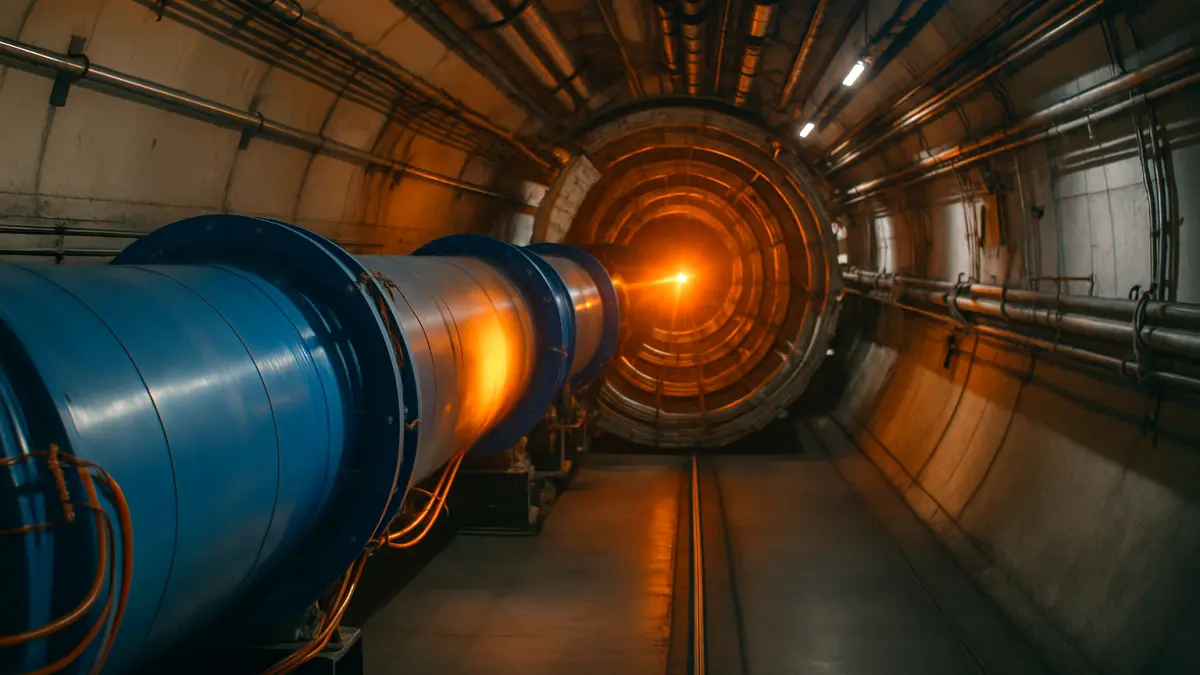
Built and operated by CERN, the LHC lies deep beneath the Franco-Swiss border in a 27-kilometer underground ring. Its enormous particle accelerator was designed to send beams of protons around the ring at nearly the speed of light before colliding them inside sophisticated detectors. The goal was ambitious: recreate conditions similar to those that existed shortly after the Big Bang and give scientists a new window into the universe’s earliest moments.
Why did this matter? Before the LHC, particle physics was constrained by the energy limits of existing accelerators and indirect observations. CERN’s new machine allowed researchers to reach unprecedented collision energies and test long-standing theories, including the existence of the Higgs boson, a particle central to explaining how other elementary particles acquire mass. It also created new opportunities to search for phenomena beyond the Standard Model, including possible clues about dark matter and extra dimensions.
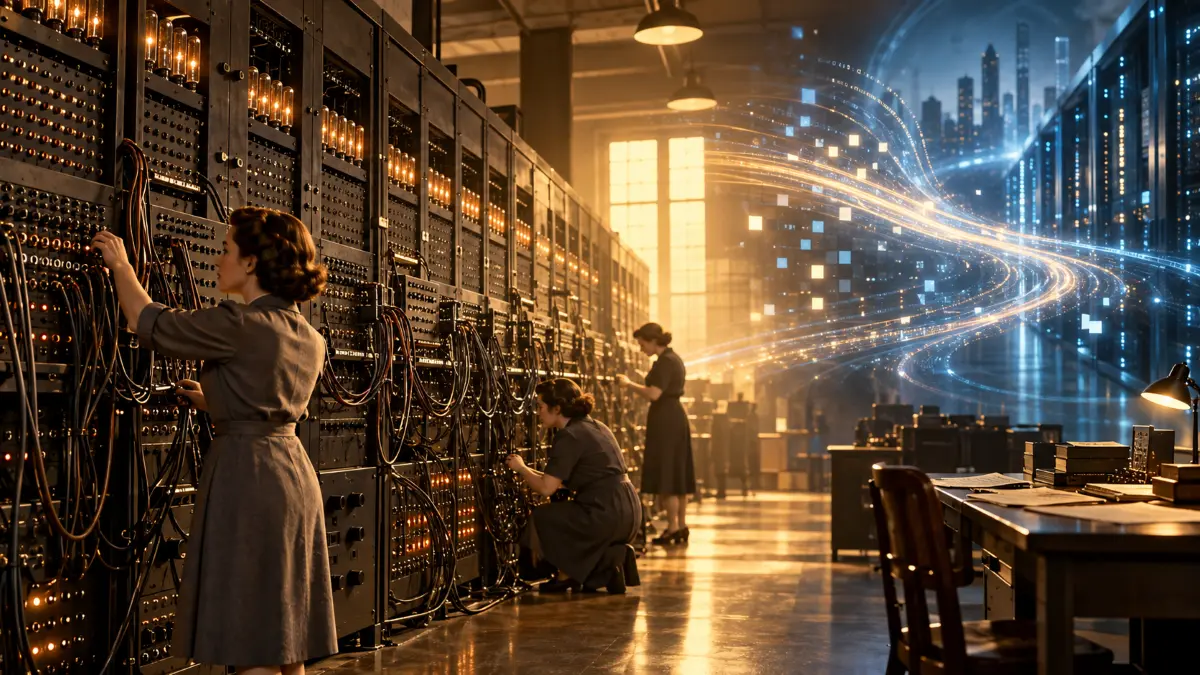
The LHC was more than a milestone in particle physics. It represented an extraordinary achievement in engineering and computing. CERN and its international partners had to advance technologies involving superconducting magnets, ultra-high vacuum systems, cryogenics, precision controls, and massive-scale data processing. The LHC’s experiments produce enormous amounts of data, requiring sophisticated algorithms and a worldwide computing infrastructure to process and analyze particle collisions.
One of CERN’s most important technological achievements surrounding the LHC was the Worldwide LHC Computing Grid, which connects computing resources across research institutions around the world. Instead of relying on a single supercomputer, CERN developed a distributed model that allows enormous datasets from LHC experiments to be processed and analyzed by researchers across multiple countries.
What changed because of the LHC? Most famously, experiments at CERN’s ATLAS and CMS detectors discovered a particle consistent with the long-predicted Higgs boson in 2012. The discovery provided crucial confirmation of the mechanism described by the Standard Model and contributed to François Englert and Peter Higgs receiving the 2013 Nobel Prize in Physics.
Beyond particle physics, CERN’s data-handling challenges helped demonstrate the potential of large-scale distributed computing and big-data analysis. The Worldwide LHC Computing Grid became an important example of how geographically dispersed computing resources could work together to process extraordinarily large scientific datasets.
Why does the LHC still matter today? CERN continues to operate and upgrade the collider, allowing researchers to perform increasingly precise measurements and search for physics that existing theories cannot fully explain. Questions involving dark matter, the imbalance between matter and antimatter, and the fundamental forces of nature remain central to its scientific mission.
The LHC also demonstrates the scale international scientific collaboration can reach. CERN brings together researchers, engineers, universities, laboratories, and computing centers from around the world, with thousands of scientists contributing to LHC experiments and sharing results across borders.
Reflecting on September 10, 2008, the LHC’s first circulating proton beam was more than the startup of an enormous machine. It represented decades of work by CERN and the international scientific community, combining physics, engineering, computing, and global collaboration on an unprecedented scale.
The LHC continues that mission today, pushing technology to its limits in pursuit of one of science’s oldest goals: understanding what the universe is made of and how it works.