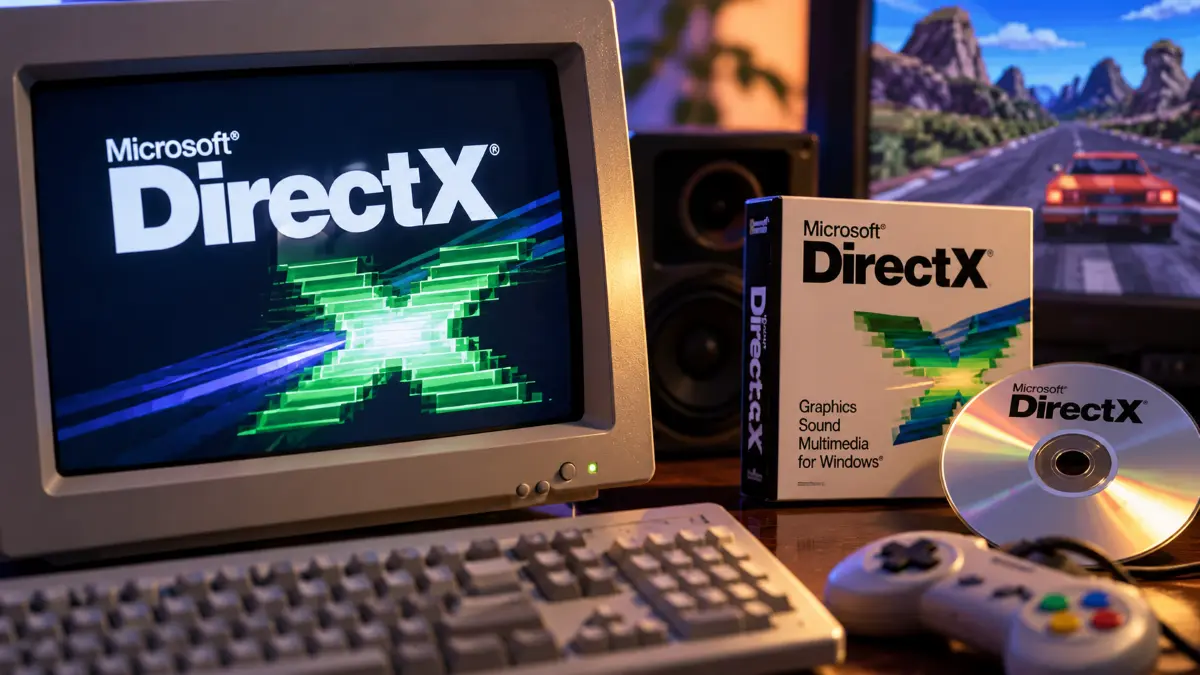

The way computers handle games and multimedia owes a lot to a quiet but powerful launch on September 30, 1995. Microsoft DirectX arrived as a suite of application programming interfaces (APIs) designed to tackle the complexities of multimedia tasks on Windows platforms. It wasn’t flashy at first glance, but it laid the groundwork for decades of digital interaction.
Microsoft DirectX is a collection of APIs that all begin with “Direct” – Direct3D, DirectDraw, DirectMusic, DirectPlay, DirectSound, and more. Each API targeted a specific multimedia function, from rendering 3D graphics to managing audio playback and networked gaming. Before DirectX, developers faced a fragmented landscape where hardware differences and inconsistent driver support made multimedia programming a headache. DirectX unified these tasks under a common framework, simplifying development and improving performance.
At the time, PC gaming and multimedia were growing fast, but the Windows platform was struggling to keep up with the demands of real-time graphics and sound. DirectX’s introduction was a technical response to this challenge. It provided a standardized way for software to communicate directly with hardware, bypassing layers that slowed down performance. This was crucial for games and applications that required fast, reliable access to graphics cards, sound devices, and input peripherals.
The release of DirectX changed the software development landscape on Windows. It enabled a surge in sophisticated multimedia applications and games by offering developers the tools to leverage hardware capabilities more efficiently. This meant smoother graphics, richer sound, and more immersive experiences. It also helped Windows compete against other platforms by making it a viable choice for gaming and multimedia production.
More than just a toolkit, DirectX became a foundation for innovation. It fostered an ecosystem where hardware manufacturers and software developers could collaborate more effectively. The APIs evolved over time, adapting to new hardware advances like GPUs and multi-core processors. Direct3D, in particular, became a cornerstone for 3D graphics rendering, influencing not just games but also professional visualization and simulation software.
Today, the legacy of Microsoft DirectX is clear. It remains a critical component of Windows, powering everything from blockbuster games to virtual reality applications. Its design principles, modularity, hardware abstraction, and performance optimization, are still relevant as multimedia demands grow more complex. The DirectX model also set a precedent for API design in other areas of computing, emphasizing the importance of bridging software and hardware efficiently.
Looking back, the launch of DirectX on September 30, 1995, was more than a software release. It was a strategic move that addressed a technical bottleneck in multimedia computing. By solving the problem of hardware fragmentation and providing a unified API suite, DirectX enabled a new era of digital experiences. Its influence continues to ripple through the tech world, reminding us how foundational tools shape the future of innovation.