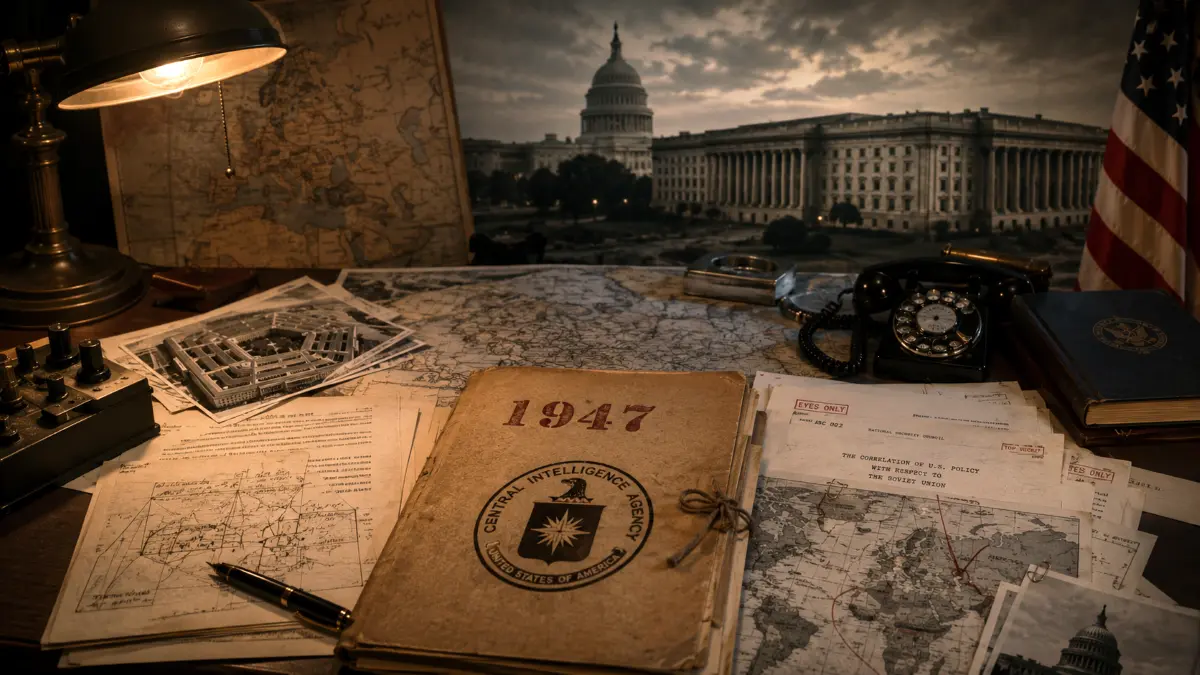

In the tense aftermath of World War II, the United States faced a new kind of challenge, one that demanded a radical rethink of how it managed defense and intelligence. On July 26, 1947, the National Security Act of 1947 was signed into law by President Harry S. Truman, setting the stage for a modern security apparatus that would influence global power dynamics for decades.
This legislation wasn’t just a bureaucratic shuffle; it created several key institutions that addressed critical gaps in U.S. national security. Among the most consequential was the establishment of the Central Intelligence Agency (CIA). Before the Act, intelligence gathering was fragmented and lacked centralized coordination. The CIA was designed to unify intelligence efforts, providing the government with a dedicated agency to collect, analyze, and act on global intelligence in a rapidly shifting geopolitical landscape.
The Act also led to the creation of the United States Air Force as a separate branch of the military. Previously part of the Army, the Air Force’s independence recognized the growing importance of air power in modern warfare and national defense strategy. This structural change allowed for specialized development in aviation technology, strategic bombing, and air defense systems, which became essential during the Cold War.
Another critical component was the establishment of the United States Department of Defense. This new department consolidated the War and Navy Departments, streamlining command and control over the military services. It was a response to the inefficiencies and inter-service rivalries that had hampered U.S. military effectiveness in previous conflicts. The Department of Defense provided a unified command structure, improving coordination and resource allocation.
The Act also formalized the Joint Chiefs of Staff, a body of senior military leaders who advise the President and Secretary of Defense. This group was crucial for integrating military strategy across different branches, ensuring that the U.S. could respond cohesively to threats.
Finally, the National Security Council (NSC) was created to serve as the President’s principal forum for considering national security and foreign policy matters. The NSC brought together top advisors from military, intelligence, and diplomatic backgrounds, enabling a more strategic and coordinated approach to national security decision-making.
At the time, these changes addressed the urgent need for a more agile and integrated defense and intelligence system. The Cold War was just heating up, and the U.S. faced an ideological and military rivalry with the Soviet Union that required constant vigilance and rapid response capabilities. The Act’s framework allowed the U.S. to better anticipate and counter threats, from espionage to military aggression.
The ripple effects of the National Security Act of 1947 are still evident today. The CIA remains central to American intelligence operations worldwide, evolving with new technologies and geopolitical challenges. The Air Force continues to push boundaries in aerospace and cyber warfare. The Department of Defense is a massive and complex organization, but its structure owes much to the clarity and unity the Act introduced. The NSC still plays a critical role in shaping U.S. foreign and defense policy.
Understanding this legislation is key to grasping how modern national security operates. It codified a system that balances military strength with intelligence gathering and strategic planning, elements that are inseparable in today’s global security environment.
Looking back, the National Security Act of 1947 was more than a post-war adjustment. It was a blueprint for a new era of defense and intelligence, one that recognized the interconnected nature of threats and the need for a coordinated response. Its legacy is a reminder that effective security depends on structure as much as technology or manpower.