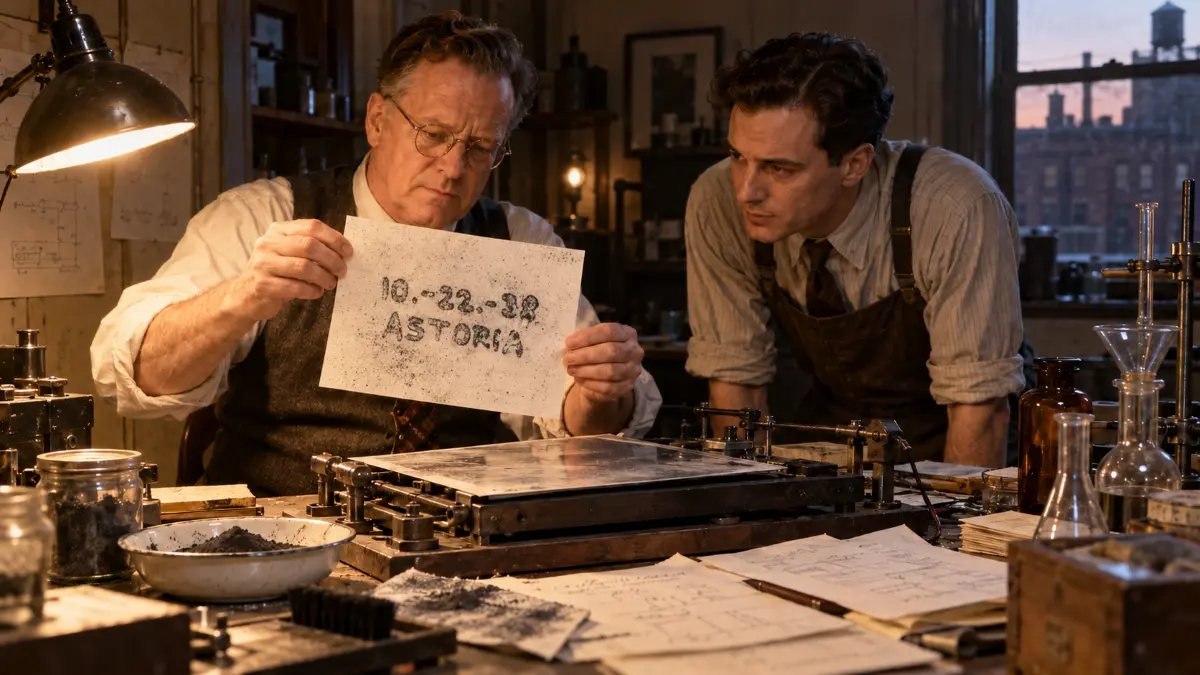

On October 22, 1938, in a small rented room in Astoria, Queens, New York, an experiment took place that would eventually transform how the world reproduced and shared information. American inventor Chester Carlson, working with physicist Otto Kornei, successfully demonstrated a new method of copying images using electricity and light. The result was a simple image bearing the inscription “10.-22.-38 ASTORIA,” recording both the date and the New York neighborhood where the experiment occurred. Although modest in appearance, that first successful electrophotographic copy marked the beginning of the technology that would later become known as xerography and form the foundation of modern photocopying.
The breakthrough did not immediately produce a commercial photocopier. Years of engineering, experimentation, and business development would be required before Carlson’s invention became practical for everyday use. Nevertheless, the 1938 demonstration established that documents could be reproduced through an electrostatic process without relying on conventional photographic chemistry, opening a new path for office technology.
A Small Laboratory and a Persistent Inventor
Chester Carlson’s interest in document reproduction grew from his professional experience working with patent applications and technical drawings. During the 1930s, producing additional copies of documents was often slow, expensive, and inconvenient. Carbon paper worked for some typed materials, while photographic and other copying methods required specialized equipment, chemicals, or additional processing. Carlson recognized that businesses needed a simpler way to reproduce existing documents, particularly those containing diagrams, handwriting, and illustrations that could not easily be duplicated with a typewriter.
Working outside his regular employment, Carlson developed the principles of electrophotography and enlisted Otto Kornei, a physicist, to help conduct experiments. They used a rented room in Astoria as a makeshift laboratory, far removed from the well-equipped research facilities typically associated with major technological breakthroughs. On October 22, 1938, they prepared a glass slide bearing the words “10.-22.-38 ASTORIA,” then used light, an electrically charged photoconductive surface, and fine powder to produce a copy. The word “ASTORIA” was simply a reference to the location of the experiment, while the numbers recorded its date. Together, the inscription became one of the most recognizable artifacts in the history of office technology.
How Electrophotography Made Copying Possible
Carlson’s invention relied on a principle fundamentally different from traditional photography. Instead of using light-sensitive film and chemical development, electrophotography employed a photoconductive material whose electrical properties changed when exposed to light. By applying an electrical charge to a surface and selectively exposing it to an image, the process could create an invisible pattern of electrical charges corresponding to the original document. Fine powder would then adhere to the charged regions, making the image visible and allowing it to be transferred onto another surface.
The original 1938 experiment was a rudimentary demonstration rather than the automated process found in modern photocopiers. Nevertheless, it established the essential scientific foundation for what later became known as xerography, a term derived from Greek words meaning dry writing. Subsequent engineering improvements introduced more practical photoconductive materials, reliable toner development, paper transfer mechanisms, and methods for permanently fixing images. These advances eventually made it possible to reproduce documents quickly without the wet chemical processing required by many earlier photographic techniques.
From Rejection to Commercial Success
Despite the successful experiment, Carlson initially struggled to attract commercial interest. His invention required substantial development before it could become a reliable office product, and many established companies were reluctant to invest in a technology whose commercial potential was uncertain. Carlson approached numerous organizations during the following years, encountering repeated rejection while continuing to refine and promote his process. Otto Kornei did not remain involved in its long-term development, leaving Carlson to pursue the invention’s future through other collaborators and commercial partners.
A major turning point came in 1944, when the Battelle Memorial Institute agreed to support further research and development. In 1947, the Haloid Company, a photographic paper manufacturer based in Rochester, New York, obtained commercial rights to develop and market the technology. Haloid would eventually adopt the Xerox name, becoming the company most closely associated with Carlson’s invention. The first commercial xerographic copier, the Xerox Model A, appeared in 1949, although it still required considerable manual intervention. The decisive breakthrough for ordinary office use came in 1959 with the introduction of the Xerox 914, an automatic plain-paper copier that made document duplication dramatically more convenient and helped establish photocopying as a standard business activity.
How Photocopying Transformed the Modern Office
The commercial success of xerography changed the economics and practicality of document reproduction. Before convenient photocopiers became widely available, offices often depended on carbon copies, typing pools, mimeograph machines, and specialized reproduction services to distribute paperwork. Producing multiple copies of an existing document could require additional preparation, equipment, or outside assistance. Automatic plain-paper copying allowed employees to duplicate contracts, correspondence, technical drawings, reports, and other materials directly from an original document, often within minutes.
This capability had consequences far beyond administrative convenience. Businesses could circulate information more efficiently, educational institutions could reproduce instructional materials, and government agencies could distribute records and forms with less effort. Photocopying also influenced publishing, legal work, research, and organizational communication by making existing information easier to preserve and share. At the same time, widespread copying introduced new questions about copyright, document security, and the control of information. The photocopier was therefore more than a productivity device. It became part of the infrastructure through which modern organizations created, distributed, and managed knowledge.
The Technology Behind Modern Printers
Although digital documents, cloud storage, and electronic communication have reduced the need for some traditional paper workflows, Carlson’s invention remains technologically relevant. Many laser printers and multifunction office devices still rely on electrophotographic principles, using electrically charged imaging surfaces, light-controlled exposure, toner, and heat or pressure to produce printed pages. Modern systems employ sophisticated electronics, precision optics, and automated paper handling, but the underlying concept remains closely related to the process demonstrated in Astoria in 1938.
The invention also illustrates how technological progress often depends on several distinct stages rather than a single moment of success. Carlson established the scientific concept, Kornei contributed to its first successful demonstration, research organizations helped develop the process, and Haloid transformed it into commercially viable equipment. The Xerox 914’s success more than two decades after the original experiment demonstrated the importance of turning a laboratory breakthrough into a product that ordinary people could operate reliably and economically.
A Small Experiment With a Lasting Legacy
Looking back at October 22, 1938, the significance of Carlson and Kornei’s experiment lies in the contrast between its humble setting and its eventual global influence. Working in a rented room in Astoria, they produced a small, imperfect image that proved an entirely new method of document reproduction was possible. The inscription “10.-22.-38 ASTORIA” was not a product name or a technical specification. It was simply a record of when and where the experiment succeeded, yet it became a lasting symbol of the origins of xerography.
The path from that first image to the modern photocopier was neither immediate nor straightforward. It required persistence, scientific refinement, commercial investment, and years of engineering before the technology became widely accessible. Once it did, xerography fundamentally changed how organizations handled information, helping establish the document-centered workflows that defined much of twentieth-century office life.
What began as an experiment in a small Queens laboratory ultimately became one of the most influential innovations in office technology, demonstrating how a practical problem, an unconventional scientific approach, and years of persistence can reshape the way information moves through society.